MCQ
A constant potential difference is applied to the ends of a graphite rod, whose resistance decreases with a rise of temperature. The rod can be $(1)$ covered with asbestos or $(2)$ left open to atmosphere. Answer for steady state.
  • A
    in both cases power lost is same but temperature of rod is more in case- $1$
  • in case- $1$ power lost as well as temperature of rod is more
  • C
    in case- $2$ power lost as well as temperature of rod is more
  • D
    in case- $1$ power lost is more but temperature of rod is less
Answer

Correct option: B.
in case- $1$ power lost as well as temperature of rod is more
b
In steady state, as asbestos is a poor conductor of heat than air, temperature of rod $( 1 )$ will be higher.

Also as temperature of rod $(1)$ is high

$\Rightarrow r \downarrow \Rightarrow \frac{v^{2}}{r} \uparrow$

Need a full question paper?

Generate a complete, print-ready paper with questions like this in minutes — across 16+ boards, with answer keys.

Start Generating Free

Similar questions

A particle of mass $m$ moving with velocity $v$ collides with a stationary particle of mass $2m$. After collision, they stick together and continue to move together with velocity ........
In a wave motion $y = a\sin (kx - \omega t)$, $y$ can represent
The r.m.s. speed of a group of $7$ gas molecules having speeds $(6, 4, 2, 0, -2, -4, -6)\, m/s$ is  ...... $m/s$
An aeroplane flying at a constant velocity releases a bomb.As the bomb drops down from the aeroplane,
Two balls at same temperature collide. What is conserved
An iron sphere of mass 10kg has the same diameter as an aluminium sphere of mass is $3.5\ kg.$ Both spheres are dropped simultaneously from a tower. When they are $10\ m$ above the ground, the have the same:
A plank with a small block on top of it is under going vertical $SHM.$ Its period is $2\, sec.$ The minimum amplitude at which the block will separate from plank is :
An angular impulse of $20 \,Nms$ is applied to a hollow cylinder of mass $2 \,kg$ and radius $20 \,cm$. The change in its angular speed is ............. $rad / s$
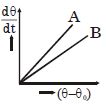
Two circular discs $A$ and $B$ with equal radii and equal mass are blackened. They are heated to same temperature and are cooled under identical conditions.What inference do you draw from their cooling curves ?
Two spherical planets $P$ and $Q$ have the same unfirom density $\rho$, masses $M_p$ and $M_Q$, an surface areas $A$ and $4 A$, respectively. A spherical planet $R$ also has unfirom density $\rho$ and its mass is $\left(M_p+M_Q\right)$. The escape velocities from the planets $P, Q$ and $R$, are $V_P, V_Q$ and $V$ respectivley. Then

$(A)$ $V_Q>V_R>V_P$

$(B)$ $V_R>V_Q>V_P$

$(C)$ $V _{ R } / V _{ P }=3$

$(D)$ $V_p / N_Q=\frac{1}{2}$