$A$ constant voltage is applied between the two ends of a uniform metallic wire. Some heat is developed in it. The heat developed is doubled if
Medium
Download our app for free and get started
Heat developed is
$H=\frac{V^{2}}{R} t$
Heat developed will be doubled when $R$ is halved. Further,
$R=\rho l /\left(\pi r^{2}\right)$ and $H=V^{2} \pi r^{2} t / \rho l .$ So heat produced when both the length and radius of the wire are doubled.

Download our appand get started for free
Experience the future of education. Simply download our apps or reach out to us for more information. Let's shape the future of learning together!No signup needed.*
Similar Questions
- 1Five identical cells each of internal resistance $1\, \Omega$ and $emf \;5\, {V}$ are connected in series and in parallel with an external resistance $'R'.$ For what value of $'R',$ current in series and parallel combination will remain the same ? (in $\Omega$)View Solution
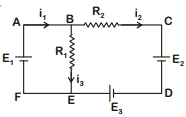
- 2For the circuit given below, the Kirchoff's loop rule for the loop $BCDEB$ is given by the equationView Solution
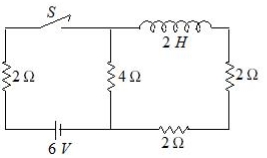
- 3For the given circuit the current through battery of $6\,V$ just after closing the switch ' $S$ ' will be$.......A$.View Solution
- 4View SolutionThe colour sequence in a carbon resistor is red, brown, orange and silver. The resistance of the resistor is
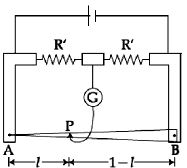
- 5In a meter bridge, the wire of length $1\, m$ has a nonuniform cross-section such that, the variation $\frac{{dR}}{{d\ell }}$ of its resistance $R$ with length $\ell $ is $\frac{{dR}}{{d\ell }} \propto \frac{1}{{\sqrt \ell }}$ Two equal resistances are connected as shown in the figure. The galvanometer has zero deflection when the jockey is at point $P$. What is the length $AP$ ? ................ $m$View Solution
- 6Two batteries with e.m.f $12\ V$ and $13\ V$ are connected in parallel across a load resistor of $10\,\Omega$ . The internal resistances of the two batteries are $1\,\Omega$ and $2\,\Omega$ respectively. The voltage across the load lies betweenView Solution
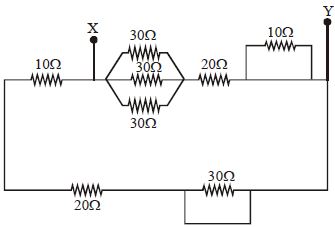
- 7Net resistance between $X$ and $Y$ is ............... $\Omega$View Solution
- 8$100$ cells each of $e.m.f.$ $5\, V$ and internal resistance $1\, ohm$ are to be arranged so as to produce maximum current in a $25\, ohms$ resistance. Each row is to contain equal number of cells. The number of rows should beView Solution
- 9View SolutionElectric power is transmitted over long distances through conducting wires at high voltage because
- 10View SolutionTwo wires of the same material are given. The first wire is twice as long as the second and has twice the diameter of the second. The resistance of the first will be