$A$ constant voltage is applied between the two ends of a uniform metallic wire. Some heat is developed in it. The heat developed is doubled if
Medium


Download our appand get started for free
Experience the future of education. Simply download our apps or reach out to us for more information. Let's shape the future of learning together!No signup needed.*
Similar Questions
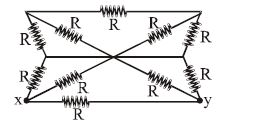
- 1What will be equivalent resistance of circuit between $x$ and $y$View Solution
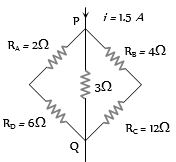
- 2Potential difference between the points $P$ and $Q$ in the electric circuit shown is ................. $V$View Solution
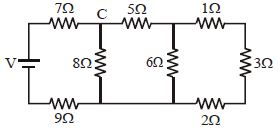
- 3In the ladder network shown, current through the resistor $3\, \Omega$ is $0.25\,A$. The input voltage $'V'$ is equal to:- ........... $V$View Solution
- 4View SolutionThe alloys constantan and manganin are used to make standard resistance due to they have
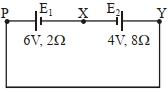
- 5A cell $E _{1}$ of $emf 6 V$ and internal resistance $2 \Omega$ is connected with another cell $E _{2}$ of $emf 4 V$ and internal resistance $8 \Omega$ (as shown in the figure). The potential difference across points $X$ and $Y$ is............ $V$View Solution
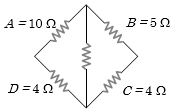
- 6In a typical Wheatstone network, the resistances in cyclic order are $A = 10 \,\Omega $, $B = 5 \,\Omega $, $C = 4 \,\Omega $ and $D = 4 \,\Omega $ for the bridge to be balancedView Solution
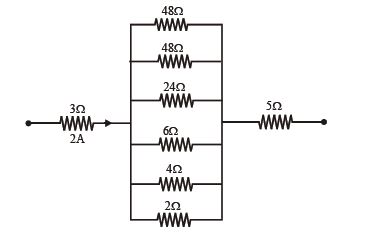
- 7Find potential difference across $24\,\Omega $ ............. $\mathrm{volt}$View Solution
- 8A piece of copper and another of germanium are cooled from room temperature to $80\, K$. The resistance of :-View Solution
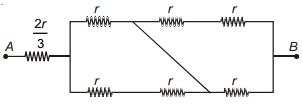
- 9The effective resistance of the network between points $A$ and $B$ isView Solution
- 10View SolutionIf a high power heater is connected to electric mains, then the bulbs in the house become dim, because there is a