Question
A converging mirror $M_1,$ a point source S and a diverging mirror $M_2$ are arranged as shown in figure. The source is placed at a distance of 30cm from $M_1$. The focal length of each of the mirrors is 20cm. Consider only the images formed by a maximum of two reflections. It is found that one image is formed on the source itself.
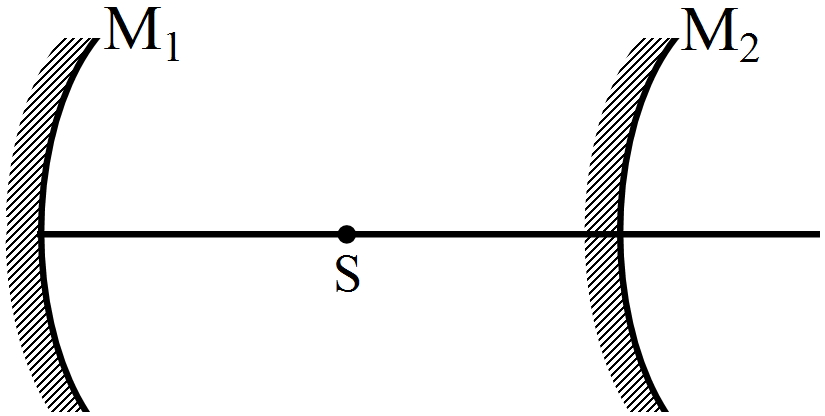
  1. Find the distance between the two mirrors.
  2. Find the location of the image formed by the single reflection from $M_2.$
Answer


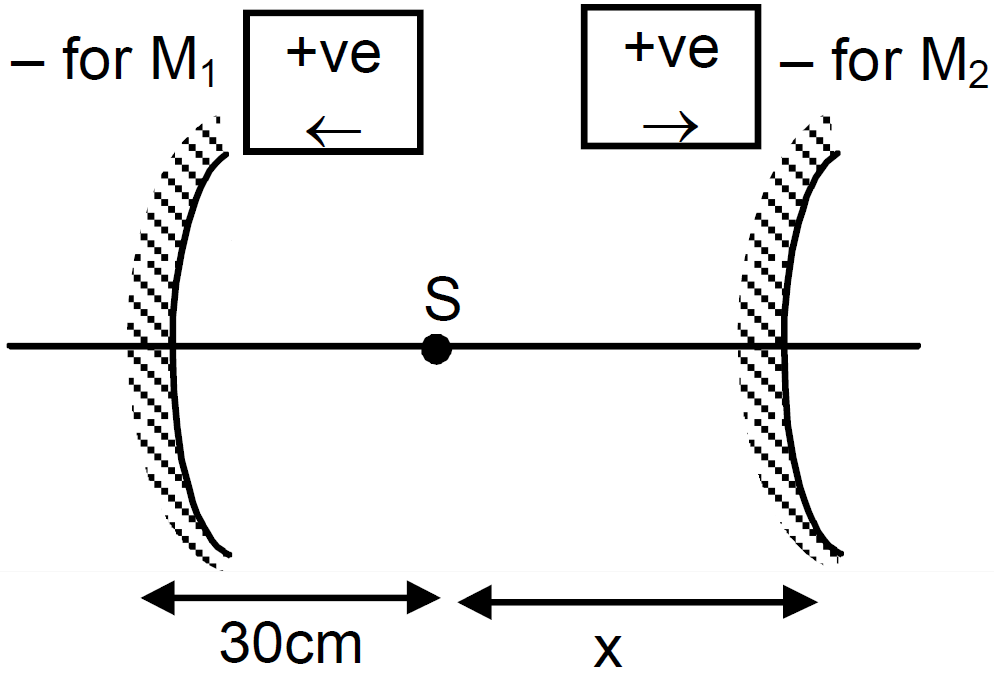
  1. As shown in figure, for $1^{st}$ reflection in $M_1, u = -30cm, f = -20cm$
$\Rightarrow\frac{1}{\text{v}}+\frac{1}{-30}=-\frac{1}{20}\Rightarrow\text{v}=-60\text{cm}.$
So, for $2^{nd}$ reflection in $M_2$
$u = 60 - (30 + x) = 30 - x$
$v = -x; f = 20cm$
$\Rightarrow\frac{1}{30-\text{x}}-\frac{1}{\text{x}}=\frac{1}{20}$
$\Rightarrow \frac{\text{x}-30+\text{x}}{\text{x}(30-\text{x})}=\frac{1}{20}$
$\Rightarrow40\text{x}-600=30\text{x}-\text{x}^2$
$\Rightarrow\text{x}^2+10\text{x}-600=0$
$\Rightarrow\text{x}=\frac{10\pm50}{2}=\frac{40}{2}=20\text{cm}$ or $-30\text{cm}$
$\therefore$ Total distance between the two lines is 20 + 30 = 50cm.

Need a full question paper?

Generate a complete, print-ready paper with questions like this in minutes — across 16+ boards, with answer keys.

Start Generating Free

Similar questions

What are coherent sources of light? Why are coherent sources required to produce interference of light? Give an example of interference in everyday life.
A particle is moving at a constant speed V from a large distance towards a concave mirror of radius R along its principal axis. Find the speed of the image formed by the mirror as a function of the distance x of the particle from the mirror.
Two parallel wires seprated by a distance of 10cm carry currents of 10A and 40A along-the same direction. Where should a third current be placed so that it experiences no magnetic force?
Figure shows a convex spherical surface with centre of curvature $C$ separating the two media of refractive indices $\mu_1$ and $\mu_2$. Draw a ray diagram showing the formation of the image of a point object $O$ lying on the principal axis. Derive the relationship between the object and image distance in terms of refractive indices of the media and the radius of curvature $R$ of the surface.
Image
A long solenoid with 15 turns per cm has a small loop of area $2.0 cm^2$ placed inside the solenoid normal to its axis. If the current carried by the solenoid changes steadily from 2.0A to 4.0A in 0.1s, what is the induced emf in the loop while the current is changing?
Calculate potential on the axis of a disc of radius R due to a charge Q uniformly distributed on its surface.
The door of an almirah is 6ft high, 1.5ft wide and weighs 8kg. The door is supported by two hinges situated at a distance of 1ft from the ends. If the magnitudes of the forces exerted by the hinges on the door are equal, find this magnitude.
The work function of a photoelectric material is 4.0eV.
  1. What is the threshold wavelength?
  2. Find the wavelength of light for which the stopping potential is 2.5V.
Figure shows a cylindrical tube with adiabatic walls and fitted with an adiabatic separator. The separator can be slid into the tube by an external mechanism. An ideal gas $(\gamma=1.5)$ is injected in the two sides at equal pressures and temperatures. The separator remains in equilibrium at the middle. It is now slid to a position where it divides the tube in the ratio 1 : 3. Find the ratio of the temperatures in the two parts of the vessel.
Figure. shows two vessels A and B with rigid walls containing ideal gases. The pressure, temperature and the volume are $p_A, T_A, V$ in the vessel A and $p_B, T_B, V$ in the vessel B. The vessels are now connected through a small tube. Show that the pressure p and the temperature T satisfy $\frac{\text{p}}{\text{T}}=\frac{1}{2}\Big(\frac{\text{P}_\text{A}}{\text{T}_\text{A}}+\frac{\text{p}_\text{B}}{\text{T}_\text{B}}\Big)$ when equilibrium is achieved.