MCQ
A convex lens
  • Converges light rays
  • B
    Diverges light rays
  • C
    Form real images always
  • D
    Always forms virtual images

Answer

Correct option: A.
Converges light rays

Need a full question paper?

Generate a complete, print-ready paper with questions like this in minutes — across 16+ boards, with answer keys.
Start Generating Free

Similar questions

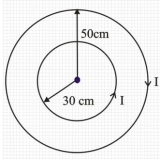
Two concentric circular loops of radii $r _{1}=30\,cm$ and $r_{2}=50\,cm$ are placed in $X - Y$ plane as shown in the figure. $A$ current $I=7\,A$ is flowing through them in the direction as shown in figure. The net magnetic moment of this system of two circular loops is approximately.
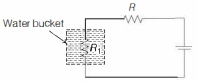
The circuit below is used to heat water kept in a bucket. Assuming heat loss only by Newton's law of cooling, the variation in the temperature of the water in the bucket as a function of time is depicted by
Energy of $H-$ atom in the ground state is $-13.6\;eV$, The energy needed to ionise a hydrogen atom which is in its second excited state is .......$eV$
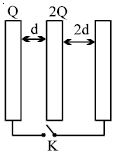
Three large plates are arranged as shown. How much charge will flow through the key $k $ if it is closed? 
Assertion : The earth’s magnetic field does not affect the working of a moving coil galvanometer.
Reason : Earth’s magnetic field is very weak.
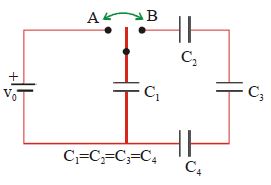
The four identical capacitors in the circuit shown below are initially uncharged. The switch is then thrown first to position $A$, and then to position $B$. After this is done: 

Note: $V_{1,2,3,4}$ are the potential differences across $C_{1,2,3,4}$ and $Q_{1,2,3,4}$ are the final charges stored in $C_{1,2,3,4}$ respectively.
A battery is connected between two points A and B on the circumference of a uniform conducting ring of radius r and resistance R. One of the arcs AB of the ring subtends an angle θ at the centre. The value of the magnetic induction at the centre due to the current in the ring is
To a germanium sample, traces of gallium are added as an impurity. The resultant sample would behave like
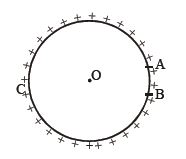
In the given figure electric field at center $O$ due to section $AB$ of uniformly charged ring is $\overrightarrow E$. What will be electric field at $O$ due to section $ACB$ ?
The work function of a metal is $1.6 \times {10^{ - 19}}J$. When the metal surface is illuminated by the light of wavelength $6400\, Å$, then the maximum kinetic energy of emitted photo-electrons will be

(Planck's constant $h = 6.4 \times {10^{ - 34}}Js$)