MCQ
A convex lens is dipped in a liquid whose refractive index is equal to the refractive index of the lens. Then its focal length will
  • Become infinite
  • B
     Become small, but non–zero
  • C
     Remain unchanged
  • D
     Become zero

Answer

Correct option: A.
Become infinite
 Become infinite

Need a full question paper?

Generate a complete, print-ready paper with questions like this in minutes — across 16+ boards, with answer keys.
Start Generating Free

Similar questions

In vacuum an electron of energy 10 keV hits tungsten target, then emitted radiation will be
Two identical light sources $S_1$ and $S_2$ emit light of same wavelength $\lambda$. These light rays will exhibit interference if
When a compact disc is illuminated by a source of white light. Coloured 'lanes' are observed. This is due to
In a double slit experiment the angular width of a fringe is found to be $0.2^o $on a screen placed $1\, m$ away. The wavelength of light used is $600\, nm$. What will be the angular width of the fringe if the entire experiment apparatus is immersed in water? Take refractive index of water to be $4/3$.......$^o$
Banding of a stick when placed in water is because:
An alternating $e.m.f$. of angular frequency $\omega $ is applied across an inductance. The instantaneous power developed in the circuit has an angular frequency
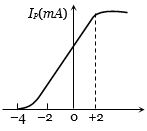
The mutual characteristic curves of a triode are as shown in figure. The cut off voltage for the triode is.....$V$
$A$ microscope is focused on a point object and then its objective is raised through a height of $2cm$. If a glass slab of refractive index $1.5$ is placed over this point object such that it is focused again, the thickness of the glass slab is......$cm$
A metallic loop is placed in a magnetic field. If a current is passed through it, then
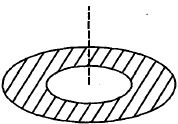
A thin disc of radius $b = 2a$  has a concentric hole of radius $'a'$ in it (see figure). It carries uniform surface charge $'\sigma '$ on it. If the electric field on its axis at height $'h'$ $(h << a)$ from its centre is given as $'Ch'$ then value of $'C'$ is