MCQ
A convex lens
  • Converges light rays
  • B
    Diverges light rays
  • C
    Form real images always
  • D
    Always forms virtual images

Answer

Correct option: A.
Converges light rays

Need a full question paper?

Generate a complete, print-ready paper with questions like this in minutes — across 16+ boards, with answer keys.

Start Generating Free

Similar questions

The focal length of objective and eye lens of a microscope are $4 \mathrm{~cm}$ and $8 \mathrm{~cm}$ respectively. If the least distance of distinct vision is $24 \mathrm{~cm}$ and object distance is $4.5 \mathrm{~cm}$ from the objective lens, then the magnifying power of the microscope will be
The volume of a gas is reduced adiabatically to $\frac{1}{4}$ of its volume at $27^{\circ} \mathrm{C}$, if the value of $\gamma=1.4$, then the new temperature will be
Choke coil works on the principle of
A heater coil connected to a supply of a $220 \quad V$ is dissipating some power $P_1$. The coil is cut into half and the two halves are connected in parallel. The heater now dissipates a power $P_2$. The ratio of power $P_1: P_2$ is
An inductor of inductance $L$ and resistor of resistance $R$ are joined in series and connected by a source of frequency $\omega$. Power dissipated in the circuit is
A galvanometer of $100 \Omega$ resistance gives full scale deflection when $10 \mathrm{~mA}$ of current is passed. To convert it into $10 \mathrm{~A}$ range ammeter, the resistance of the shunt required will be
A ray of light incidents on a plane mirror at an angle of $30^{\circ}$. The deviation produced in the ray is
A ball is thrown vertically upwards. Which of the following plots represents the speed-time graph of the ball during its height if the air resistance is not ignored
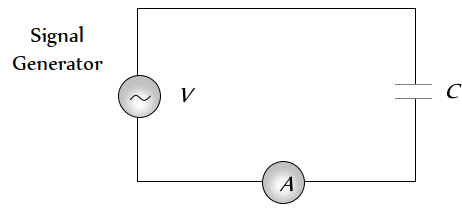
A constant voltage at different frequencies is applied across a capacitance $C$ as shown in the figure. Which of the following graphs
Correctly depicts the variation of current with frequency?
Image
The velocity of a freely falling body changes as $g^p h^q$ where $g$ is acceleration due to gravity and $h$ is the height. The values of $p$ and $q$ are