A conveyor belt is moving at a constant speed of $2\, ms^{-1}$. A box is gently dropped on it. The coefficient of friction between them is $\mu = 0.5$. The distance that the box will move relative to belt before coming to rest on it, (taking $g = 10\, ms^{-2}$) is ........ $m$.
Medium
Download our app for free and get started
Force of friction, $f=\mu m g$
$\therefore a=\frac{\mathrm{f}}{\mathrm{m}}=\frac{\mu \mathrm{mg}}{\mathrm{m}}=\mu \mathrm{g}=0.5 \times 10=5 \mathrm{ms}^{-2}$
Using, $\mathrm{v}^{2}-\mathrm{u}^{2}=2 \mathrm{aS}$
${0^{2}-2^{2}=2(-5) \times 5} $
${\mathrm{S}=0.4 \mathrm{m}}$

Download our appand get started for free
Experience the future of education. Simply download our apps or reach out to us for more information. Let's shape the future of learning together!No signup needed.*
Similar Questions
- 1A body takes just twice the time as long to slide down a plane inclined at $30^o$ to the horizontal as if the plane were frictionless. The coefficient of friction between the body and the plane isView Solution
- 2The force required just to move a body up an inclined plane is double the force required just to prevent the body from sliding down. If $\mu $ is the coefficient of friction, the inclination of plane to the horizontal isView Solution
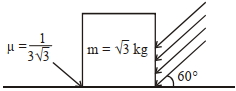
- 3As shown in the figure, a block of mass $\sqrt{3}\, kg$ is kept on a horizontal rough surface of coefficient of friction $\frac{1}{3 \sqrt{3}}$. The critical force to be applied on the vertical surface as shown at an angle $60^{\circ}$ with horizontal such that it does not move, will be $3 x$. The value of $3x$ will beView Solution
$\left[ g =10 m / s ^{2} ; \sin 60^{\circ}=\frac{\sqrt{3}}{2} ; \cos 60^{\circ}=\frac{1}{2}\right]$
- 4Statement $I :$ A cyclist is moving on an unbanked road with a speed of $7\, kmh ^{-1}$ and takes a sharp circular turn along a path of radius of $2 \,m$ without reducing the speed. The static friction coefficient is $0.2$ . The cyclist will not slip and pass the curve $\left( g =9.8\, m / s ^{2}\right)$View Solution
Statement $II :$ If the road is banked at an angle of $45^{\circ}$, cyclist can cross the curve of $2\, m$ radius with the speed of $18.5\, kmh ^{-1}$ without slipping.
In the light of the above statements, choose the correct answer from the options given below.
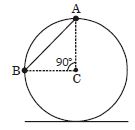
- 5Two beads connected by massless inextensible string are placed over the fixed ring as shown in figure. Mass of each bead is $m$ , and there is no friction between $B$ and ring. Find minimum value of coefficient of friction between $A$ and ring so that system remains in equilibrium. ( $C \to $center of ring, $AC$ line is vertical)View Solution
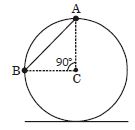
- 6Two beads connected by massless inextensible string are placed over the fixed ring as shown in figure. Mass of each bead is $m$ , and there is no friction between $B$ and ring. Find minimum value of coefficient of friction between $A$ and ring so that system remains in equilibrium. ( $C \to $center of ring, $AC$ line is vertical)View Solution
- 7A $500 \,kg$ car takes a round turn of radius $50 \,m$ with a velocity of $36 \,km/hr$. The centripetal force is .......... $N$View Solution
- 8A cyclist riding the bicycle at a speed of $14\sqrt 3 ms^{-1}$takes a turn around a circular road of radius $20\sqrt 3 $ m without skidding. Given $g = 9.8 ms^{-2},$ what is his inclination to the vertical ....... $^o$View Solution
- 9View SolutionWhich one of the following statements is incorrect?
- 10View SolutionWhen a bicycle is in motion, the force of friction exerted by the ground on the two wheels is such that it acts