A copper wire of length $1\, m$ and radius $1\, mm$ is joined in series with an iron wire of length $2\, m$ and radius $3\, mm$ and a current is passed through the wires. The ratio of the current density in the copper and iron wires is
Easy


Download our appand get started for free
Experience the future of education. Simply download our apps or reach out to us for more information. Let's shape the future of learning together!No signup needed.*
Similar Questions
- 1An electric bulb is rated $60\,W$, $220\,V$. The resistance of its filament is ............. $\Omega$View Solution
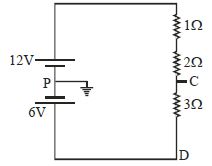
- 2Find potential at point $C$ and $D$View Solution
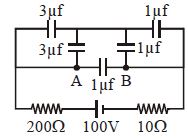
- 3Find potential difference between $A$ and $B$ in given circuit in steady state ............... $\mathrm{V}$View Solution
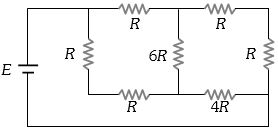
- 4A battery of internal resistance $4$ $\Omega$ is connected to the network of resistances as shown. In order to give the maximum power to the network, the value of $R$ (in $\Omega $) should beView Solution
- 5Heat produced in a wire of resistance $R$ due to current flowing at constant potential difference is proportional toView Solution
- 6Two indentical electric lamps marked $500\, W, \,\,220\, V$ are connected in series and then joined to a $110\, V$ line. The power consumed by each lamp isView Solution
- 7The resistance of a rectangular block of copper of dimensions $2 \,mm \times 2 \,mm \times 5 \,m$ between two square faces is $0.02 \,\Omega$. What is the resistivity of copper?View Solution
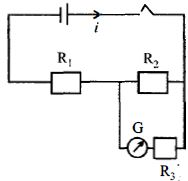
- 8To find the resistance of a galvanometer by the half deflection method the following circuit is used with resistances $R_1 = 9970\,\Omega,$ $R_2 = 30\,\Omega$ and $R_3 = 0\,\Omega.$ The deflection in the galvanometer is $d$. With $R_3 = 107\,\Omega$ the deflection changed to $\frac {d}{2}$The galvanometer resistance is approximately ............... $\Omega$View Solution
- 9A certain wire has a resistance $R$. The resistance of another wire identical with the first except having twice its diameter isView Solution
- 10An electric bulb is rated $220\, volt$ and $100\, watt$. Power consumed by it when operated on $110\, volt$ is ............. $watt$View Solution