Question
A copper wire of radius 0.1mm and resistance $1\text{k}\Omega$ is connected across a power supply of 20V.
(a) How many electrons are transferred per second between the supply and the wire at one end? (b) Write down the current density in the wire.
Answer

$\text{r}=0.1\text{mm}=10^{-4}\text{m}$$\text{R}=1\text{K}\Omega=10^3\Omega,\text{V}=20\text{V}$
  1. No.of electrons transferred
$\text{i}=\frac{\text{V}}{\text{R}}=\frac{20}{10^3}=20\times10^{-3}=2\times10^{-2}\text{A}$
$\text{q}=\text{it}=2\times10^{-2}\times1=2\times10^{-2}\text{C}$
No. of electrons transferred $=\frac{2\times10^{-2}}{1.6\times10^{-19}}=\frac{2\times10^{-17}}{1.6}=1.25\times10^{17}.$
  1. Current density of wire
​​​​​​​​​​​​​​​​​​​​​$=\frac{\text{i}}{\text{A}}=\frac{2\times10^{-2}}{\pi\times10^{-8}}=\frac{2}{3.14}\times10^6$
$=0.6369\times10^6=6.37\times10^5\text{A}/\text{m}^2.$

Need a full question paper?

Generate a complete, print-ready paper with questions like this in minutes — across 16+ boards, with answer keys.

Start Generating Free

Similar questions

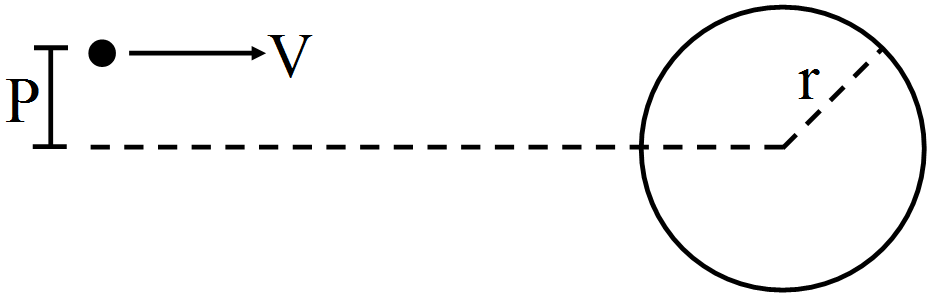
A small particle travelling with a velocity u collides elastically with a spherical body of equal mass and of radius r initially kept at rest. The centre of this spherical body is located a distance (p < r) away from the direction of motion of the particle. Find the final velocities of the two particles. [Hint: The force acts along the normal to the sphere through the contact. Treat the collision as onedimensional for this direction. In the tangential direction no force acts and the velocities do not change].
On an open ground, a motorist follows a track that turns to his left by an angle of 600 after every 500m. Starting from a given turn, specify the displacement of the motorist at the third, sixth and eighth turn. Compare the magnitude of the displacement with the total path length covered by the motorist in each case.
Though the law gives women equal status in India, many people hold unscientific views on a woman’s innate nature, capacity and intelligence, and in practice give them a secondary status and role. Demolish this view using scientific arguments, and by quoting examples of great women in science and other spheres; and persuade yourself and others that, given equal opportunity, women are on par with men.
Steam at $120^{\circ} \mathrm{C}$ is continuously passed through a 50 cm long rubber tube of inner and outer radii 1.0 cm and 1.2 cm . The room temperature is $30^{\circ} \mathrm{C}$. Calculate the rate of heat flow through the walls of the tube. Thermal conductivity of rubber $=0.15 \mathrm{Js}^{-1} \mathrm{~m}^{-1^\circ} \mathrm{C}^{-1}$.
A girl riding a bicycle with a speed of $5m/ s$ towards north direction, observes rain falling vertically down. If she increases her speed to $10m/ s$, rain appears to meet her at $45°$ to the vertical. What is the speed of the rain? In what direction does rain fall as observed by a ground based observer?
(Hint: Assume north to be $\hat{\text{i}}$ direction and vertically downward to be $-\hat{\text{j}}$. Let the rain velocity $\text{v}_\text{r}$ be $\text{a}\hat{\text{i}}+\text{b}\hat{\text{j}}.$ The velocity of rain as observed by the girl is always $V_r-V_{girl}$. Draw the vector diagram/s for the information given and find a and b. You may draw all vectors in the reference frame of ground based observer)
A lead bullet penetrates into a solid object and melts. Assuming that $50\%$ of the K.E. was used to heat it, calculate the initial speed of the bullet. The initial temperature of bullet is $27°C$ and its melting point is $327°C$. Latent heat of fusion of lead = $2.5 \times 10^4J kg^{-1}$ and specific heat capacity of lead = $125J kg^{-1}K^{-1}​​​​​​​$.
A cylindrical piece of cork of density of base area $A$ and height $h$ floats in a liquid of density $\rho_l$. The cork is depressed slightly and then released. Show that the cork oscillates up and down simple harmonically with a period $T=2 \pi \sqrt{\frac{h \rho}{\rho, g}}$ Where $\rho$ is the density of cork. (Ignore damping due to viscosity of the liquid).
A bulb with rating 250V, 100W is connected to a power supply of 220V situated 10m away using a copper wire of area of cross-section $5mm^2$. How much power will be consumed by the connecting wires? Resistivity of copper $1.7\times10^{-8}\Omega-\text{m}$.
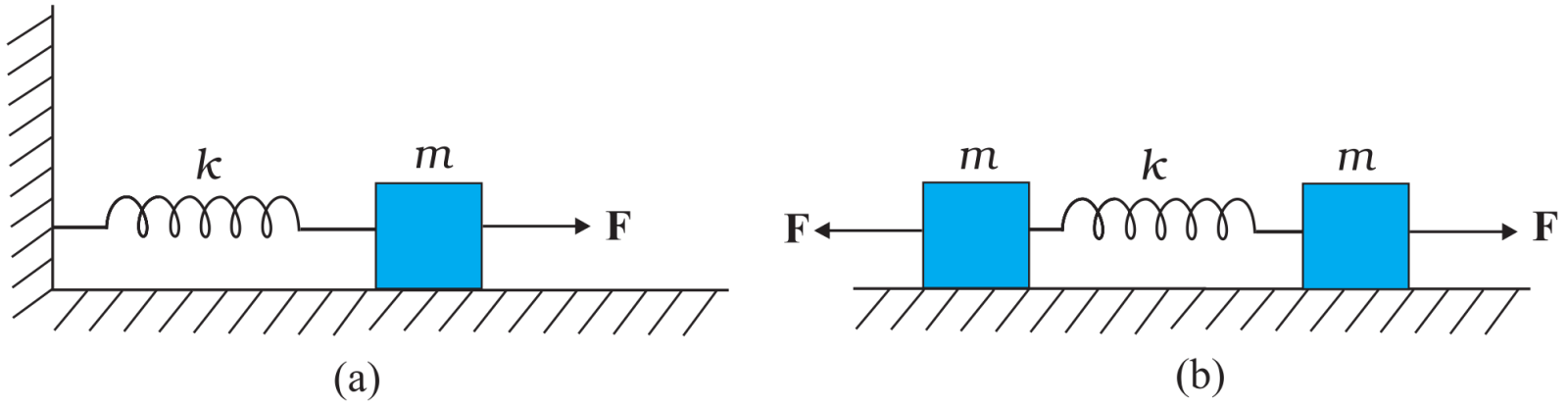
Figure (a) shows a spring of force constant k clamped rigidly at one end and a mass m attached to its free end. A force F applied at the free end stretches the spring. Figure (b) shows the same spring with both ends free and attached to a mass m at either end. Each end of the spring in Fig. (b) is stretched by the same force F.
If the mass in Fig. (a) and the two masses in Fig. (b) are released, what is the period of oscillation in each case?
The electric field associated with a light wave is given by $\text{E}=\text{E}_0\sin[(1.57\times10^7\text{m}^{-1})(\text{x}-{\text{ct}})].$ Find the stopping potential when this light is used in an experiment on photoelectric effect with the emitter having work function 1.9eV.