Question
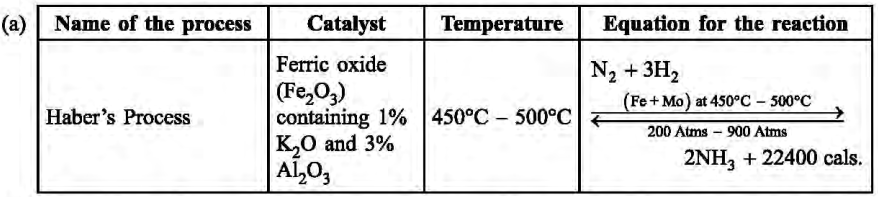
(a) Copy and complete the following table:
Name of the processCatalystTemperatureEquation for the reaction
Haber's Process
(b) How is ammonia separated from unreacted nitrogen and hydrogen?

Answer


Image
(b) The mixture of gases is suddenly allowed to expand by passing it through a nozzle with a very small orfice. The ammonia gas on sudden expansion liquefies, but not hydrogen and nitrogen (Boiling point of NH3 is -33°C, whereas that of N2 is -196°C and H2 is -253°C).
The recovery of ammonia is achieved either by liquefaction (discussed above) or by absorption of water.

Need a full question paper?

Generate a complete, print-ready paper with questions like this in minutes — across 16+ boards, with answer keys.

Start Generating Free

Similar questions

(a) Fill in the blanks using the most appropriate words :
(i) The ore from which aluminium is extracted must first be treated with ________ so that pure aluminium oxide can be obtained.
(ii) Pure aluminium oxide is dissolved in ________ to make it a conducting solution.
(b) Write the formula of Cryolite.
(a) Distinguish between Qualitative and Quantitative analysis.
(b) Define Reagent
(c) Define Precipitate
Write the observation, and balanced equation for the following reaction:
Excess of ammonium hydroxide is added to a substance, obtained by adding hydrochloric acid to silver nitrate solution.
A compound gave a following data:
C = 57.82%, O = 38.58% and the rest hydrogen. Its relative molecular mass is 166.
Find its empirical formula and molecular formula.
[C = I2, O = 16, H = 1]
Convert:
Methane into chloroform
How dose Avogadro's Law explain Gay-Lussac's Law of combining volumes?
Complete the following table which relates to the homologous series of hydrocarbons.
General formulaIUPAC name of the homologous seriesCharacteristic bond typeIUPAC name of the first member of the series
CnH2n-2(A) ________(B) ________(C) ________
CnH2n+2(D) ________(E) ________(F) ________
(a) Calculate the mass of ammonia that can be obtained from $21.4 g$ of $NH _4 Cl$ by the reaction:
$2 NH _4 Cl + Ca ( OH )_2 \rightarrow CaCl _2+2 H _2 O +2 NH _3$
(b) What will be the volume of ammonia when measured at S.T.P?
The molar volume of a gas $=22.4$ litres at STP.
The equation given below relates the manufacture of sodium carbonate (molecular weight of $\left. Na _2 CO _3=106\right)$
  1. $\ce{NaCl + NH3 + CO2 + H2O-> NaHCO3 + NH4Cl}$
  2. $\ce{2NaHCO3-> Na2CO3 + H2O + CO2}$
Equations (1) and (2) are based on the production of 21.2 g of sodium carbonate.
(a) What mass of sodium hydrogen carbonate must be heated to give 21.2 g of sodium carbonate?
(b) To produce the mass of sodium hydrogen carbonate calculate in (a), what volume of carbon dioxide, measured at S.T.P. would be required?
24 cc Marsh gas $\left( CH _4\right)$ was mixed with $106 cc$ oxygen and then exploded. On cooling the volume of the mixture became $82 cc$ , of which, $58 cc$ was unchanged oxygen. Which law does this experiment support? Explain with calculations.