MCQ
A couple produces
  • A
    Purely linear motion                 
  • Purely rotational motion
  • C
    Linear and rotational motion
  • D
    No motion

Answer

Correct option: B.
Purely rotational motion
b
Couple (formed by two equal and opposite forces) produces purely rotational motion.

Need a full question paper?

Generate a complete, print-ready paper with questions like this in minutes — across 16+ boards, with answer keys.

Start Generating Free

Similar questions

For a projectile the ratio of maximum height reached to the square of flight time is
$A$ uniform rod $AB$ of mass $m$ and length $l$ is at rest on a smooth horizontal surface.An impulse $J$ is applied $l$ to the end $B$, perpendicular to the rod in the horizontal direction. Speed of particle $P$ at a distance $\frac{{l}}{6}$ from the centre towards $A$ of the rod after time $t = \frac{{\pi m{l}}}{{12J}}$
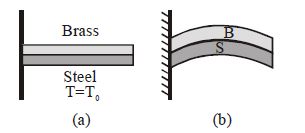
In figure which strip brass or steel have higher coefficient of linear expansion
Two metallic spheres ${S_1}$ and ${S_2}$are made of the same material and have identical surface finish. The mass of ${S_1}$ is three times that of ${S_2}$. Both the spheres are heated to the same high temperature and placed in the same room having lower temperature but are thermally insulated from each other. The ratio of the initial rate of cooling of ${S_1}$ to that of ${S_2}$ is
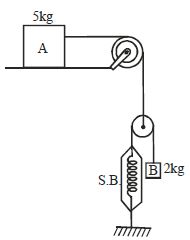
If all the pulleys are massless and string is ideal, find the reading of spring balance
Two drops of the same radius are falling through air with a steady velocity of $5 cm per sec.$  If the two drops coalesce, the terminal velocity would be
A string is stretched so that its length is increased by $\frac{1}{\eta }$ of its original length. The ratio of fundamental frequency of transverse vibration to that of fundamental frequency of longitudinal vibration will be
A body, which emits radiations of all possible wavelengths, is known as ...........
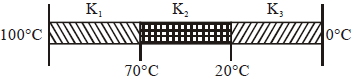
Three rods of identical cross-section and lengths are made of three different materials of thermal conductivity $K _{1}, K _{2},$ and $K _{3}$, respectively. They are joined together at their ends to make a long rod (see figure). One end of the long rod is maintained at $100^{\circ} C$ and the ther at $0^{\circ} C$ (see figure). If the joints of the rod are at  $70^{\circ} C$ and $20^{\circ} C$ in steady state and there is no loss of energy from the surface of the rod, the correct relationship between $K _{1}, K _{2}$ and $K _{3}$ is 
If the radius of the earth be increased by a factor of $5,$ by what factor its density be changed to keep the value of $g$ the same ?