MCQ
A couple produces
  • A
    Purely linear motion                 
  • Purely rotational motion
  • C
    Linear and rotational motion
  • D
    No motion

Answer

Correct option: B.
Purely rotational motion
b
Couple (formed by two equal and opposite forces) produces purely rotational motion.

Need a full question paper?

Generate a complete, print-ready paper with questions like this in minutes — across 16+ boards, with answer keys.
Start Generating Free

Similar questions

Vibration magnetometer works on the principle of
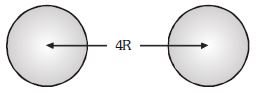
Two identical spheres each of radius $R$ are kept at center-to-center spacing $4R$ as shown in the figure. They are charged and the electrostatic force of interaction between them is first calculated assuming them point like charges at their centers and the force is also measured experimentally. The calculated and measured forces are denoted by $F_c$ and $F_m$ respectively.
($F_c$ and $F_m$ denote magnitude of force)
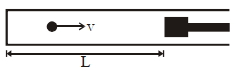
A small particle of mass $m$ moving inside a heavy, hollow and straight tube along the tube axis undergoes elastic collision at two ends. The tube has no friction and it is closed at one end by a flat surface while the other end is fitted with a heavy movable flat piston as shown in figure. When the distance of the piston from closed end is $L = L _0$ the particle speed is $v = v _0$. The piston is moved inward at a very low speed $V$ such that $V \ll \frac{ dL }{ L } v _0$, where $dL$ is the infinitly small displacement of the piston. Which of the following statement($s$) is/are correct?

$(1)$ The rate at which the particle strikes the piston is $v / L$

$(2)$ After each collision with the piston, the particle speed increases by $2 V$

$(3)$ The particle's kinetic energy increases by a factor of $4$ when the piston is moved inward from $L _0$ to $\frac{1}{2} L _0$

$(4)$ If the piston moves inward by $d L$, the particle speed increases by $2 v \frac{d L}{L}$
$100$  coplanner forces each equal to  $10\,\,N$  act on a body. Each force makes angle $\pi /50$ with the preceding force. What is the resultant of the forces.......... $N$
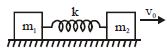
Two block of masses $m_1$ and $m_2$ connected with the help of a spring of spring constant $k$ initially to natural length as shown. A sharp impulse is given to mass $m_2$ so that it acquires a velocity $v_0$ towards right. If the system is kept an smooth floor then find the maximum elongation that the spring will suffer
If the breaking force for a given wire is $F$, then the breaking force of two wires of same magnitude will be
A metal wire of resistance $3\,\Omega $ is elongated to make a uniform wire of double its previous length. The new wire is now bent and the ends joined to make a circle. If two points on this circle make an angle $60^o$ at the centre, the equivalent resistance between these two points will be
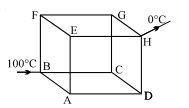
Twelve conducting rods form the riders of a uniform cube of side $'l'.$ If in steady state, $B$ and $H$ ends of the rod are at $100^o C$ and $0^o C$. Find the temperature of the junction $'A'$  ....... $^oC$ 
Five identical cells each of internal resistance $1\, \Omega$ and $emf \;5\, {V}$ are connected in series and in parallel with an external resistance $'R'.$ For what value of $'R',$ current in series and parallel combination will remain the same ? (in $\Omega$)
The radius of a nucleus of a mass number $A$ is directly proportional to