MCQ
A crystal diode is a
  • Non-linear device
  • B
    Amplifying device
  • C
    Linear device
  • D
    Fluctuating device

Answer

Correct option: A.
Non-linear device
a
(a)It doesn't Obey's ohms law.

Need a full question paper?

Generate a complete, print-ready paper with questions like this in minutes — across 16+ boards, with answer keys.
Start Generating Free

Similar questions

A photon of wavelength $4400 \,Å$ is passing through vacuum. The effective mass and momentum of the photon are respectively
The angular speed of earth, so that the object on equator may appear weightless, is $(g = 10\,m/{s^2}$, radius of earth $6400\, km$)
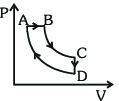
A cyclic process $ABCDA$ is shown in the $P-V$ diagram. Which of the following curves represent the same process
Compton effect supports that
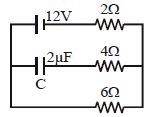
Charge on the capacitor in the given circuit in steady state condition is :- ............... $\mu C$
Two cars $A$ and $B$ are travelling in the same direction with velocities ${v_1}$ and ${v_2}$$({v_1} > {v_2})$. When the car $A$ is at a distance $d$ ahead of the car $B$, the driver of the car $A$ applied the brake producing a uniform retardation $a$ There will be no collision when
A circular coil ‘$A$’ has a radius $R$ and the current flowing through it is $I$. Another circular coil ‘$B$’ has a radius $2R$ and if $2I$ is the current flowing through it, then the magnetic fields at the centre of the circular coil are in the ratio of (i.e.${B_A}$ to ${B_B}$)
Two niclos are crossed to each other. Now one of them is rotated through $60^o$. What percentage of incident light will pass through the system?
An electric dipole of moment $p$ is placed at the origin along the $x$-axis. The electric field at a point $P$, whose position vector makes an angle $\theta $ with the $x$-axis, will make an angle ..... with the $x$-axis, where $\tan \alpha = \frac{1}{2}\tan \theta $
Two blocks of mass $2 \,kg$ and $4 kg$ are accelerated with same acceleration by a force $10 \,N$ as shown in figure on a smooth horizontal surface. Then the spring force between the two blocks will be .......... $N$ (spring is massless)
