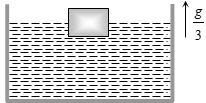
A cubical block is floating in a liquid with half of its volume immersed in the liquid. When the whole system accelerates upwards with acceleration of $g/3,$ the fraction of volume immersed in the liquid will be
Medium


Download our appand get started for free
Experience the future of education. Simply download our apps or reach out to us for more information. Let's shape the future of learning together!No signup needed.*
Similar Questions
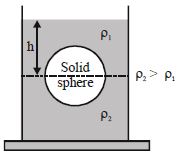
- 1A solid sphere of radius $r$ is floating at the interface of two immiscible liquids of densities $\rho_1$ and $\rho_2\,\, (\rho_2 > \rho_1),$ half of its volume lying in each. The height of the upper liquid column from the interface of the two liquids is $h.$ The force exerted on the sphere by the upper liquid is $($ atmospheric pressure $= p_0\,\,\&$ acceleration due to gravity is $g) $View Solution
- 2Two liquids of densities $d_1$ and $d_2$ are flowing in identical capillary tubes uder the same pressure difference. Ift $t_1$ and $t_2$ are time taken for the flow of equal quantities (mass) of liquids, then the ratio of coefficient of viscosity of liquids must beView Solution
- 3View SolutionThe Reynolds number of a flow is the ratio of
- 4A plane is in level flight at constant speed and each of its two wings has an area of $40 \mathrm{~m}^2$. If the speed of the air is $180 \mathrm{~km} / \mathrm{h}$ over the lower wing surface and $252 \mathrm{~km} / \mathrm{h}$ over the upper wing surface, the mass of the plane is______ $\mathrm{kg}$. (Take air density to be $1 \mathrm{~kg} \mathrm{~m}^{-3}$ and $\mathrm{g}=10 \mathrm{~ms}^{-2}$ )View Solution
- 5A tank is filled up to a height $2H$ with a liquid and is placedon a platform of height $H$ from the ground. The distance $x$ from the ground where a small hole is punched to get the maximum range $R$ is:View Solution
- 6Eight equal drops of water are falling through air with a steady speed of $10\,cm / s$. If the drops coalesce, the new velocity is $.........\,cm/s$View Solution
- 7The approximate depth of an ocean is $2700\,\, m.$ The compressibility of water is $45.4 \times 10^{-11} Pa^{-1}$ and density of water is $10^3 \,kg/m^3 $. What fractional compression of water will be obtained at the bottom of the ocean?View Solution
- 8$Assertion :$ In a pressure cooker the water is brought to boil. The cooker is then remove from the stove. Now on removing the lid of the pressure cooker, the water starts boiling against.View Solution
$Reason :$ The impurities in water bring down its boiling point - 9Two water pipes $P$ and $Q$ having diameters $2$$ \times 10^{-2} $ $m$ and $4$ $\times 10^{-2}$ $m$, respectively, are joined in series with the main supply line of water. The velocity of water flowing in pipe $P$ isView Solution
- 10View SolutionAn application of Bernoulli's equation for fluid flow is found in