MCQ
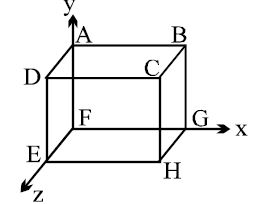
A cuboid $ABCDEFGH$ is anisotropic with $\alpha_x = 1 × 10^{-5} /^o C$, $\alpha_y = 2 × 10^{-5} /^o C$, $\alpha_z = 3 × 10^{-5} /^o C$. Coefficient of superficial expansion of faces can be
  • A
    $\beta_{ABCD} = 5 × 10^{-5} /^o C$
  • B
    $\beta_{BCGH} = 4 × 10^{-5} /^o C$
  • $\beta_{CDEH} = 3 × 10^{-5} /^o C$
  • D
    $\beta_{EFGH} = 2 × 10^{-5} /^o C$

Answer

Correct option: C.
$\beta_{CDEH} = 3 × 10^{-5} /^o C$
c
Coefficient of superficial expansion of face $\mathrm{CDEH}=\alpha_{x}+\alpha_{y}=3 \times 10^{-5} /^{\circ} \mathrm{C}$

Need a full question paper?

Generate a complete, print-ready paper with questions like this in minutes — across 16+ boards, with answer keys.

Start Generating Free

Similar questions

A shell in free space initially at rest explodes into two pieces, $A$ and $B$ , which then move in opposite directions. Piece $A$ has less mass than piece $B$ . Ignore all external forces. Identify correct statement
The distance between Sun and Earth is $R.$ The duration of year if the distance between Sun and Earth becomes $3R$ will be 
Particles of masses 2M, m and M are respectively at points A, B and C with AB = ½ (BC). m is muchmuch smaller than M and at time t = 0, they are all at rest. At subsequent times before any collision takes place:
Two racing cars of masses ${m_1}$ and ${m_2}$ are moving in circles of radii ${r_1}$ and ${r_2}$ respectively. Their speeds are such that each makes a complete circle in the same duration of time $t$. The ratio of the angular speed of the first to the second car is
At $300\,K$, the rms speed of oxygen molecules is $\sqrt{\frac{\alpha+5}{\alpha}}$ times to that of its average speed in the gas. Then, the value of $\alpha$ will be (used $\pi=\frac{22}{7}$ )
A particle performs simple harmonic motion with amplitude $A$. Its speed is trebled at the instant that it is at a distance $\frac{{2A}}{3}$ from equilibrium position. The new amplitude of the motion is
An object is at a temperature of ${400^o}C$. At what temperature would it radiate energy twice as fast? The temperature of the surroundings may be assumed to be negligible
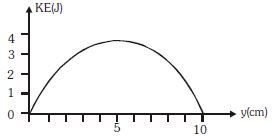
A mass on a vertical spring begins its motion at rest at $y = 0\  cm$. It reaches a maximum height of $y = 10\  cm$. The two forces acting on the mass are gravity and the spring force. The graph of its kinetic energy ($KE$) versus position is given below. Net force on the mass varies with $y$ as
Two wires are made of the same material and have the same volume. The first wire has cross-sectional area $A$ and the second wire has cross-sectional area $3A$. If the length of the first wire is increased by $\Delta l$ on applying a force $F$, how much force is needed to stretch the second wire by the same amount?
Time period of a simple pendulum will be double, if we