Question
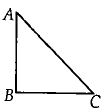
A current carrying closed loop in the form of a right angle isosceles triangle $ABC$ is placed in a uniform magnetic field acting along $AB.$ If the magnetic force on the arm $BC$ is $\vec F,$ the force on the arm $AC$ is
Answer

$\text { Here, } \vec{F}_{B C}=\vec{F}$

$\because \quad \vec{F}_{A B}=0$

The net magnetic force on a current carrying closed loop in a uniform magnetic field is zero.

$\therefore \vec{F}_{A B}+\vec{F}_{B C}+\vec{F}_{A C}=0$

$\Rightarrow \vec{F}_{A C}=-\vec{F}_{B C}$    $\left(\because \vec{F}_{A B}=0\right)$

Need a full question paper?

Generate a complete, print-ready paper with questions like this in minutes — across 16+ boards, with answer keys.
Start Generating Free

Similar questions

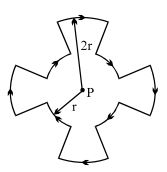
A current $I$ flows around a closed path in the horizontal plane of the circle as shown in the figure. The path consists of eight arcs with alternating radii $r$ and $2r$. Each segment of arc subtends equal angle at the common centre $P.$ The magnetic field produced by current path at point $P$ is
The radius of hydrogen atom in its ground state is $5.3 \times {10^{ - 11}}m$. After collision with an electron it is found to have a radius of $21.2 \times {10^{ - 11}}m$. What is the principal quantum number $n$ of the final state of the atom $n=.........$
What vector must be added to the two vectors $\hat i - 2\hat j + 2\hat k$ and $2\hat i + \hat j - \hat k,$ so that the resultant may be a unit vector along $X-$axis
The elasticity of invar
The magnitude of pairs of displacement vectors are given. Which pair of displacement  vectors cannot be added to give a resultant vector of magnitude $13\, cm$?
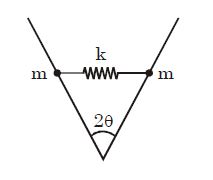
Two particles of mass $m$ are constrained to move along two horizontal frictionless rails that make an angle $2\theta $ with respect to each other. They are connected by a spring with spring constant $k$ . The angular frequency of small oscillations for the motion where the two masses always stay parallel to each other (that is the distance between the meeting point of the rails and each particle is equal) is 
An ice cube contains a large air bubble. The cube is floating on the horizontal surface of water contained in a trough. What will happen to the water level, when the cube melts?
If value of  $R$  is changed then
With rise in temperature, density of a given body changes according to one of the following relations
A wooden block of mass $M$ resting on a rough horizontal surface is pulled with a force $F$ at an angle $\phi $ with the horizontal. If $\mu $ is the coefficient of kinetic friction between the block and the surface, then acceleration of the block is