MCQ
A current carrying conductor produces :
  • A
    Only electric field
  • B
    Only magnetic field
  • Electric and magnetic field both
  • D
    None of these

Answer

Correct option: C.
Electric and magnetic field both
C

Need a full question paper?

Generate a complete, print-ready paper with questions like this in minutes — across 16+ boards, with answer keys.
Start Generating Free

Similar questions

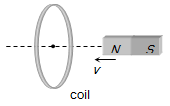
In the following figure, the magnet is moved towards the coil with a speed $v$ and induced $emf$ is $e.$ If magnet and coil recede away from one another each moving with speed $v,$ the induced $emf$ in the coil will be
If an insulated non$-$conducting sphere of radius $R$ has charge density $\rho$. The electric field at a distance $r$ from the centre of sphere $( r<R )$ will be
A p-n junction diode cannot be used:
In ballistic galvanometer, the frame on which the coil is wound is non-metallic to (a) Avoid the production of induced e.m.f.(b) Avoid the production of eddy currents(c) Increase the production of eddy currents(d) Increase the production of induced e.m.f.
   
   
The direction of the induced current in the coil can also be found by:
Two metal pieces having a potential difference of $800V$ are $0.02m$ apart horizontally. $A$ particle of mass $1.96 \times 10^{-15}\ kg$ is suspended in equilibrium between the plates. If e is the elementary charge, then charge on the particle is:
A cylindrical conductor has uniform cross$-$section. Resistivity of its material increase linearly from left end to right end. If a constant current is flowing through it and at a section distance $x$ from left end, magnitude of electric field intensity is $E,$ which of the following graphs is correct
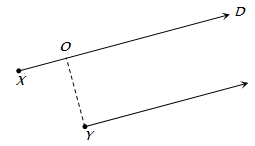
Two point sources $X$ and $Y$ emit waves of same frequency and speed but $Y$ lags in phase behind $X$ by $2pl$ radian. If there is a maximum in direction $D$ the distance $XO$ using $n$ as an integer is given by
Which of following  can not be polarised(a) Radio waves(b) Ultraviolet rays(c) Infrared rays(d)  Ultrasonic waves
       
Two resistances are connected in two gaps of a metre bridge. The balance point is 20 cm from the zero end. A resistance of 15 ohms is connected in series with the smaller of the two. The null point shifts to 40 cm. The value of the smaller resistance in ohms is(a) 3 (b) 6(c) 9  (d) 12