MCQ
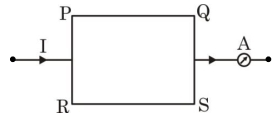
A current carrying rectangular loop PQRS is made of uniform wire. The length $PR = QS =5\,cm$ and $PQ = RS =100\,cm$. If ammeter current reading changes from I to $2 I$, the ratio of magnetic forces per unit length on the wire $P Q$ due to wire RS in the two cases respectively $f_{ PQ }^{ I }: f_{ PQ }^{2 I }$ is :
  • A
    $1: 2$
  • $1: 4$
  • C
    $1: 5$
  • D
    $1: 3$

Answer

Correct option: B.
$1: 4$
b
$F \propto I _1 I _2$

$F _{ I }: F _{2 I }=1: 4$

Need a full question paper?

Generate a complete, print-ready paper with questions like this in minutes — across 16+ boards, with answer keys.

Start Generating Free

Similar questions

The recoil speed of a hydrogen atom after it emits a photon in going from $n =5$ state to $n =1$ state will be ..... $m/s$
Two close organ pipe having length $20\,cm$ and $20.5\, cm$ produce $5\, beats/sec$. Determine the frequency of both organ pipe
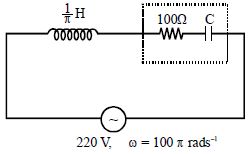
In the circuit shown in figure if the value of $rms$ current is $2.2\, A$ the power factor of the box is 
Two open organ pipes of length $25 cm$ and $25.5 cm$ produce $10$ beat/sec. The velocity of sound will be ..... $m/s$
A liquid is flowing in a horizontal uniform capillary tube under a constant pressure difference $P$. The value of pressure for which the rate of flow of the liquid is doubled when the radius and length both are doubled is
A mass m oscillates with simple harmonic motion with frequency $f = \frac{\omega }{{2\pi }}$ and amplitude A on a spring with constant $K$ , therefore
The peak voltage of the ac source is equal to:
If on heating liquid through $80°C$, the mass expelled is $(1/100)^{th}$ of mass still remaining, the coefficient of apparent expansion of liquid is
Separation between the plates of a parallel plate capacitor is $d$ and the area of each plate is $A$. When a slab of material of dielectric constant $k$ and thickness $t(t < d)$ is introduced between the plates, its capacitance becomes
A cell of negligible resistance and $e.m.f.$ $2$ $volts$ is connected to series combination of $2$, $3$ and $5\, ohm$. The potential difference in volts between the terminals of $3\, ohm$ resistance will be