MCQ
A current carrying solenoid is approaching a conducting loop as shown in the figure. The direction of induced current as observed by an observer on the other side of the loop will be
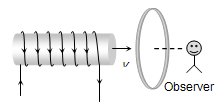
  • A
    Anticlockwise
  • Clockwise
  • C
    East
  • D
    West

Answer

Correct option: B.
Clockwise
(b) Clockwise

Need a full question paper?

Generate a complete, print-ready paper with questions like this in minutes — across 16+ boards, with answer keys.

Start Generating Free

Similar questions

Two conducting spheres of radii $R_1$ and $R_2$ are charged with charges $Q_1$ and $Q_2$ respectively. On bringing them in contact there is
An electromagnetic wave with frequency $\omega $ and wavelength $\lambda $ travels in the $+ y$ direction . Its magnetic field is along $+\, x-$ axis. The vector equation for the associated electric field ( of amplitude $E_0$) is
The thermo e.m.f. of a thermo-couple is 25μV/℃ at room temperature. A galvanometer of 40 ohm resistance, capable of detecting current as low as $10^{-5}A$, is connected with the thermocouple. The smallest temperature difference that can be detected by this system is
The binding energy of deuteron ${ }_1^2 H$ is 1.112 MeV per nucleon and an $\alpha$-particle ${ }_2^4 He$ has a binding energy of 7.047 MeV per nucleon. Then in the fusion reaction ${ }_1^2 H +{ }_1^2 H \rightarrow{ }_2^4 He + Q$, the energy Q released is
Bohrs atomic model assumes:
Two nucleons are at a separation of $1 \times 10^{-15} m$. The net force between them is $F_1$, if both are neutrons, $F_2$ if both are protons and $F_3$ if one is a proton and other is a neutron. In such a case
Two identical electric point dipoles have dipole moments $\overrightarrow{p}_{1}= p\hat i$ and $\overrightarrow{p}_{2}=- p\hat i$ and are held on the $x-$axis at distance $'a'$ from each other. When released, they move along the $x-$axis with the direction of their dipole moments remaining unchanged. If the mass of each dipole is $'m',$ their speed when they arc infinitely far apart is
A potentiometer wire, $10\,m$ long, has a resistance of $40\,\Omega $. It is connected in series with a resistance box and a $2\,V$ storage cell. If the potential gradient along the wire is $0.1\,m\,V/cm$, the resistance unplugged in the box is .............. $\Omega$
Two cells, $e.m.f.$ of each is $E$ and internal resistance $r$ are connected in parallel between the resistance $R$. The maximum energy given to the resistor will be, only when
Consider a wire carrying a steady current, I placed in a uniform magnetic field B perpendicular to its length. Consider the charges inside the wire. It is known that magnetic forces do no work. This implies that: