Question
A current i is passed through a silver strip of width d and area of cross-section A. The number of free electrons per unit volume is n.
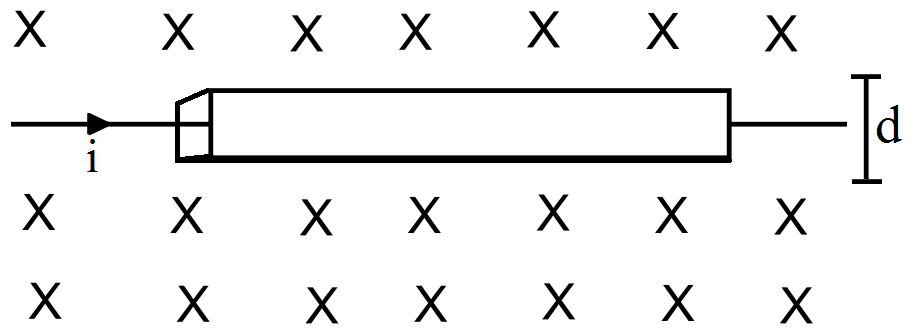
  1. Find the drift velocity v of the electrons.
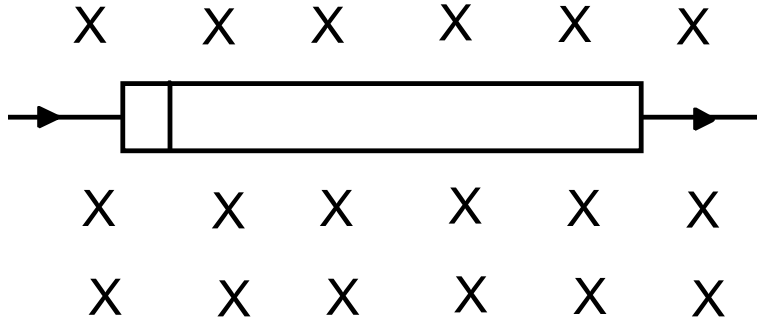
  2. If a magnetic field B exists in the region, as shown in the figure, what is the average magnetic force on the free electrons?
  3. Due to the magnetic force, the free electrons get accumulated on one side of the conductor along its length. This produces a transverse electric field in the conductor, which opposes the magnetic force on the electrons. Find the magnitude of the electric field which will stop further accumulation of electrons.
  4. What will be the potential difference developed across the width of the conductor due to the electron-accumulation? The appearance of a transverse emf, when a current-carrying wire is placed in a magnetic field, is called Hall effect.
Answer


  1. $\text{i}=\text{V}_0\text{n}\text{Ae}$
$\Rightarrow\text{V}_0=\frac{\text{i}}{\text{nae}}$
  1. $\text{F}=\text{ilB}=\frac{\text{iB}}{\text{nA}}$ (upwards)
  2. Let the electric field be E
$\text{Ee}=\frac{\text{iB}}{\text{An}}\Rightarrow\text{E}=\frac{\text{iB}}{\text{Aen}}$
  1. $\frac{\text{dv}}{\text{dr}}=\text{E}\Rightarrow\text{dV}=\text{Edr}$
$=\text{E}\times\text{d}=\frac{\text{ib}}{\text{Aen}}\text{d}$

Need a full question paper?

Generate a complete, print-ready paper with questions like this in minutes — across 16+ boards, with answer keys.

Start Generating Free

Similar questions

A block of mass m moves on a horizontal circle against the wall of a cylindrical room of radius R. The floor of the room on which the block moves is smooth but the friction coefficient between the wall and the block is $\mu.$ The block is given an initial speed $\nu_0.$ As a function of the speed $\nu$ write,
  1. The normal force by the wall on the block.
  2. The frictional force by the wall.
  3. The tangential acceleration of the block.
  4. Integrate the tangential acceleration $\Big(\frac{\text{d}\nu}{\text{dt}}=\nu\frac{\text{d}\nu}{\text{ds}}\Big)$ to obtain the speed dt ds of the block after one revolution.
A satellite is in an elliptic orbit around the earth with aphelion of $6R$ and perihelion of 2R where $R = 6400km$ is the radius of the earth. Find eccentricity of the orbit. Find the velocity of the satellite at apogee and perigee. What should be done if this satellite has to be transferred to a circular orbit of radius $6R$?[$G = 6.67 \times 10^{–11}$ SI units and $4M = 6 \times 10^{24}kg$]
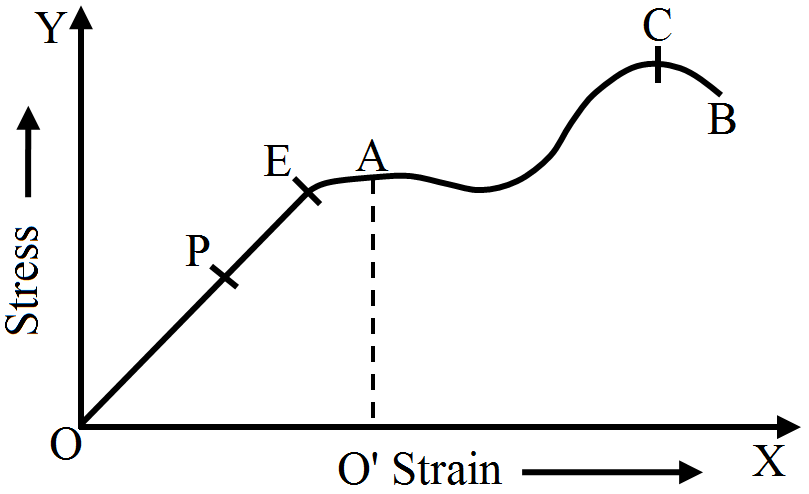
The Stress-Strain graph for a metal wire is shown in the figure upto the point E. The wire returns to its original state O along the curve EPO when it is gradually unloaded. Point B corresponds to the fracture of the wire:
  1. Upto what point of the curve is Hooke's law obeyed?
  2. Which point on the curve corresponds to the elastic limit or yield point of the wire?
  3. Indicate the elastic and plastic regions of the Stress-Strain graph.
  4. Describe what happens when the wire is loaded upto a stress corresponding to the point A on the graph, and then unloaded gradually. In particular, explain, the dotted curve.
  5. What is peculiar about the portion of the Stress-Strain graph from C to B? Upto what stress can the wire be subjected without causing fracture?
An eye can distinguish between two points of an object if they are separated by more than 0.22mm when the object is placed at 25cm from the eye. The object is now seen by a compound microscope having a 20D objective and 10D eyepiece separated by a distance of 20cm. The final image is formed at 25cm from the eye. What is the minimum separation between two points of the object which can now be distinguished?
A chain of length l and mass m lies on the surface of a smooth sphere of radius R>1 with one end tied to the top of the sphere.
  1. Find the gravitational potential energy of the chain with reference level at the centre of the sphere.
  2. Suppose the chain is released and slides down the sphere. Find the kinetic energy of the chain, when it has slid through an angle $\theta.$
  3. Find the tangential acceleration $\frac{\text{dv}}{\text{dt}}$ of the chain when the chain starts sliding down.
The Marina trench is located in the Pacific Ocean, and at one place it is nearly eleven km beneath the surface of water. The water pressure at the bottom of the trench is about $1.1 \times 10^8 Pa$. A steel ball of initial volume $0.32m^3$ is dropped into the ocean and falls to the bottom of the trench. What is the change in the volume of the ball when it reaches to the bottom?
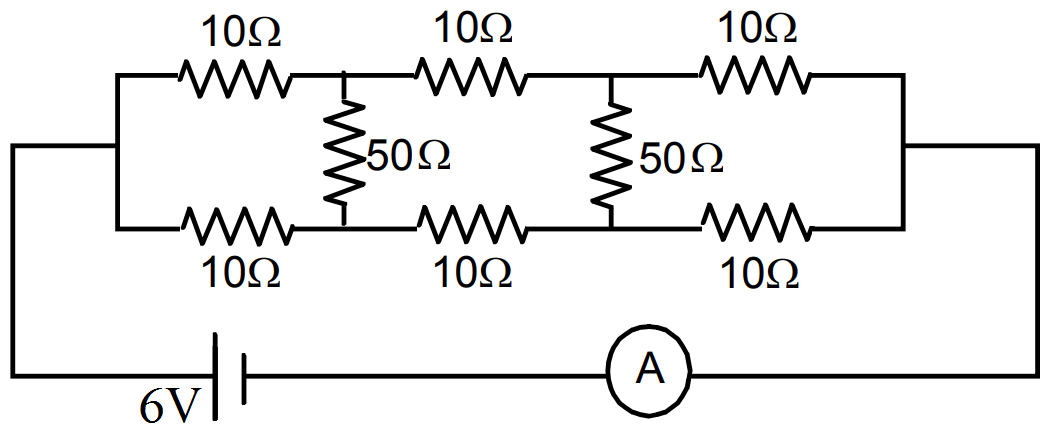
Find the current measured by the ammeter in the circuit shown in the figure.
The two blocks in an Atwood machine have masses $2.0kg$ and $3.0kg$. Find the work done by gravity during the fourth second after the system is released from rest.
A body of mass 3kg is under a constant force, which causes a displacement S in metre in it, given by the relation $\text{S}=\frac{1}{2}\text{t}^2$, where t is in second. Find the work done by the force in 2s.
An ammeter is to be constructed that can read currents up to 2.0A. If the coil has resistance of $25\Omega$ and takes 1mA for full-scale deflection, what should be the resistance of the shunt used?