A current of $10\, A$ exists in a wire of crosssectional area of $5\, mm ^{2}$ with a drift velocity of $2 \times 10^{-3}\, ms ^{-1}$. The number of free electrons in each cubic meter of the wire is ..........
JEE MAIN 2021, Medium
Download our app for free and get started
$i =10 A , A =5 mm ^{2}=5 \times 10^{-6} m ^{2}$
and $v _{ d }=2 \times 10^{-3} m / s$
We know, $i= neAvd$
$\therefore 10= n \times 1.6 \times 10^{-19} \times 5 \times 10^{-6} \times 2 \times 10^{-3}$
$\Rightarrow n =0.625 \times 10^{28}=625 \times 10^{25}$

Download our appand get started for free
Experience the future of education. Simply download our apps or reach out to us for more information. Let's shape the future of learning together!No signup needed.*
Similar Questions
- 1If a wire is stretched to make it $0.1 \%$ longer, its resistance willView Solution
- 2If the ammeter in the given circuit reads $2\, A$, the resistance $R$ is ............ $ohm$View Solution
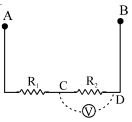
- 3Resistances $R_1$ and $R_2$ each $60\,\Omega$ are connected in series as shown in figure. The Potential difference between $A$ and $B$ is kept $120$ volt. Then what ............. $V$ will be the reading of voltmeter connected between the point $C$ and $D$ if resistance of voltmeter is $120\,\Omega .$View Solution
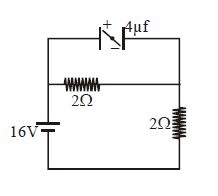
- 4What is net force on the small dipole placed inside the capacitor at steady state if the plates are separated by $1\ cm$ ?......$N$View Solution
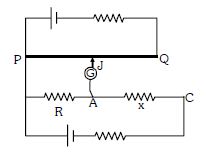
- 5Circuit for the measurement of resistance by potentiometer is shown. The galvanometer is first connected at point $A$ and zero deflection is observed at length $P J = 10\ cm$ . In second case it is connected at point $C$ and zero deflection is observed at a length $30\ cm$ from $P$ . Then the unknown resistance $X$ isView Solution
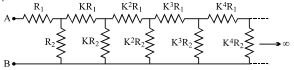
- 6The circuit diagram shown consists of a large number of element (each element has two resistors $R_1$ and $R_2$). The resistance of the resistors in each subsequent element differs by $a$ factor of $K = 1/2$ from the resistance of the resistors in the previous elements. The equivalent reistance between $A$ and $B$ shown in figure is :View Solution
- 7View SolutionThe internal resistance of a cell depends on
- 8Two uniform wires $A$ and $B$ are of the same metal and have equal masses. The radius of wire $A$ is twice that of wire $B$. The total resistance of A and $B$ when connected in parallel isView Solution
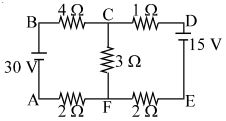
- 9The figure shows a network of five resistances and two batteries The current through the $30\,V$ battery is ............... $A$View Solution
- 10A $50 \,W$ bulb connected in series with a heater coil is put to an $AC$ mains. Now the bulb is replaced by a $100 \,W$ bulb. The heater output will ...........View Solution