MCQ
A current of 2 A flows in a system of conductors as shown. The potential difference $(V_A - V_B)$ will be
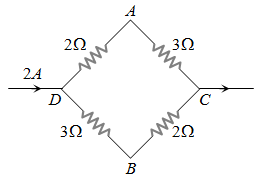
  • A
    +2V
  • +1V
  • C
    -1V
  • D
    -2V

Answer

Correct option: B.
+1V
(b) +1V

Need a full question paper?

Generate a complete, print-ready paper with questions like this in minutes — across 16+ boards, with answer keys.

Start Generating Free

Similar questions

Mixed $He^+$ and $O^{2+}$ ions (mass of $He^+ =4$ amu  and that of $O^{2+}=16$ amu ) beam passes a region of constant perpendicular magnetic field. If kinetic energy of all the ions is same then
Two spherical conductors each of capacity C are charged to potentials V and – V. These are then connected by means of a fine wire. The loss of energy will be
Heavy water is
$X-$ rays are in nature similar to
Given below are two statements :

Statement $I$ : In an $LCR$ series circuit, current is maximum at resonance.

Statement $II$ : Current in a purely resistive circuit can never be less than that in a series LCR circuit when connected to same voltage source.

In the light of the above statements, choose the correct from the options given below :
A coil of $50\, turns$ and $4\,cm$ radius carries $2\,A$ current then magnetic field at its centre is......$mT$
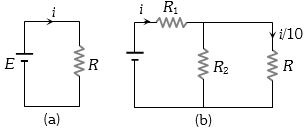
Consider the circuits shown in the figure. Both the circuits are taking same current from battery but current through $R$ in the second circuit is $\frac{1}{{10}}$$^{th}$ of current through $R$ in the first circuit. If $R$ is $11$ $\Omega$, the value of $ R_1$ ................  $\Omega$
A star has $100 \%$ helium composition. It starts to convert three ${ }^4 \mathrm{He}$ into one ${ }^{12} \mathrm{C}$ via triple alpha process as ${ }^4 \mathrm{He}+{ }^4 \mathrm{He}+{ }^4 \mathrm{He} \rightarrow{ }^{12} \mathrm{C}+\mathrm{Q}$. The mass of the star is $2.0 \times 10^{32} \mathrm{~kg}$ and it generates energy at the rate of $5.808 \times 10^{30} \mathrm{~W}$. The rate of converting these ${ }^4 \mathrm{He}$ to ${ }^{12} \mathrm{C}$ is $\mathrm{n} \times 10^{42} \mathrm{~s}^{-1}$, where $\mathrm{n}$ is. . . . . . .[Take, mass of ${ }^4 \mathrm{He}=4.0026 \mathrm{u}$, mass of ${ }^{12} \mathrm{C}=12 \mathrm{u}$ ]
The work function of a metal is $1.6 \times 10^{-19}$ J. When the metal surface is illuminated by the light of wavelength 6400 Å, then the maximum kinetic energy of emitted photo-electrons will be (Planck's constant $\mathrm{h}=6.4 \times 10^{-34} \mathrm{Js}$)
In the given circuit, the potential of the point E is