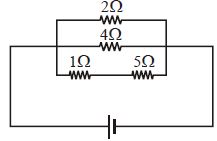
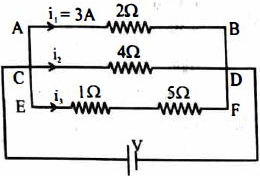
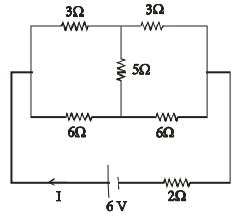
A current of $3\,amp$ flows through the $2\,\Omega $ resistor shown in the circuit. The power dissipated in the $5\,\Omega $ resistor is ................. $watt$
AIPMT 2008, Medium


Download our appand get started for free
Experience the future of education. Simply download our apps or reach out to us for more information. Let's shape the future of learning together!No signup needed.*
Similar Questions
- 1If the current through a resistor in a circuit increases by $3 \%$, then the power dissipated by the resistorView Solution
- 2View SolutionOhm's law is true
- 3The electric intensity $E$, current density $j$ and specific resistance $k$ are related to each other by the relationView Solution
- 4A potential divider is used to give outputs of $4\,V$ and $8\,V$ from a $12\,V$ source. Which combination of resistances, $(R_1 : R_2 : R_3)$ gives the correct voltagesView Solution
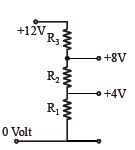
- 5Refer to the circuit shown. What will be the total power dissipation in the circuit if $P$ is the power dissipated in $R_1$ ? It is given that $R_2=4 R_1$ and $R_3=12 R_1$ are .......... $P$View Solution
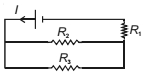
- 6If the resistivity of a potentiometer wire be $\rho $ and area of cross-section be $A$, then what will be potential gradient along the wireView Solution
- 7A battery of $6\,V$ is connected to the circuit as shown below. The current I drawn from the battery is:View Solution
- 8View SolutionThrough a semiconductor, an electric current is due to drift of
- 9If $2.2\,kW$ power is transmitted through a $100\,\Omega $ line at $22,000\,V,$ the power loss in the form of heat will be ............. $W$View Solution
- 10If six identical cells each having an $e.m.f.$ of $6\,V$ are connected in parallel, the $e.m.f.$ of the combination is ................ $V$View Solution