Question
A cycle followed by an engine (made of one mole of an ideal gas in a cylinder with a piston) is shown in Fig. Find heat exchanged by the engine, with the surroundings for each section of the cycle. $(C_v = (3/2) R)$
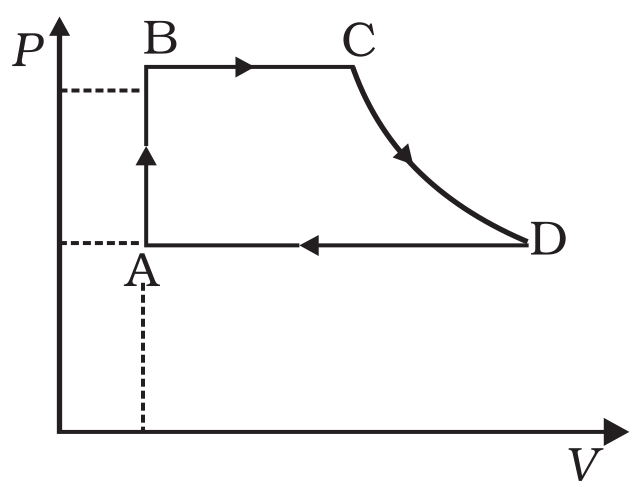
AB : constant volume
BC : constant pressur CD : adiabati DA : constant pressure
Answer

  1. : For A → B, dV = 0
so,$\text{dW}=\int\text{P}.\text{dV}=\int\text{p}\times0=0$
$\text{dW}=0$

By $1^\text{st}$ law of thermodynamics
$\text{dQ}=\text{dU}+\text{dW}=\text{dU}+0$
$\therefore\ \text{dQ} =\text{dU}$
$\big(\text{dQ}=\text{n}\text{C}_\text{V}\text{dT}\big)$
So, $\text{dQ}-1\frac{3}{2}\text{R}\big(\text{T}_\text{B}-\text{T}_\text{A}\big).....(\text{i})$
$\text{dU}=\text{dQ}=\frac{3}{2}\big(\text{R}\text{T}_\text{}B-\text{R}\text{T}_\text{A}\big)=\frac{3}{2}\big(\text{P}_\text{B}\text{V}_\text{B}-\text{P}_\text{A}\text{}V_\text{A}\big)$
$\therefore$ Heat exchange [to system]
$\text{dQ}_1=\text{dU}=\frac{3}{2}\big(\text{P}_\text{s}\text{V}_\text{s}-\text{P}_\text{A}\text{V}_\text{A}\big)$
  1. For B to C, $\Delta\text{P}=0\ \text{n}=1$
$\text{dQ}=\text{dU}+\text{dW}=\text{C}_\text{V}\text{(dT)}+\text{P}_\text{S}\text{dV}$
$\text{dQ}_2=\frac{3}{2}\text{R}\big(\text{T}_\text{C}-\text{T}_\text{B}\big)+\text{P}_\text{B}\big(\text{V}_\text{C}-\text{V}_\text{B}\big)$
$=\frac{3}{2}\big(\text{T}_\text{C}\text{R}-\text{RT}_\text{B}\big)+\text{P}_\text{B}\text{V}_\text{C}-\text{P}_\text{B}\text{V}_\text{B}$
$=\frac{3}{2}[\text{P}_\text{C}\text{V}_\text{C}]-\frac{3}{2}[\text{P}_\text{B}\text{V}_\text{B}]-\text{P}_\text{B}\text{V}_\text{B}-\text{P}_\text{B}\text{V}_\text{C}$
$\text{V}_\text{A}=\text{V}_\text{B}\ \text{and}\ \text{P}_\text{B}=\text{P}_\text{C}$
$\therefore\text{dQ}_2=\frac{3}{2}\text{P}_\text{B}\text{V}_\text{C}-\frac{3}{2}\text{P}_\text{B}\text{V}_\text{A}-\text{P}_\text{B}\text{V}_\text{A}+\text{P}_\text{B}\text{V}_\text{C}$
$=\frac{5}{2}\text{P}_\text{B}\text{V}_\text{C}-\frac{5}{2}\text{P}_\text{B}\text{V}_\text{A}$
$\text{dQ}_2=\frac{5}{2}\text{P}_\text{B}[\text{V}_\text{C}-\text{V}_\text{A}]$
  1. For diagram C → B, adiabatic change
$\text{dQ}_3=0$ (No exchange of heat )
  1. For diagram D → A, $\Delta\text{P}=0$ Compression of gas from volume $V_D$ to $V_A$ pressure hence heat exchange similar to part (b) i.e. Heat exchange$\text{dQ}_3=\frac{5}{2}\text{P}_\text{A}\big(\text{V}_\text{A}-\text{V}_\text{D}\big)$

Need a full question paper?

Generate a complete, print-ready paper with questions like this in minutes — across 16+ boards, with answer keys.

Start Generating Free

Similar questions

A $100kg$ block is started with a speed of $2.0ms^{-1}$ on a long, rough belt kept fixed in a horizontal position. The coefficient of kinetic friction between the block and the belt is $0.20$.
  1. Calculate the change in the internal energy of the block-belt system as the block comes to a stop on the belt.
  2. Consider the situation from a frame of reference moving at $2.0ms^{-1}$ along the initial velocity of the block. As seen from this frame, the block is gently put on a moving belt and in due time the block starts moving with the belt at $2.0ms^{-1}$ Calculate the increase in the kinetic energy of the block as it stops slipping past the belt.
  3. Find the work done in this frame by the external force holding the belt.
Find the speed at which the kinetic enei:gy of a particle will differ by 1% from its nonrelativistic value $\frac{1}{2}\text{m}_0\text{v}^2$
A. What is meant by thermal conductivity? What are the SI unit and CGS unit of coefficient of thermal conductivity?
B. Mention three applications of thermal conductivity in daily life.
Show that in case of one dimensional elastic collision of two bodies, the relative velocity of separation after the collision is equal to the relative velocity of approach before the collision.
Obtain a relation between the distance travelled by a body in time t, if its initial velocity be u and acceleration:
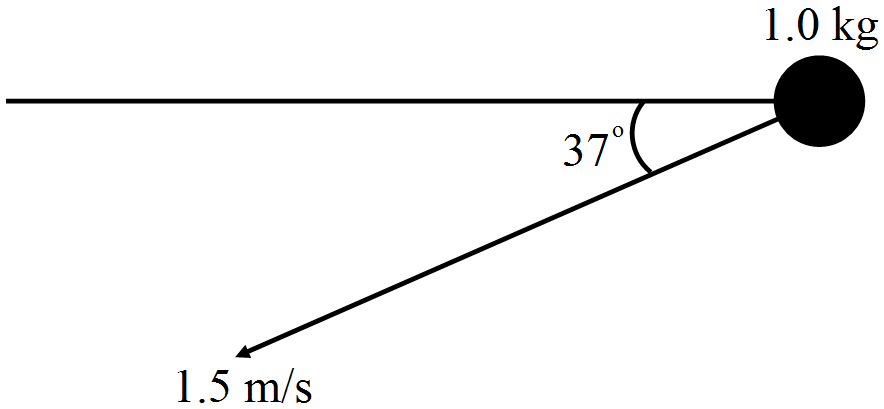
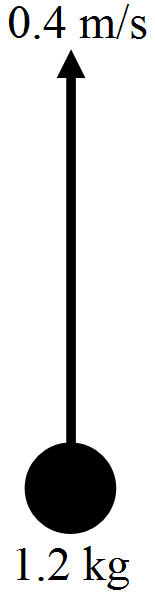
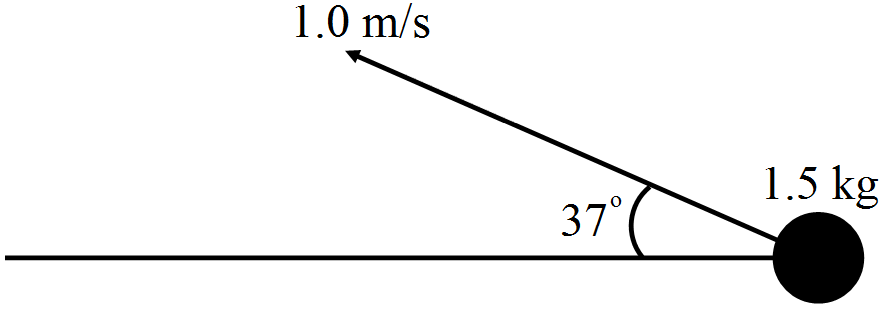
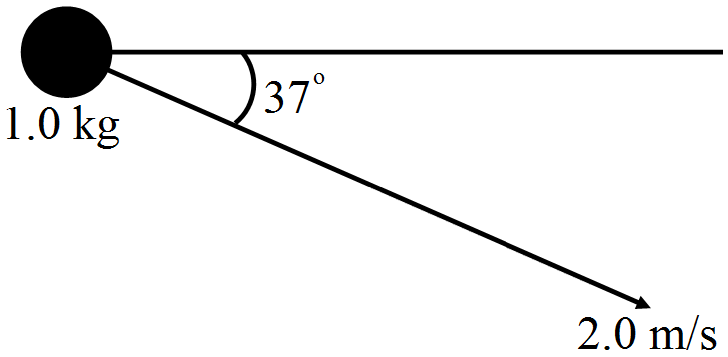
Calculate the velocity of the centre of mass of the system of particles shown in figure.


A ball moves along a curved path of radius 5m as shown in figure. It starts from point A and reaches point B. If there is no force of friction between the ball and surface of the path, then find the normal force that acts on the ball at the bottom (B) of the curved path.
Write the dimensions and derived units in M.K.S. unit system of the following quantities :
(i) Force, (ii) Power, (iii) Pressure, (iv) Stress, (v) Strain, (vi) Coefficient of elasticity, (vii) Relative density (viii) Gravitational constant.
Suppose the block of the previous problem is pushed down the incline with a force of 4N. How far will the block move in the first two seconds after starting from rest? The mass of the block is 4kg.
The angle between the resultant contact force and the normal force exerted by a body on the other is called the angle of friction. Show that, if $\lambda$ be the angle of friction and la the coefficient of static friction, $\lambda\leq\tan^{-1}\mu.$