MCQ
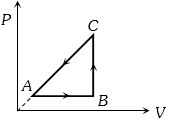
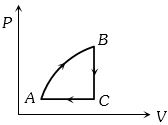
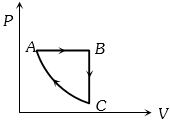
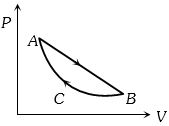
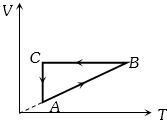
A cyclic process $ABCA$ is shown in the $V-T $ diagram. Process on the $P-V$ diagram is
  • A

  • B


  • D

Answer

Correct option: C.

c
(c) From the given $VT$ diagram,

In process $AB, \,V  \propto  T$ ==> Pressure is constant (As quantity of the gas remains same) 

In process $BC,\, V =$ Constant and 

in process $CA, \,T =$ constant 

$\therefore$ These processes are correctly represented on $PV$ diagram by graph $(c).$

Need a full question paper?

Generate a complete, print-ready paper with questions like this in minutes — across 16+ boards, with answer keys.

Start Generating Free

Similar questions

For a certain gas, the ratio of specific heats is given to be $\gamma = 1.5$. For this gas
The breaking stress of a wire depends on:
  1. Material of the wire.
  2. Length of the wire.
  3. Radius of the wire.
  4. Shape of the cross-section.
The diffusion current in a p-n junction is:
  1. From the n-side to the p-side.
  2. From the p-side to the n-side.
  3. From the n-side to the p-side if the junction is forward-biased and in the opposite direction if it is reverse-biased.
  4. From the p-side to the n-side if the junction is forward-biased and in the opposite direction if it is reverse-biased.
Young’s moduli of two wires $A$ and $B$ are in the ratio $7 : 4$. Wire $A$ is $2\, m$ long and has radius $R$. Wire $A$ is $2\, m$ long and has radius $R$. Wire $B$ is $1.5\, m$ long and has radius $2\, mm$. If the two wires stretch by the same length for a given load, then the value of $R$ is close to ......... $mm$
A mass of diatomic gas $(\gamma = 1 .4)$ at a pressure of $2$ atmospheres is compressed adiabatically so that its temperature rises from $27^o C$ to $927^o C.$ The pressure of the gas in the final state is  ...... $atm$
A tube of length $50\,cm$ is filled completely with an incompressible liquid of mass $250\,g$ and closed at both ends. The tube is then rotated in horizontal plane about one of its ends with a uniform angular velocity $x \sqrt{ F }$ rad $s ^{-1}$. If $F$ be the force exerted by the liquid at the other end then the value of $x$ will be$....$
A certain amount of gas is taken through a cyclic process $(A\,B\,C\,D\,A)$  that has two isobars, one isochore and one isothermal. The cycle can be represented on a $P-V$ indicator diagram as
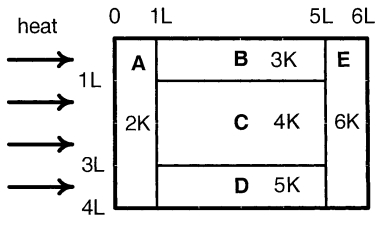
A composite block is made of slabs $A, B, C, D$ and $E$ of different thermal conductivities (given in terms of a constant $K$ ) and sizes (given in terms of length, $L$ ) as shown in the figure. All slabs are of same width. Heat $'Q'$ flows only from left to right through the blocks. Then in steady state $Image$

$(A)$ heat flow through $A$ and $E$ slabs are same.

$(B)$ heat flow through slab $E$ is maximum.

$(C)$ temperature difference across slab $E$ is smallest.

$(D)$ heat flow through $C =$ heat flow through $B +$ heat flow through $D$.
Which of the following is true for elastic potential energy density
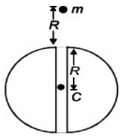
A particle of mass $m$ is dropped from a height $R$ equal to the radius of the earth above the tunnel dug through the earth as shown in the figure. Hence the correct statement is