A cyclist goes round a circular path of circumference $34.3\, m$ in $\sqrt {22} $ sec. the angle made by him, with the vertical, will be ....... $^o$
Medium
Download our app for free and get started
(a) $2\pi r = 34.3$ $⇒$ $r = \frac{{34.3}}{{2\pi }}$ and $v = \frac{{2\pi r}}{T} = \frac{{2\pi r}}{{\sqrt {22} }}$
Angle of binding $\theta = {\tan ^{ - 1}}\left( {\frac{{{v^2}}}{{rg}}} \right) = 45^\circ $

Download our appand get started for free
Experience the future of education. Simply download our apps or reach out to us for more information. Let's shape the future of learning together!No signup needed.*
Similar Questions
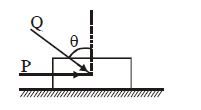
- 1A block of mass $m$ lying on a rough horizontal plane is acted upon by a horizontal force $P$ and another force $Q$ inclined an at an angle $\theta $ to the vertical. The minimum value of coefficient of friction between the block and the surface for which the block will remain in equilibrium isView Solution
- 2A disc rotates about its axis of symmetry in a hoizontal plane at a steady rate of $3.5$ revolutions per second. A coin placed at a distance of $1.25\,cm$ from the axis of rotation remains at rest on the disc. The coefficient of friction between the coin and the disc is $(g\, = 10\,m/s^2)$View Solution
- 3The maximum velocity (in $ms^{-1}$) with which a car driver must traverse a flat curve of radius $150 \,m$ and coefficient of friction $0.6$ to avoid skidding isView Solution
- 4Concretemixture is made by mixing cement, stone and sand in a rotating cylindrical drum . If the drum rotates too fast, the ingredients remain stuck to the wall of the drum and proper mixing of ingredients does not take place. The maximum rotational speed of the drum in revolutions per minute (rpm) to ensure proper mixing is close to (Take the radius of the drum to be $1.25\, m$ and its axle to be horizontal)View Solution
- 5View SolutionA hockey player is moving northward and suddenly turns westward with the same speed to avoid an oopponent. The force that acts on the player is
- 6The coefficient of friction between a body and the surface of an inclined plane at $45^°$ is $0.5.$ If $g = 9.8\,m/{s^2}$, the acceleration of the body downwards in $m/{s^2}$ isView Solution
- 7A $2\,kg$ block slides on a horizontal floor with a speed of $4\, m/s$. It strikes a uncompressed spring, and compresses it till the block is motionless. The kinetic friction force is $110\,N$ and spring constant is $1000\, N/m$. The spring compresses by ........ $cm$View Solution
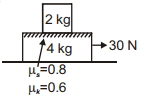
- 8Figure shows two block system, $4 \,kg$ block rests on a smooth horizontal surface, upper surface of $4 \,kg$ is rough. A block of mass $2 \,kg$ is placed on its upper surface. The acceleration of upper block with respect to earth when $4 \,kg$ mass is pulled by a force of $30 \,N$, is ......... $m / s ^2$View Solution
- 9A car is moving on a horizontal curved road with radius $50\,m$. The approximate maximum speed of car will be $............\,ms^{-1}$, if friction between tyres and road is $0.34.\left[\right.$ Take $\left.g =10 ms ^{-2}\right]$View Solution
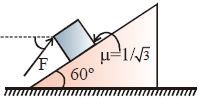
- 10The minimum value of $‘F’$ so that block is in equilibrium isView Solution