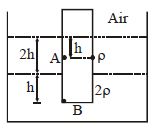
A cylinder stands vertical in two immiscible liquids of densities $\rho$ and $2 \rho$. The height of two liquids are shown. Find the difference in pressure at point $A$ and $B$
Medium


Download our appand get started for free
Experience the future of education. Simply download our apps or reach out to us for more information. Let's shape the future of learning together!No signup needed.*
Similar Questions
- 1View SolutionGauge pressure ........
- 2A train with cross-sectional area $S _{ t }$ is moving with speed $v_t$ inside a long tunnel of cross-sectional area $S _0\left( S _0=4 S _{ t }\right)$. Assume that almost all the air (density $\rho$ ) in front of the train flows back between its sides and the walls of the tunnel. Also, the air flow with respect to the train is steady and laminar. Take the ambient pressure and that inside the train to be $p _0$. If the pressure in the region between the sides of the train and the tunnel walls is $p$, then $p _0- p =\frac{7}{2 N } \rho v_{ t }^2$. The value of $N$ is. . . . .View Solution
- 3Radius of an air bubble at the bottom of the lake is $r$ and it becomes $ 2r $ when the air bubbles rises to the top surface of the lake. If $P $ $cm$ of water be the atmospheric pressure, then the depth of the lake isView Solution
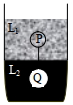
- 4Two spheres $P$ and $Q$ of equal radii have densities $\rho_1$ and $\rho_2$, respectively. The spheres are connected by a massless string and placed in liquids $L_1$ and $L_2$ of densities $\sigma_1$ and $\sigma_2$ and viscosities $\eta_1$ and $\eta_2$, respectively. They float in equilibrium with the sphere $P$ in $L_1$ and sphere $Q$ in $L _2$ and the string being taut (see figure). If sphere $P$ alone in $L _2$ has terminal velocity $\overrightarrow{ V }_{ P }$ and $Q$ alone in $L _1$ has terminal velocity $\overrightarrow{ V }_{ Q }$, thenView Solution
$(A)$ $\frac{\left|\overrightarrow{ V }_{ P }\right|}{\left|\overrightarrow{ V }_{ Q }\right|}=\frac{\eta_1}{\eta_2}$ $(B)$ $\frac{\left|\overrightarrow{ V }_{ P }\right|}{\left|\overrightarrow{ V }_{ Q }\right|}=\frac{\eta_2}{\eta_1}$
$(C)$ $\overrightarrow{ V }_{ P } \cdot \overrightarrow{ V }_{ Q } > 0$ $(D)$ $\overrightarrow{ V }_{ P } \cdot \overrightarrow{ V }_{ Q } < 0$
- 5A thin uniform tube is bent into a circle of radius $r$ in the virtical plane. Equal volumes of two immiscible liquids, whose densities are ${\rho _1}$ and ${\rho _2}\left( {{\rho _1} > {\rho _2}} \right)$ fill half the circle. The angle $\theta$ between the radius vector passing through the common interface and the vertical isView Solution
- 6A wide vessel with a small hole at the bottom is filled with two liquids. The density and heightof one liquid are $\rho_1$ and $h_1$ and that of the otherare $\rho_2$ and $h_2 \ (\rho_1 >\rho_2)$. The velocity of liquid coming out of the hole is :View Solution
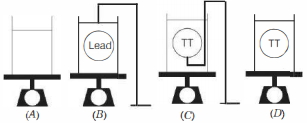
- 7Four identical beakers contain same amount of water as shown below. Beaker $A$ contains only water. A lead ball is held submerged in the beaker $B$ by string from above. A same sized plastic ball, say a table tennis $(TT)$ ball, is held submerged in beaker $C$ by a string attached to a stand from outside. Beaker $D$ contains same sized $TT$ ball which is held submerged from a string attached to the bottom of the beaker. These beakers (without stand) are placed on weighing pans and register readings $w_{A}, w_{B}, w_{C}$ and $w_{D}$ for $A, B, C$ and $D$, respectively. Effects of the mass and volume of the stand and string are to be neglected.View Solution
- 8The approximate depth of an ocean is $2700\,\, m.$ The compressibility of water is $45.4 \times 10^{-11} Pa^{-1}$ and density of water is $10^3 \,kg/m^3 $. What fractional compression of water will be obtained at the bottom of the ocean?View Solution
- 9Consider a solid sphere of radius $\mathrm{R}$ and mass density $\rho(\mathrm{r})=\rho_{0}\left(1-\frac{\mathrm{r}^{2}}{\mathrm{R}^{2}}\right), 0<\mathrm{r} \leq \mathrm{R} .$ The minimum density of a liquid in which it will float isView Solution
- 10An object falling through a fluid is observed to have acceleration given by $a = g -bv$ where $g =$ gravitational acceleration and $b$ is constant. After a long time of release, it is observed to fall with constant speed. The value of constant speed isView Solution