MCQ
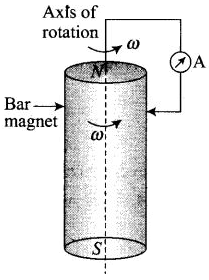
A cylindrical bar magnet is rotated about its axis $($Fig$)$. A wire is connected from the axis and is made to touch the cylindrical surface through a contact. Then,
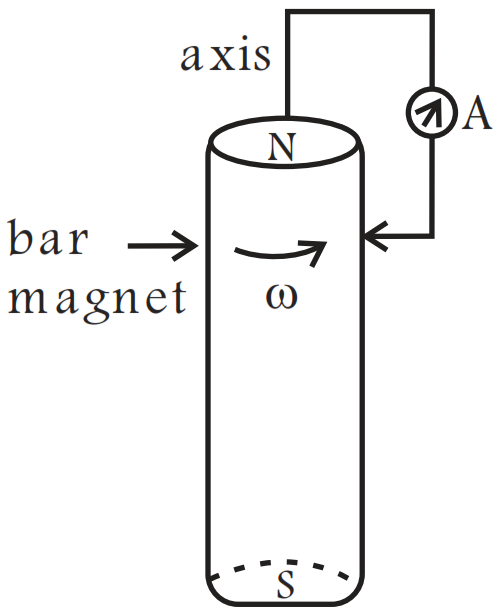
  • A direct current flows in the ammeter $A.$
  • B
    No current flows through the ammeter $A$.
  • C
    An alternating sinusoidal current flows through the ammeter A with a time period $\text{T}=\frac{2\pi}{\omega}$.
  • D
    A time varying non-sinosoidal current flows through the ammeter $A.$
Answer

Correct option: A.
A direct current flows in the ammeter $A.$

Key concept: The phenomenon of electromagnetic induction is used in this problem. Whenever the number of magnetic lines of force $($magnetic flux$)$ passing through a circuit changes $($or a moving conductor cuts the magnetic flux$)$ an emf is produced in the circuit $($or emf induces across the ends of the conductor$)$ is called induced emf. The induced emf persists only as long as there is a change or cutting of flux.
When cylindrical bar magnet is rotated about its axis, no change in flux linked with the circuit takes place, consequently no emf induces and hence, no current flows through the ammeter A.
Hence the ammeter shows no deflection.

Need a full question paper?

Generate a complete, print-ready paper with questions like this in minutes — across 16+ boards, with answer keys.

Start Generating Free

Similar questions

The number of turns in the coil of an ac­ generator is 5000 and the area of the coil is $0.25 \mathrm{~m}^2$. The coil is rotated at the rate of 100 cycles/sec in a magnetic field of $0.2 \mathrm{~W} / \mathrm{m}^2$. The peak value of the emf generated is nearly
You are given many resistances, capacitors and inductors. These are connected to a variable $DC$ voltage source (the first two circuits) or an $\mathrm{AC}$ voltage source of $50 \mathrm{~Hz}$ frequency (the next three circuits) in different ways as shown in Column $II$. When a current $I$ (steady state for $DC$ or rms for $AC$) flows through the circuit, the corresponding voltage $\mathrm{V}_1$ and $\mathrm{V}_2$. (indicated in circuits) are related as shown in Column $\mathrm{I}$. Match the two

$Image$

Which of the following shown particle nature of light
To measure which of the following, is a tangent galvanometer used
The ratio of the largest to shortest wavelengths in Lyman series of hydrogen spectra is
A resistor $R_1$ dissipates the power P when connected to a certain generator. If the resistor $R_2$ is put in series with $R_1$, the power dissipated by $R_1$
Assertion : The lightening conductor at the top of high building has sharp pointed ends.
Reason : The surface density of charge at sharp points is very high resulting in setting up of electric wind.
Lateral displacement of the emergent ray of light increases with:
Energy stored in electromagnetic oscillations is in the form of
$..........$ happens when a wave passes from one medium to another at an angle.