MCQ
A cylindrical jar of cross-sectional area $0.01 m^2$ is filled with water to a height of 50 cm . It carries a tight-fitting piston of negligible mass. What is the pressure at the bottom of the jar when the mass of 1 kg is placed on the piston? Take $g =10 ms^{-2}$.
  • A
    6000 Pa
  • B
    4000 Pa
  • C
    2000 Pa
  • D
    5000 Pa

Need a full question paper?

Generate a complete, print-ready paper with questions like this in minutes — across 16+ boards, with answer keys.

Start Generating Free

Similar questions

Two wires $A$ and $B$ of the same material have radii in the ratio $2 : 1$ and lengths in the ratio $4 : 1$. The ratio of the normal forces required to produce the same change in the lengths of these two wires is:
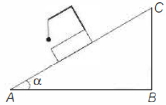
A simple pendulum is attached to a block which slides without friction down an inclined plane $A B C$ having an angle of inclination $\alpha$ as shown below. While the block is sliding down the pendulum oscillates in such a way that at its mean position the direction of the string is
If the momentum of a body is increased by $100\%$, then the percentage increase in the kinetic energy is ............ $\%$
Find the gravitational field at a distance of $2000\, km$ from centre of earth. (in $m / s ^{2}$)

(Given $\left.R_{\text {earth }}=6400 km , r =2000 km , M _{\text {earth }}=6 \times 10^{24} kg \right)$

Given below are two statements :

Statements $I$ : Astronomical unit $(Au)$. Parsec $(Pc)$ and Light year $(ly)$ are units for measuring astronomical distances.

Statements $II:$ $Au < Parsec ( Pc ) < ly$

In the light of the above statements. choose the most appropriate answer from the options given below:

The volume of a gas is reduced adiabatically to $\frac{1}{4}$ of its volume at $27°C$, if the value of $\gamma = 1.4,$ then the new temperature will be
A bag (mass $M$) hangs by a long thread and a bullet (mass $m$) comes horizontally with velocity $v$ and gets caught in the bag. Then for the combined (bag $+$ bullet) system
Young's modulus of elasticity $Y$ is expressed in terms of three derived quantities, namely, the gravitational constant $G$, Planck's constant $h$ and the speed of light $c$, as $Y=c^\alpha h^\beta G^\gamma$. Which of the following is the correct option?
A particle moves in the $xy-$plane under the action of a force $F$ such that the components of its linear momentum $p$ at any time $t$ are ${p_x} = 2\cos t$, ${p_y} = 2\sin t$. The angle between $F$ and $p$ at time $t$ is  ........... $^o$
A student of mass $M$ is $1.5 \,m$ tall and has her centre of mass $1 \,m$ above ground when standing straight. She wants to jump up vertically. To do so. she bends her knees so that her centre of mass is lowered by $0.2 \,m$ and then pushes the ground by a constant force F. As a result, she jumps up such that the maximum height of her feet is $0.3 \,m$ above ground. The ratio $F / Mg$ is