Question
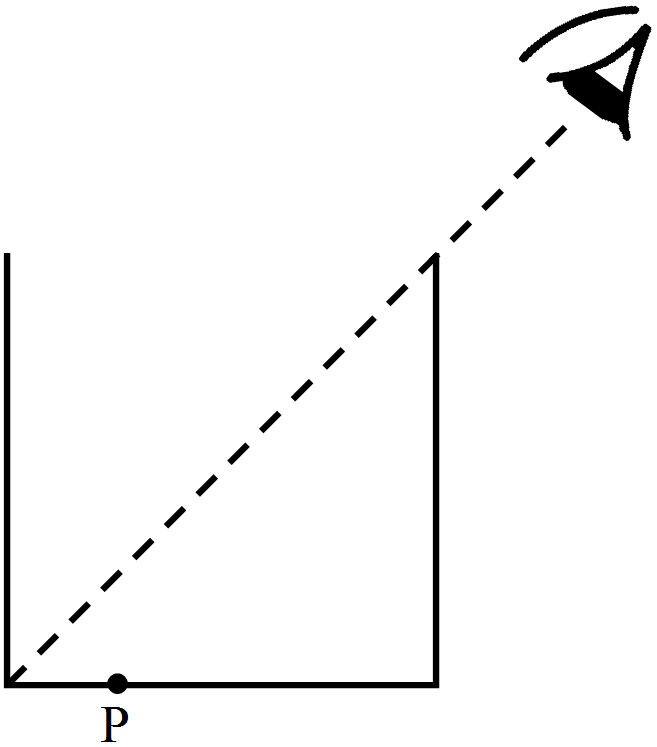
A cylindrical vessel, whose diameter and height both are equal to 30cm, is placed on a horizontal surface and a small particle P is placed in it at a distance of 5.0cm from the centre. An eye is placed at a position such that the edge of the bottom is just visible. The particle P is in the plane of drawing. Up to what minimum height should water be poured in the vessel to make the particle P visible?
Answer


For the given cylindrical vessel, dimetre = 30cm
⇒ r = 15cm and h = 30cm
Now, $\frac{\sin\text{i}}{\sin\text{r}}=\frac{3}{4}\Big[\mu_{\text{w}}=1.33=\frac{4}{3}\Big]$
$\Rightarrow\sin\text{i}=\frac{3}{4\sqrt{2}} \ \big[\because \text{r}=45^{\circ}\big]$
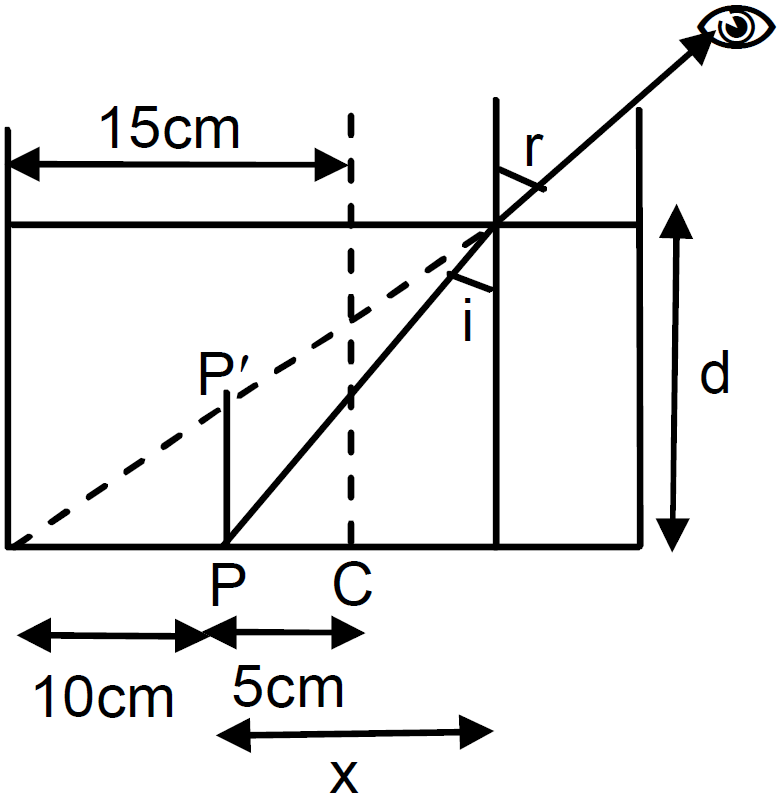
The point P will be visible when the refracted ray makes angle 45° at point of refraction.
Let x = distance of point P from X.
Now, $\tan45^{\circ}=\frac{\text{x}+10}{\text{d}}$
$\Rightarrow\text{d}=\text{x}+10 \ ...(1)$
Again, $\tan\text{i}=\frac{\text{x}}{\text{d}}$
$\Rightarrow\frac{3}{\sqrt{23}}=\frac{\text{d}-10}{\text{d}} \ \Big[\text{Since,} \ \sin\text{i}=\frac{3}{4\sqrt{2}}\Rightarrow\tan\text{i}=\frac{3}{4\sqrt{2}}\Big]$
$\Rightarrow\frac{3}{\sqrt{23}}-1=-\frac{10}{\text{d}}\Rightarrow\text{d}=\frac{\sqrt{23}\times10}{\sqrt{23}-3}=26.7\text{cm}$

Need a full question paper?

Generate a complete, print-ready paper with questions like this in minutes — across 16+ boards, with answer keys.

Start Generating Free

Similar questions

A copper wire having resistance 0.01 ohm in each metre is used to wind a 400-turn solenoid of radius 1.0cm and length 20cm. Find the emf of a battery which when connected the solenoid will eauee a magnetic field of 1.0 × 10⁻²T near the centre of the solenoid.
What is the speed of a photon with respect to another photon if:
  1. The two photons are going in the same direction and.
  2. They are going in opposite directions?
In an experiment on photoelectric effect, the stopping potential is measured for monochromatic light beams corresponding to different wavelengths. The data collected are 11s follows:

wavelength (nm) 350 400 450 500 550
stopping potential(V): 1.45 1.00 0.66 0.38 0.16

Plot the stopping potential against inverse of wavelength $\big(\frac{1}{\lambda}\big) $ on a graph paper and find

  1. The Planck constant,
  2. The work function of the emitter and.
  3. The threshold wavelength.
The voltmeter shown in the figure. reads 18V across the $50\Omega$ resistor. Find the resistance of the voltmeter.

A bar magnet of magnetic moment m and moment of inertia I (about centre, perpendicular to length) is cut into two equal pieces, perpendicular to length. Let T be the period of oscillations of the original magnet about an axis through the mid point, perpendicular to length, in a magnetic field B. What would be the similar period T' for each piece?
A 4.5 cm needle is placed 12 cm away from a convex mirror of focal length 15 cm. Give the location of the image and the magnification. Describe what happens as the needle is moved farther from the mirror.
An adiabatic cylindrical tube of cross-sectional area 1cm2 is closed at one end and fitted with a piston at the other end. The tube contains 0.03g of an ideal gas. At 1atm pressure and at the temperature of the surrounding, the length of the gas column is 40cm. The piston is suddenly pulled out to double the length of the column. The pressure of the gas falls to 0.355atm. Find the speed of sound in the gas at atmospheric temperature.
Let there be n resistors R1............Rn with Rmax = max (R1......... Rn) and Rmin = min {R1 ..... Rn}. Show that when they are connected in parallel, the resultant resistance RP < Rmin and when they are connected in series, the resultant resistance RS > Rmax. Interpret the result physically.
In semiconductors, thermal collisions are responsible for taking a valence electron to the conduction band. Why does the number of conduction electrons not go on increasing with time as thermal collisions conμnuously take place?
A capacitor having a capacitance of $100\mu\text{F}$ is charged to a potential difference of 50V.
  1. What is the magnitude of the charge on each plate?
  2. The charging battery is disconnected and a dielectric of dielectric constant 2.5 is inserted. Calculate the new potential difference between the plates.
  3. What charge would have produced this potential difference in absence of the dielectric slab.
  4. Find the charge induced at a surface of the dielectric slab.