Question
(a) Define conduction current. Explain the necessity of displacement current and derive to formula for it.
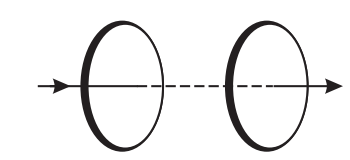
(b) In adjoining figure a capacitor is shown which is made by placing two circular plates (each of 12 cm radius) at a distance 5.0 cm apart.
Image
The capacitor is being charged by an external source which is not shown in the figure. The charging current is 0.15 A. Calculate:
(i) capacitance of the capacitor and rate of change of potential difference between its plates.
(ii) the displacement current between the plates.
(iii) Is the Kirchhoff's first law related to electric current obeyed on each plate.
Answer

(a) Conduction current : The actual electric current flowing through connecting wires of electrical circuit is called conduction current.
Necessity of displacement current : The concept of displacement current arised due to following points:
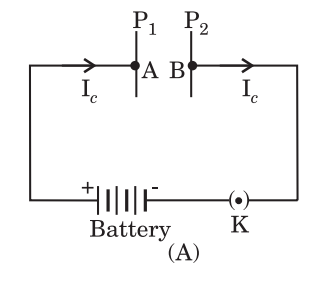
(1) Apparent Violation of Kirchhoff's First Law i.e., Law of Junction : In Fig. (A) a circuit containing a capacitor, a battery and a key is shown which is set for charging the capacitor. When the key is closed a conduction current $l _c$ flows through the connecting wires and the capacitor beings to be charged.
Image
The current decreases as the charge on the capacitor grows. When the capacitor is fully charged to the voltage equal to that of the battery, the current vanishes. There is no current between the plates $P _1$ and $P _2$ of the capacitor during charging. Therefore if Kirchhoff's first law is applied on the junction points A and B of the plates separately then its violation is seen because a current $I _c$ is observed going towards A but no current is observed going away from it and similarly no current is seen going towards B but a current $I _c$ is going away from it. But Kirchhoff's first law is in accordance with the law of conservation of charge which is always true. Therefore, necessarily there is some current between the plates of the capacitor which is going away from A towards B but it is not being seen. This current is the displacement current whose concept was given by Maxwell.
(2) Violation of Ampere's Circuital Law : A magnetic field is produced around a current carrying conductor. Ampere's circuital law gives the qualitative relationship between the current and the magnetic field. According to this law the line integral of the magnetic field $\overrightarrow{ B }$ around any closed loop is $\mu_0$ times the net current I the treading through the area enclosed by the loop.
i.e. $\quad \int \vec{B} \cdot \overrightarrow{d l}=\mu_0 I$
When this law was applied by Maxwell on the conduction current during the charging of a capacitor the violation of this law was seen as explained below :
Image
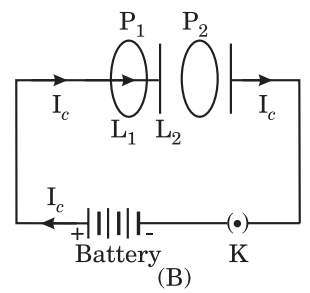
In Fig. (B) a set up for charging a capacitor is shown in which $I_2$ is the conduction current through the connecting wires, which is varying with time. There will be magnetic field around this current. During charging of the capacitor there is no conduction current between the plates $P _1$ and $P _2$ of the capacitor.
Let us now consider a plane circular look $L _1$ just before the plate $P _1$ and another closed loop $L _2$ parallel to $L _1$ and lying between the plates of the capacitor. Current threading through the area enclosed by the loop $L _1$ is the conduction current $I _c$ and no current is threading through the area of loop $L _2$ because there is no conduction current between the plates of the capacitor. Now, on applying Ampere's circuital law for these loops, we have.
$\text { For loop } L_1: \int_{L_1} \overrightarrow{B} \cdot \overrightarrow{d l}=\mu_0 I_c $ ...(1)
$\text { For loop } L_2: \int_{L_2} \overrightarrow{B} \cdot \overrightarrow{d l}=\mu_0 \times 0=0$ ...(2)
If loops $L_1$ and $L_2$ are very close to each other then it is expected that
$\int_{L_1} \overrightarrow{B} \cdot \overrightarrow{dl}=\int_{L_2} \overrightarrow{B} \cdot \overrightarrow{dl}$
But it is obvious from equations (1) and (2) that $\int_{ L _1} \overrightarrow{B} \cdot \overrightarrow{d l} \neq \int_{ L _2} \overrightarrow{B} \cdot \overrightarrow{d l}$. Hence there is violation of Ampere's circuital law during charging of a capacitor. Therefore, in order to give the correct form to Ampere's circuital law. Maxwell gave the concept of displacement current.
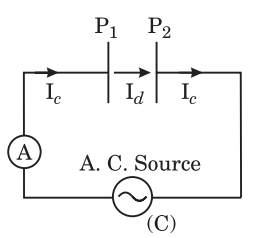
(3) Flow of Alternating Current through the Capacitor : In Fig. (C) a parallel plate capacitor connected to an a.c. source through a hot wire ammeter is shown where there is air in between the plates of the capacitor. The a.c. ammeter shows a deflection showing the flow of current through the circuit. But the circuit seems to be broken between the plates of the capacitor due to air gap between them.
Image
Now the question arises whether any current can flow through a broken circuit? In order to understand this, Maxwell introduced to concept of displacement current (Id) to flow between the plates of the capacitor through air.
Such a current is produced due to changing electric field between the plates of the parallel plate capacitor during its charging or due to the applied a.c. source its plates.
Expression for displacement current : During the charging process of a parallel plate capacitor the electric charge on the plates is time varying. Let at any instant 't' the electric charge on the plates of the capacitor be q and let the intensity of electric field between the plate be E. is given by the following formula :
$E =\frac{q}{\varepsilon_0 A}$,
where A = area of each of the plates of the capacitor.
Since $q$ is time varying i.e., it is the function or 't', therefore the time rate of change of electric field between the plates is given by :
$\frac{d E }{d t}=\frac{d}{d t}\left[\frac{q}{\varepsilon_0 A}\right]=\frac{1}{\varepsilon_0 A}\left(\frac{d q}{d t}\right)$
$\frac{d q}{d t}=\varepsilon_0 A\left(\frac{d E }{d t}\right)$
Because the time rate of change of electric charge is called electric current and $\left[\varepsilon_0 A \cdot \frac{d E }{d t}\right]$has the dimension of current, the quantity $\varepsilon_0 A\left(\frac{d E }{d t}\right)$ is called displacement current is denoted by Id.
Displacement Current
$I _d=\varepsilon_0 A \left(\frac{ d E }{ d t }\right)$ ...(1)
This expression for Id can be expressed as follows also :
$I _d=\varepsilon_0 A\left(\frac{d E }{d t}\right) \Rightarrow I _d=\varepsilon_0 \frac{d}{d t}( E . A )$
But E.A. = Electric flux through the plates of the capacitor $=\Phi_{ E }$
Displacement Current
$I _d=\varepsilon_0\left(\frac{ d \Phi_{ E }}{ d t }\right)$ ...(2)
Thus displacement current is a current in a region where change of electric flux takes place due to change in electric flux intensity. It is produced by the displace-ment and distance of electrons caused by changing electric field, hence the name displacement current. In magnitude it is equal to conduction current.
(b) Given: Radius of the circular plate r = 12 cm = 0.12 m and distance between the plates d = 5 cm = 0.05 m and conduction current Ic = 0.15 A.
(i) Capcitance of the Capacitor :
$C =\frac{\varepsilon_0 A}{d}=\frac{\varepsilon_0\left(\pi r^2\right)}{d}$
$=\left[\frac{\left(8.85 \times 10^{-12}\right)(3.14)(0.12)}{0.05}\right] F$
$=8.0 \times 10^{-12} F=8.0 pF$
Charge at any instant on the capacitor :
$Q = CV = V = Q / C$
∴ Rate of change of potential difference between the plates:
$\frac{d V}{d t}=\frac{d}{d t}\left(\frac{ Q }{ C }\right)=\frac{1}{ C }\left(\frac{d Q }{d t}\right) ;$ But $\frac{d Q }{d t}=$ Conduction
current $I _c$
i.e., charging current = 0.15 Ampere
$\therefore \frac{d V}{d t}=\frac{1}{ C } \times I _c=\left(\frac{1}{8.0 \times 10^{-12}}\right)(0.15) \frac{ V }{ s }$
$=1.87 \times 10^{-10}$ volt second $^{-1}$
(ii) Displacement Current = Conduction Current = 0.15 A.
(iii) Yes Kirchhoff's first law is obeyed at each of the plates because electric current coming towards each plate to equal to the current going away from the plate since conduction current $I _c=$ displacement current $I _d$, i.e., in fig. (C) at $P _1$ we have $I _d= I _c$ and at $P _2$ we have $I _c=$ $I _d$.

Need a full question paper?

Generate a complete, print-ready paper with questions like this in minutes — across 16+ boards, with answer keys.

Start Generating Free

Similar questions

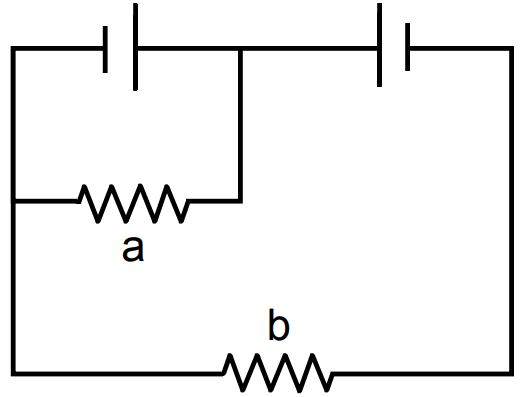
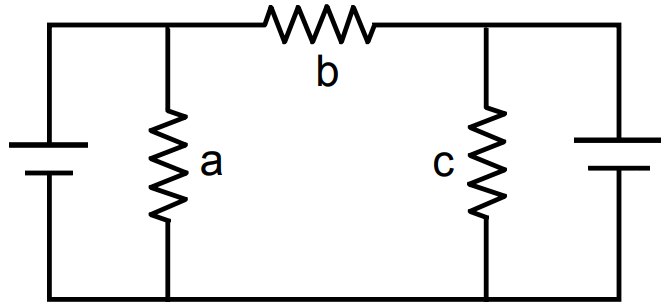
Each of the resistors shown in figure. has a resistance of $10\Omega$ and each of the batteries has an emf of 10V. Find the currents through the resistors a and b in the two circuits.

Find the wavelength of the radiation emitted by hydrogen in the transitions $(a) n = 3$ to $n= 2, (b) n = 5$ to $n = 4$ and $(c) n = 10$ to $n = 9.$
Two heaters are marked 200V, 300W and 200V, 600W. If the heaters are connected in series and the combination connected to a 200V dc supply, which heater will produce more heat?
What is meant by power of lens? Explain this.
Answer the following Questions.
  1. Find expressions for the force and torque on an electric dipole kept in a uniform electric field.
OR
An electric dipole is held in a uniform electric field. (i) Using suitable diagram show that it does not undergo any translatory motion, and (ii) derive an expression for torque acting on it and specify its direction.
  1. Derive an expression for the work done in rotating a dipole from the angle $\theta_0$ to $\theta_1$ in a uniform electric field E.
​​​​​​​OR
  1. Define torque acting on a dipole of dipole moment $\vec{\text{p}}$ placed in a uniform electric field $\vec{\text{E}}.$ Express it in the vector form and point out the direction along which it acts.
  2. What happens if the field is non-uniform?
  3. What would happen if the external field $\vec{\text{E}}$ is increasing (i) parallel to $\vec{\text{p}}$ and (ii) anti-parallel to $\vec{\text{p}}?$
In beta decay, an electron (or a positron) is emitted by a nucleus. Does the remaining atom get oppositely charged?
The frequency of vibration of a string depends on the length L between the nodes, the tension F in the string and its mass per unit length m. Guess the expression for its frequency from dimensional analysis.
  1. Derive the mathematical relation between refractive indices $n_1$ and $n_{2}$ of two radii and radius of curvature $R$ for refraction at a convex spherical surface. Consider the object to be a point since lying on the principle axis in rarer medium of refractive index $n_{1}$ and a real image formed in the denser medium of refractive index $n_{2.}$ Hence, derive lens maker's formula.
  2. Light from a point source in air falls on a convex spherical glass surface of refractive index $1.5$ and radius of curvature $20 \ cm$. The distance of light source from the glass surface is $100 \ cm$. At what position is the image formed?
Two identical pith balls are charged by rubbing against each other. They are suspended from a horizontal rod through two strings of length $20\ cm$ each, the separation between the suspension points being $5\ cm$. In equilibrium, the separation between the balls is $ 3\ cm$. Find the mass of each ball and the tension in the strings. The charge on each ball has a magnitude $2.0 \times 10^{-8}C.$
You have learned in the text how Huygens’ principle leads to the laws of reflection and refraction. Use the same principle to deduce directly that a point object placed in front of a plane mirror produces a virtual image whose distance from the mirror is equal to the object distance from the mirror.