MCQ
A circular disc $X$ of radius $R$ is made from an iron plate of thickness $t,$ and another plate $y$ of radius $4R$ is made from an iron plate of thickness $\frac {t}{4}$. The ratio of moment of inertia $\frac {I_y}{I_x}$ is
  • A
    $32$
  • B
    $16$
  • C
    $1$
  • $64$

Answer

Correct option: D.
$64$
d
$\mathrm{I} \propto \mathrm{m} \mathrm{r}^{2} \propto \mathrm \rho\left(\pi \mathrm{r}^{2}\right) \mathrm{tr}^{2}$

$\mathrm{I}=\rho \pi \mathrm{r}^{4} \mathrm{t} \quad$ so $\frac{\mathrm{I}_{1}}{\mathrm{I}_{2}}=\frac{\mathrm{r}_{1}^{4} \mathrm{t}_{1}}{\mathrm{r}_{2}^{4} \mathrm{t}_{2}}$

Need a full question paper?

Generate a complete, print-ready paper with questions like this in minutes — across 16+ boards, with answer keys.

Start Generating Free

Similar questions

The specific heat of isothermal process is
An ideal heat engine exhausting heat at $27^\circ C$ is to have $25\%$ efficiency. It must take heat at:
To make the frequency double of a spring oscillator, we have to
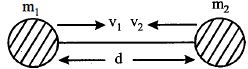
Two hypothetical planets of masses $m_1$ and $m_2$ are at rest when they are infinite distance apart. Because of the gravitational force they move towards each other along the line joining their centres . What is their speed when their separation is $'d'$ ? (Speed of $m_1$ is $v_1$ and that of $m_2$ is $v_2$ )
Two lithium nuclei in a lithium vapour at room temperature do not combine to form a carbon nucleus because:
The bob of a pendulum is released from a horizontal position. If the length of the pendulum is $1.\;5 m$, what is the speed (in $m/s$) with which the bob arrives at the lowermost point, given that it dissipated $5\%$ of its initial energy against air resistance ?
particle is moving in a circular path. The acceleration and momentum of the particle at a certain moment are $\vec a\, = \,(4\hat i + 3\hat j)\,\,m/{s^2}$ and $\vec P\, = \,(8\hat i\, - \,6\hat j)\,kg\, - \,m/s$ . The motion of the particle is
$m x^{2}-b x+k=0$

Find time after which to the energy will become half of initial maximum value in damped force oscillation.

The radius of the earth is $6400\, km$ and $g = 10\,m/{\sec ^2}$. In order that a body of $5 \,kg$ weighs zero at the equator, the angular speed of the earth is
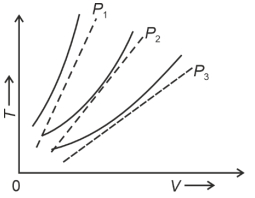
The following graph represents the $T-V$ curves of an ideal gas (where $T$ is the temperature and $V$ the volume) at three pressures $P_1, P_2$ and $P_3$ compared with those of Charles's law represented as dotted lines.

Then the correct relation is: