Question
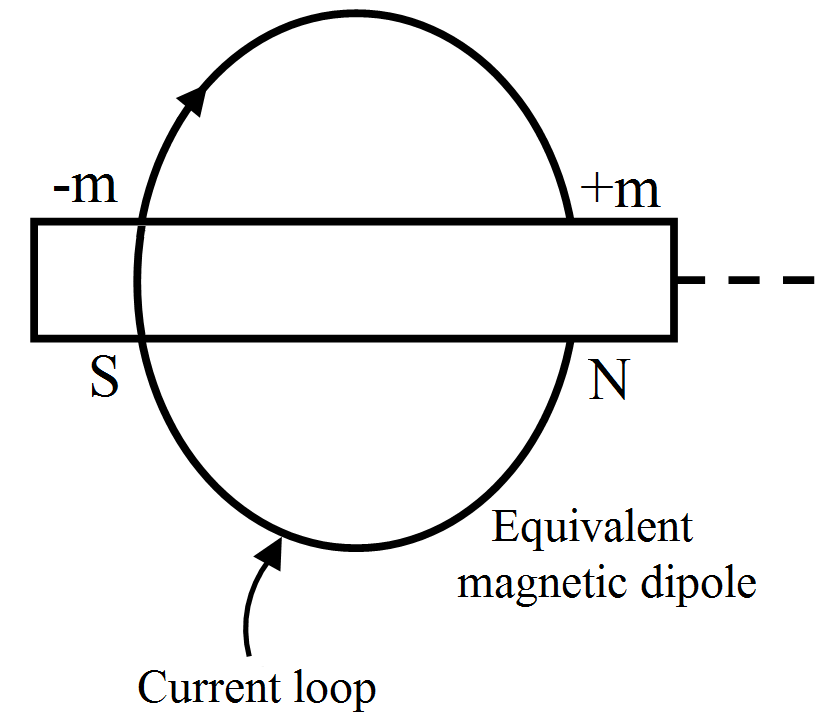
A circular loop carrying a current is replaced by ann equivalent magnetic dipole. A point on the axis of the loop is in:
  1. End-on position.
  2. Broadside-on position.
  3. Both.
  4. None.

Answer

  1. End-on position.
Explanation:

Points lying on the axis of a magnet are called end-on points. In our case, the point on the axis of the loop (on replacing the circular loop with an equivalent magnetic dipole) lies on the axis of the magnetic dipole or on the end-on position.
If P was the point on the axis of the loop, then it is clear from the figure that P lies on the end-on position of the equivalent magnetic dipole.

Need a full question paper?

Generate a complete, print-ready paper with questions like this in minutes — across 16+ boards, with answer keys.
Start Generating Free

Similar questions

The dimensional formula of intensity of electric field is :
Displacement current goes through the gap between the plates of a capacitor when the charge of the capacitor:
  1. Increases.
  2. Decreases.
  3. Does not change.
  4. Is zero.
Particle like behavior of light arises from the fact that each quanta of light has definite ...X... and a fixed value of ...Y.. just like a particle, Here, X and Y refer to?
Three $\alpha -$ particles and one $\beta -$ particle decaying takes place in series from an isotope $88^{\mathrm{Ra}^{288}}$.Finally the isotope obtained will be
Which one of the following properties of an element is not variable?
To compare magnetic moments of two magnets by vibration magnetometer, 'sum and difference method' is better because(a) Determination of moment of inertia is not needed which minimises the errors(b) Less observations are required(c) Comparatively less calculations(d) All the above


A conducting square loop of side l and resistance R moves in its plane with a uniform velocity u perpendicular to one of its sides. A uniform and constant magnetic field B exists along the perpendicular to the plane of the loop as shown in figure. The current induced in the loop is:
The resistance of 10 metre long potentiometer wire is 1ohm/meter. A cell of e.m.f. 2.2 volts and a high resistance box are connected in series to this wire. The value of resistance taken from resistance box for getting potential gradient of 2.2 millivolt/metre will be(a) 790 Ω(b) 810 Ω(c) 990 Ω(d) 1000 Ω
       
A moving charge produces:
The electric potential $V$ at any point $O ( x , y , z$ all in metres$)$ in space is given by $V =4 x ^2$ volt . The electric field at the point $(1 m, 0,2 m)$ in volt$/$metre is