Question
a. Derive an expression for the energy stored in a parallel plate capacitor of capacitance C when charged up to voltage V. How is this energy stored in the capacitor?
b. A capacitor of capacitance $1 \mu F$ is charged by connecting a battery of negligible internal resistance and emf 10 V across it. Calculate the amount of charge supplied by the battery in charging the capacitor fully.
Answer

a. Work done in adding a charge $dq = dW$
$\begin{array}{l}= Vdq \\ =\frac{q}{c} d q\end{array}$
$\therefore$ Total Amount of work(W) in charging a capacitor
$\begin{array}{l} W =\int d W=\frac{1}{C} \int_0^Q q d q \\ W=\frac{Q^2}{2 C} \\ =\frac{(C V)^2}{2 C}=\frac{1}{2} C V^2\end{array}$
The electrostatic Energy/ potential energy is stored in the electric field between the plates.
b. $C =1 \mu F=1 \times 10^{-6} F ; V =10$ volt
$\begin{array}{l}Q=C V \\ =1 \times 10^{-6} \times 10 \\ =10^{-5} \text { coulomb }\end{array}$
hence, the amount of charge supplied by the battery in charging the capacitor fully is $10^{-5}$ coulomb.

Need a full question paper?

Generate a complete, print-ready paper with questions like this in minutes — across 16+ boards, with answer keys.

Start Generating Free

Similar questions

Consider the situation of the previous problem. A charges of -2.0 × 10-4C is moved from the point A to the point B. Find the change in electrical potential energy UB - UA for the cases (a), (b) and (c).
Draw a schematic sketch of a cyclotron. Explain briefly how it works and how it is used to accelerate the charged particles.
  1. Show that time period of ions in a cyclotron is independent of both the speed and radius of circular path.
  2. What is resonance condition? How is it used to accelerate the charged particles?
Explain the shortcomings of Rutherford's Atomic Model.###Write two shortcomings of Rutherford's Atomic Model.
An electron makes 3 × 10⁵ revolutions per second in a circle of radius 0.5 angstrom. Find the magnetic field B at the centre of the circle.
What is electric dipole? Find and expression for electric potential at any point due to an electric dipole.
The plates of a capacitor are 2.00cm apart. An electronproton pair is released somewhere in the gap between the plates and it is found that the proton reaches the negative plate at the same time as the electron reaches the positive plate. At what distance from the negative plate was the pair released?
A block of mass 2.0kg is pushed down an inclined plane of inclination 37° with a force of 20N acting parallel to the incline. It is found that the block moves on the incline with an acceleration of 10m/s2. If the block started from rest, find the work done.
  1. By the applied force in the first second.
  2. By the weight of the block in the first second.
  3. By the frictional force acting on the block in the first second. Take g = 10m/s2.
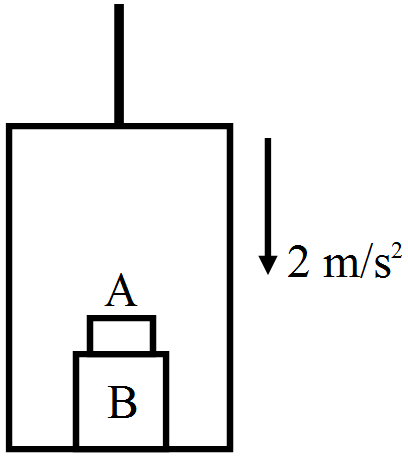
The elevator shown in figure is descending with an acceleration of 2m/s2. The mass of the block A is 0.5kg. What force is exerted by the block A on the block B?

Consider the fission of $^{238}_{92}\text{U}$ by fast neutrons. In one fission event, no neutrons are emitted and the final end products, after the beta decay of the primary fragments, are $^{140}_{58}\text{Ce}$ and $^{99}_{44}\text{Ru}.$ Calculate Q for this fission process.
The relevant atomic and particle masses are:
$\text{m}(^{238}_{92}\text{U})=238.05079\text{ u}$
$\text{m}(^{140}_{58}\text{Ce})=139.90543\text{ u}$
$\text{m}(^{99}_{44}\text{Ru})=98.90594\text{ u}$
A thin prism of angle $6.0^\circ,\omega=0.07$ and $\mu_\text{y}=1.50$ is combined with another thin prism having $\omega=0.08$ and $\mu_\text{y}=1.60.$ The combination produces no deviation in the mean ray.
  1. Find the angle of the second prism.
  2. Find the net angular dispersion produced by the combination when a beam of white light passes through it.
  3. If the prisms are similarly directed, what will be the deviation in the mean ray
  4. Find the angular dispersion in the situation described in (c).