Question
A device $Y$ is connected across an $AC$ source of emf $e = e_0$ sinωt. The current through $Y$ is given as $i = i_0 \sin(\omega t + \pi /2)$
a) Identify the device $Y$ and write the expression for its reactance.
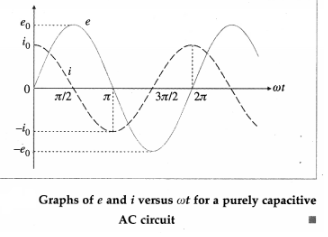
b) Draw graphs showing variation of emf and current with time over one cycle of AC for $Y$.
c) How does the reactance of the device $Y$ vary with the frequency of the $AC$ ? Show graphically
d) Draw the phasor diagram for the device $Y$.
Answer

(a) The device $Y$ is a capacitor. Its reactance is $X_c=\frac{1}{\omega C}$, where $\omega$ is the angular frequency of the applied emf and $C$ is the capacitance of the capacitor.
(b)

Image
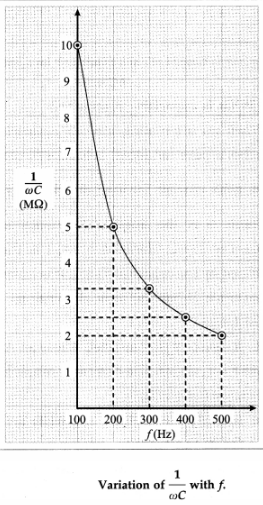
(c) $X_C=\frac{1}{\omega C}=\frac{1}{2 \pi f C}$. Thus $X_C \propto \frac{1}{f}$, where $f$ is the frequency of $A C$. Suppose $C=\left(\frac{1000}{2 \pi}\right)$
$pF$
For $f =100 Hz , X _C=1 \times 10^7 \Omega=10 M \Omega$;
for $f=200 Hz , X_C=5 M \Omega$;
for $f=300 Hz , X _{ C }=\frac{10}{3} M \Omega$;
for $f=400 Hz , X _{ C }=2.5 M \Omega$
for $f=500 Hz , X_C=2 M \Omega$ and so on
$\left(1 M \Omega=10^6 \Omega\right)$.


Image
(d)


Image
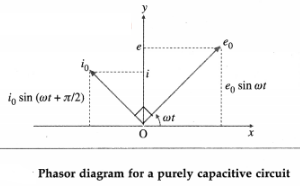
The phasor representing the peak emf $\left(e_0\right)$ makes an angle $(\omega t)$ in an anticlockwise direction with respect to the horizontal axis. As the current leads the voltage by $90^{\circ}$, the phasor representing the peak current ( $i _0$ ) is turned $90^{\circ}$ anticlockwise with respect to the phasor representing emf $e _0$. The projections of these phasors on the vertical axis give instantaneous values of $e$ and i .

Need a full question paper?

Generate a complete, print-ready paper with questions like this in minutes — across 16+ boards, with answer keys.

Start Generating Free

Similar questions

Obtain an expression for the energy density of a magnetic field.
A rigid object is rolling down an inclined plane. Derive expressions for the acceleration along the track and the speed after falling through a certain vertical distance.
A sonometer wire of length $L_1$ is in unison with a tuning fork of frequency $n$. When the vibrating length of the wire is reduced to $L_2$, it produces $x$ beats per second with the fork. Show that $n = x _2 \cdot \frac{L_2}{L_1-L_2}$.
A pendulum consisting of a massless string of length $20\ cm$ and a tiny bob of mass $100\ g$ is set up as a conical pendulum. Its bob now performs $75$ rpm. Calculate kinetic energy and increase in the gravitational potential energy of the bob. $\left(\right.$ Use $\left.\pi^2=10\right)$
A conductor of length $25 cm$ is placed (i) parallel (ii) perpendicular (iii) inclined at an angle $30^{\circ}$, to a uniform magnetic field of induction $2 T$. If $1 C$ of charge passes through it in $5 s$, calculate the force experienced by the conductor in each case.
Two tanks of equal volume contain equal masses of oxygen and nitrogen at $127^{\circ} \mathrm{C}$. Find the ratio of
(i) the number of molecules of the gases
(ii) the pressure exerted by the gases in the two tanks. [Molar mass of oxygen $=32 \mathrm{~g} / \mathrm{mol}$,
molar mass of nitrogen $=28 \mathrm{~g} / \mathrm{mol}$ ]
A closed pipe and an open pipe sounded together produce $5$ beats/s. If the length of the open pipe is $30 cm$, find by how much should the length of the closed pipe be changed to make the air columns in the two pipes vibrate in unison. [Speed of sound in air $=330 m / s$ ]
Describe the construction of a suspended-type moving-coil galvanometer with a neat labelled diagram.
In a resonance tube experiment, a tuning fork $v$ resonates with an air column $10 cm$ long and again resonates when it is $32.2 cm$ long. Calculate the wavelength of the wave and the end correction.
What is diamagnetism?