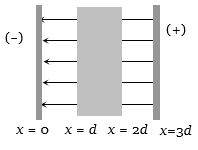
A dielectric slab of thickness $d$ is inserted in a parallel plate capacitor whose negative plate is at $x = 0$ and positive plate is at $x = 3d$. The slab is equidistant from the plates. The capacitor is given some charge. As one goes from $0$ to $3d$
A
The magnitude of the electric field remains the same
B
The direction of the electric field remains the same
C
The electric potential increases continuously
DBoth $(b)$ and $(c)$
IIT 1998, Medium
Download our app for free and get started
DBoth $(b)$ and $(c)$
d (d) Even after introduction of dielectric slab, direction of electric field will be perpendicular to the plates and directed from positive plate to negative plate.
Further, magnitude of electric field in air $ = \frac{\sigma }{{{\varepsilon _0}}}$
Magnitude of electric field in dielectric $ = \frac{\sigma }{{K{\varepsilon _0}}}$
Similarly electric lines always flows from higher to lower potential, therefore, electric potential increases continuously as we move from $x = 0$ to $x = 3d$.
Download our app
and get started for free
Experience the future of education. Simply download our apps or reach out to us for more information. Let's shape the future of learning together!No signup needed.*
Two circuits $(a)$ and $(b)$ have charged capacitors of capacitance $C, 2C$ and $3C$ with open switches. Charges on each of the capacitor are as shown in the figures. On closing the switches
A parallel plate capacitor has $1\,\mu F$ capacitance. One of its two plates is given $+2\,\mu C$ charge and the other plate, $+4\,\mu C$ charge. The potential difference developed across the capacitor is......$V$
A dipole consisting of two charge $\pm q$ separated by a distance $2 a$ is placed with its centre $D$ away from the center of a grounded sphere of radius $R ( D > > a )$. When the dipole moment vector is perpendicular to the line joining the two centres (those of the dipole and sphere) the charge induced on the sphere is
$0.2\,F$ capacitor is charged to $600\,V$ by a battery. On removing the battery, it is connected with another parallel plate condenser of $1\,F$. The potential decreases to.........$volts$
$n$ identical condensers are joined in parallel and are charged to potential $V$. Now they are separated and joined in series. Then the total energy and potential difference of the combination will be
Between the plates of a parallel plate capacitor a dielectric plate is introduced just to fill the space between the plates. The capacitor is charged and later disconnected from the battery. The dielectric plate is slowly drawn out of the capacitor parallel to the plates. The plot of the potential difference across the plates and the length of the dielectric plate drawn out is
A metal ball of radius $R$ is placed concentrically inside a hollow metal sphere of inner radius $2R $ and outer radius $3R$. The ball is given a charge $+2Q$ and the hollow sphere a total charge $- Q$. The electrostatic potential energy of this system is :
Two thin dielectric slabs of dielectric constants $K_1$ and $K_2$ $(K_1 < K_2)$ are inserted between plates of a parallel plate capacitor, as shown in the figure. The variation of electric field $E$ between the plates with distance $d$ as measured from plate $P$ is correctly shown by