Question
A differential equation is said to be in the variable separable form if it is expressible in the form $f(x)\ dx = g(y)\ dy.$
The solution of this equation is given by
$\int\text{f(x)dx}=\int\text{g(y)dy}+\text{c},$ where c is the constant of integration.
Based on the above information, answer the following questions.
  1. If the solution of the differential equation $\frac{\text{dy}}{\text{dx}}=\frac{\text{ax+3}}{\text{2y+f}}$ represents a circle, then the value of $'a'$ is:
  1. $2$
  2. $-2$
  3. $3$
  4. $-4$
  1. The differential equation $\frac{\text{dy}}{\text{dx}}=\frac{\sqrt{1-\text{y}^2}}{\text{y}}$ determines a family of circle with.
  1. Variable radii and fixed centre $(0, 1)$
  2. Variable radii and fixed centre $(0, -1)$
  3. Fixed radius $1$ and variable centre on $x-$axis
  4. Fixed radius $1$ and variable centre on $y-$axis
  1. If $= y'+ 1, y(0) = 1,$ then $y (In\ 2) =$
  1. $1$
  2. $2$
  3. $3$
  4. $4$
  1. The solution of the differential equation $\frac{\text{dy}}{\text{dx}}=\text{e}^\text{x-y}+\text{x}^2\text{e}^\text{-y}$ is:
  1. $\text{e}^\text{x}=\frac{\text{y}^3}{3}+\text{e}^\text{y}+\text{c}$
  2. $\text{e}^\text{y}=\frac{\text{x}^2}{3}+\text{e}^\text{x}+\text{c}$
  3. $\text{e}^\text{y}=\frac{\text{x}^3}{3}+\text{e}^\text{x}+\text{c}$
  4. None of these
  1. If $\frac{\text{dy}}{\text{dx}}=\text{y}\sin2\text{x},\ \text{y}(0)=1,$ then its solution is:
  1. $\text{y}=\text{e}^{\sin^2}\text{x}$
  2. $\text{y}={\sin^2}\text{x}$
  3. $\text{y}={\cos^2}\text{x}$
  4. $\text{y}=\text{e}^{\cos^2}\text{x}$

Answer

  1. $(b)\ -2$
Solution:
We have, $\frac{\text{dy}}{\text{dx}}=\frac{\text{ax+3}}{\text{2y+f}}$
$\Rightarrow\ \ (\text{ax+3})\text{dx}=(2\text{y}+\text{f})\text{dy}$
$\Rightarrow\text{a}\frac{\text{x}^2}{2}+\text{3x}=\text{y}^2+\text{fy}+\text{c} ($Integrating$)$
$\Rightarrow-\frac{\text{a}}{2}\text{x}^2+\text{y}^2-\text{3x}+\text{fy}+\text{C}=0$
This will represent a circle, if $\frac{-\text{a}}{2}=1\Rightarrow\text{a}=-2$
$[ \therefore$ In circle, coefficient of $x^2 =$ coefficient of $y^2)$
  1. $(c)$ Fixed radius $1$ and variable centre on $x-$axis
Solution:
We have, $\frac{\text{ydy}}{\sqrt{1-\text{y}^2}}=\text{dx}$
On integration, we get $-\sqrt{1-\text{y}^2}=\text{x+c}$
$\Rightarrow 1 - y^2 = (x + c)^{2}​​​​​​​$
$\Rightarrow ^(x + c)^{2 }+ y^{2 }= 1$ which represents a circle with radius $I$ and centre on the $x-$axis.
  1. $(c)\ 3$
Solution:
$\text{y}'=\text{y}+1\Rightarrow\frac{\text{dy}}{\text{y}+1}=\text{dx}$
$\Rightarrow $ In $(y + 1) = x + c ($integrating$)$
Now, $y(0) = 1 \Rightarrow c = In\ 2$
$\therefore \ \text{In}\Bigg(\frac{\text{y}+1}{2}\Bigg)=\text{x}$
$\Rightarrow y + 1 = 2e^x$​​​​​​​
So, $y (In\ 2) = -1 + 2e^{In\ 2} = -1 + 4 = 3$
  1. $(c)\ \text{e}^\text{y}=\frac{\text{x}^3}{3}+\text{e}^\text{x}+\text{c}$
Solution:
From the given differential equation, we have
$\frac{\text{dy}}{\text{dx}}=\frac{\text{e}^\text{x}+\text{x}^\text{2}}{\text{e}^\text{y}}$
$\Rightarrow\ \text{e}^\text{y}\text{dy}=(\text{e}^\text{x}+\text{x}^2)\text{dx}$
Integrating, we get $\text{e}^\text{y}=\text{e}^\text{x}+\frac{\text{x}^3}{3}+\text{c}$
  1. $(a)\ \text{y}=\text{e}^{\sin^2}\text{x}$
Solution:
We have, $\frac{\text{dy}}{\text{dx}}=\text{y}\sin2\text{x}$
$\Rightarrow\ \frac{\text{dy}}{\text{y}}=\sin2\text{x}\ \text{dx}$
$\Rightarrow\ \log\text{y}=-\frac{\cos2\text{x}}{2}+\text{c}$
Since $x = 0, y = 1$
therefore $\text{C}=\frac{1}{2}$
Now, $\log\text{y}=\frac{1}{2}(1-\cos2\text{x})$
$\Rightarrow\ \log\text{y}=\sin^2\text{x}\Rightarrow\text{y}=\text{e}^{\sin^2}\text{x}$

Need a full question paper?

Generate a complete, print-ready paper with questions like this in minutes — across 16+ boards, with answer keys.

Start Generating Free

Similar questions

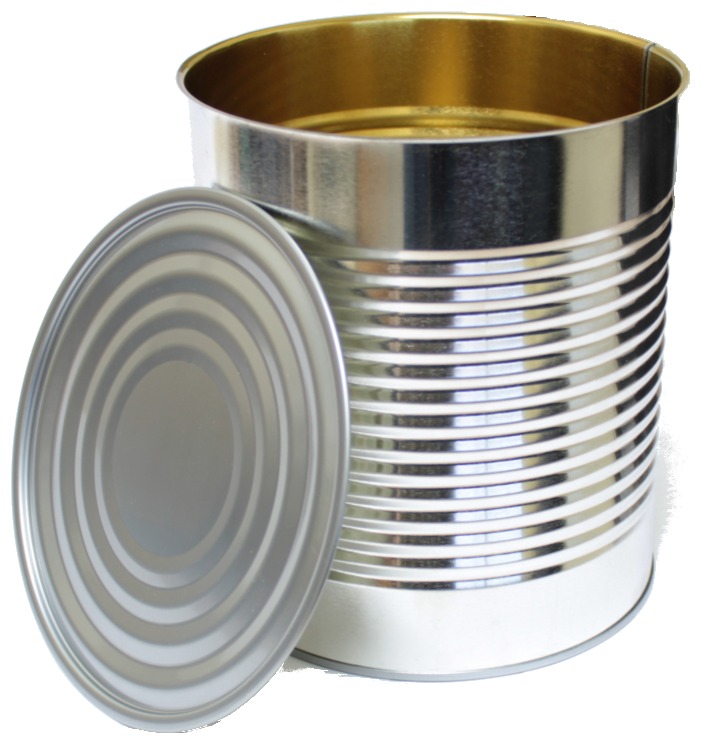
A tin can manufacturer designs a cylindrical tin can for a company making sanitizer and disinfector. The tin can is made to hold $3$ litres of sanitizer or disinfector.

Based on the above in formation, answer the following questions.
  1. If $r \ cm$ be the radius and $h \ cm$ be the height of the cylindrical tin can, then the surface area expressed as a function of r as.
  1. $2\pi\text{r}^2$
  2. $2\pi\text{r}^2+6000$
  3. $2\pi\text{r}^2+\frac{5000}{\text{r}}$
  4. $2\pi\text{r}^2+\frac{6000}{\text{r}}$
  1. The radius that will minimize the cost of the material to manufacture the tin can is.
  1. $\sqrt[3]{\frac{600}{\pi}}\text{cm}$
  2. $\sqrt{\frac{500}{\pi}}\text{cm}$
  3. $\sqrt[3]{\frac{1500}{\pi}}\text{cm}$
  4. $\sqrt{\frac{1500}{\pi}}\text{cm}$
  1. The height that will minimize the cost of the material to manufacture the tin can is.
  1. $\sqrt[3]{\frac{600}{\pi}}\text{cm}$
  2. $2\sqrt[3]{\frac{1500}{\pi}}\text{cm}$
  3. $\sqrt{\frac{1500}{\pi}}$
  4. $2\sqrt{\frac{1500}{\pi}}$
  1. If the cost of material used to manufacture the tin can is $₹\frac{100}{\text{m}^2}$ and $\sqrt[3]{\frac{1500}{\pi}}\approx7.8,$ then minimum cost is approximately.
  1. $₹\ 11.538$
  2. $₹\ 12$
  3. $₹\ 13$
  4. $₹\ 14$
  1. To minimize the cost of the material used to manufacture the tin can, we need to minimize the.
  1. Volume.
  2. Curved surface area.
  3. Total surface area.
  4. Surface area of the base.
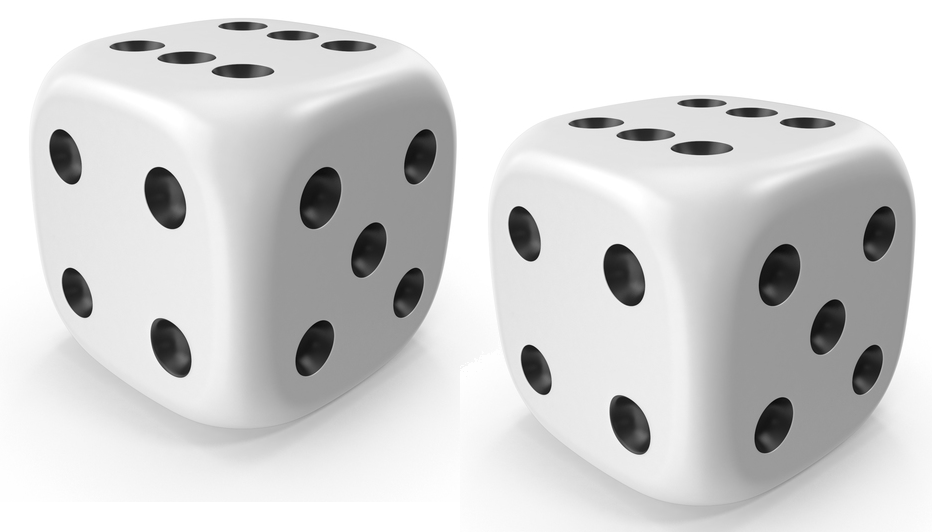
Three friends A, Band Care playing a dice game. The numbers rolled up by them in their first three chances were noted and given by A= {1, 5}, B = {2, 4, 5} and C = {1, 2, 5} as A reaches the cell 'SKIP YOUR NEXT TURN' in second throw. Based on the above information, answer the following questions.
  1. P(A | B) =
  1. $\frac{1}{6}$
  2. $\frac{1}{3}$
  3. $\frac{1}{2}$
  4. $\frac{2}{3}$
  1. P(B | C) =
  1. $\frac{2}{3}$
  2. $\frac{1}{12}$
  3. $\frac{1}{9}$
  4. $0$
  1. $\text{P}(\text{A}\cap\text{B}|\text{C})=$
  1. $\frac{1}{6}$
  2. $\frac{1}{2}$
  3. $\frac{1}{12}$
  4. $\frac{1}{3}$
  1. P(A | C) 
  1. $\frac{1}{4}$
  2. $1$
  3. $\frac{2}{3}$
  4. None of these.
  1. $\text{P}(\text{A}\cup\text{B}|\text{C})=$
  1. 0
  2. $\frac{1}{2}$
  3. $\frac{2}{3}$
  4. 1
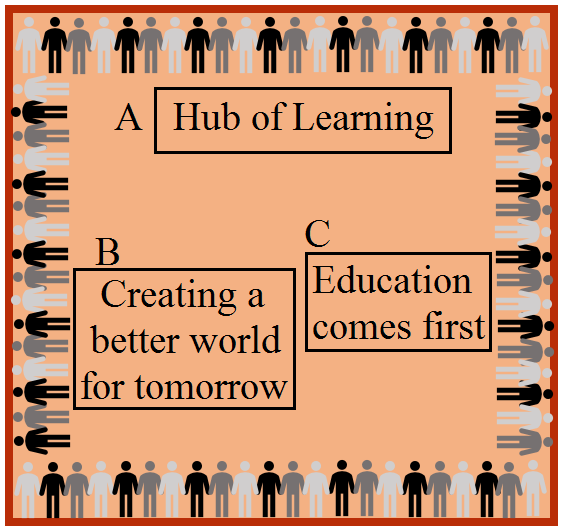
Three slogans on chart papers are to be placed on a school bulletin board at the points A, Band C displaying A (Hub of Learning), B (Creating a better world for tomorrow) and C (Education comes first). The coordinates of these points are (1, 4, 2), (3, -3, -2) and (-2, 2, 6) respectively.

Based on the above information, answer the following questions.
  1. Let $\vec{\text{a}},\vec{\text{b}}$ and $\vec{\text{c}}$ be the position vectors of points A, B and C respectively, then $\vec{\text{a}}+\vec{\text{b}}+\vec{\text{c}}$ is equal to:
  1. $2\hat{\text{i}}+3\hat{\text{j}}+6\hat{\text{k}}$
  2. $2\hat{\text{i}}-3\hat{\text{j}}-6\hat{\text{k}}$
  3. $2\hat{\text{i}}+8\hat{\text{j}}+3\hat{\text{k}}$
  4. $2(7\hat{\text{i}}+8\hat{\text{j}}+3\hat{\text{k}})$
  1. Which of the following is not true?
  1. $\overline{\text{AB}}+\overline{\text{BC}}+\overline{\text{CA}}=\vec{0}$
  2. $\overline{\text{AB}}+\overline{\text{BC}}-\overline{\text{AC}}=\vec{0}$
  3. $\overline{\text{AB}}+\overline{\text{BC}}-\overline{\text{CA}}=\vec{0}$
  4. $\overline{\text{AB}}-\overline{\text{CB}}+\overline{\text{CA}}=\vec{0}$
  1. Area of $\triangle\text{ABC}$ is:
  1. 19 sq. units
  2. $\sqrt{1937}\text{sq}.\text{units}$
  3. $\frac{1}{2}\sqrt{1937}\text{sq}.\text{units}$
  4. $\sqrt{1837}\text{sq}.\text{units}$
  1. Suppose, if the given slogans are to be placed on a straight line, then the value of $|\vec{\text{a}}\times\vec{\text{b}}+\vec{\text{b}}\times\vec{\text{c}}+\vec{\text{c}}\times\vec{\text{a}}|$ will be equal to:
  1. -1
  2. -2
  3. 2
  4. 0
  1. If $\vec{\text{a}}=2\hat{\text{i}}+3\hat{\text{j}}+6\hat{\text{k}},$ then unit vector in the direction of vector $\vec{\text{a}}$ is:
  1. $\frac{2}{7}\hat{\text{i}}-\frac{3}{7}\hat{\text{j}}-\frac{6}{7}\hat{\text{k}}$
  2. $\frac{2}{7}\hat{\text{i}}+\frac{3}{7}\hat{\text{j}}+\frac{6}{7}\hat{\text{k}}$
  3. $\frac{3}{7}\hat{\text{i}}+\frac{2}{7}\hat{\text{j}}+\frac{6}{7}\hat{\text{k}}$
  4. None of these
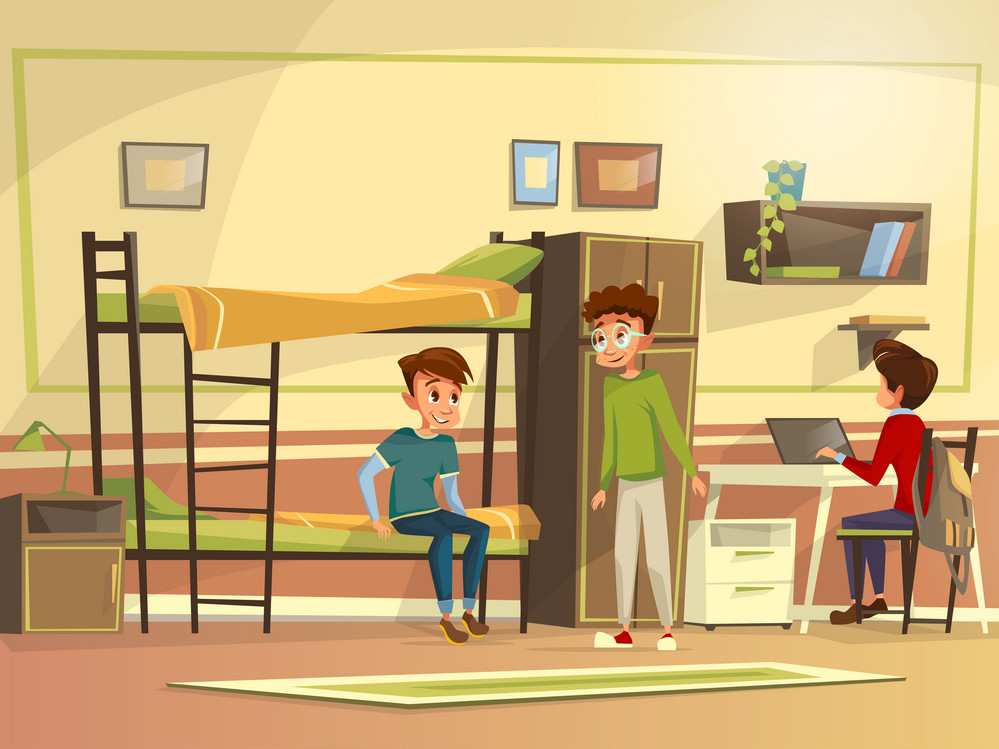
In a college hostel accommodating 1000 students, one of the hostellers came in carrying Corona virus, and the hostel was isolated. The rate at which the virus spreads is assumed to be proportional to the product of the number of infected students and remaining students. There are 50 infected students after 4 days.

Based on the above information, answer the following questions.

  1. If n(I) denote the number of students infected by Corona virus at any time I, then maximum value of n(I) is:
  1. 50
  2. 100
  3. 500
  4. 1000
  1. $\frac{\text{dn}}{\text{dt}}$ is proporuona to:
  1. n(1000 - n)
  2. n(100 + n)
  3. n(100 - n)
  4. n(100 + n)
  1. The value of n(4) is:
  1. 1
  2. 50
  3. 100
  4. 1000
  1. The most general solution of differential equation formed in given situation is:
  1. $\frac{1}{1000}\log\Big(\frac{1000-\text{n}}{\text{n}}\Big)=\lambda\text{t}+\text{c}$
  2. $\log\Big(\frac{\text{n}}{100-\text{n}}\Big)=\lambda\text{t}+\text{c}$
  3. $\frac{1}{1000}\log\Big(\frac{\text{n}}{1000-\text{n}}\Big)=\lambda\text{t}+\text{c}$
  4. None of these.
  1. The value of n at any time is given by:
  1. $\text{n(t)}=\frac{1000}{1+999\text{e}^{-0.9906\text{t}}}$
  2. $\text{n(t)}=\frac{1000}{1-999\text{e}^{-0.9906\text{t}}}$
  3. $\text{n(t)}=\frac{100}{1-999\text{e}^{-0.9906\text{t}}}$
  4. $\text{n(t)}=\frac{100}{1+999\text{e}^{-0.9906\text{t}}}$
Read the following text carefully and answer the questions that follow:
Shama is studying in class $XII$.
She wants do graduate in chemical engineering.
Her main subjects are mathematics, physics, and chemistry. In the examination, her probabilities of getting grade $A$ in these subjects are $0.2, 0.3,$ and $0.5$ respectively.
Image
$1.$ Find the probability that she gets grade $A$ in all subjects. $(1)$
$2.$ Find the probability that she gets grade $A$ in no subjects. $(1)$
$3.$ Find the probability that she gets grade $A$ in two subjects. $(2)$
$OR$
Find the probability that she gets grade $A$ in at least one subject. $(2)$
Logarithmic differentiation is a powerful technique to differentiate functions of the form $\text{f}(\text{x})=[\text{u}(\text{x})]^{\text{v}(\text{x})},$ where both $u(x)$ and $v(x)$ are differentiable functions and $f$ and $u$ need to be positive functions. Let function $\text{y}=\text{f}(\text{x})=(\text{u}(\text{x}))^{\text{v}(\text{x})},$ then $\text{y}\ '=\text{y}\Big[\frac{\text{v}(\text{x})}{\text{u}(\text{x})}\text{u}\ '(\text{x})+\text{v}\ '(\text{x})\cdot\log[\text{u}(\text{x})]\Big]$ On the basis of above information, answer the following questions.
  1. Differentiate $x^x \ w.r.t. x.$
  1. $\text{x}^\text{x}(1+\log\text{x})$
  2. $\text{x}^\text{x}(1-\log\text{x})$
  3. $-\text{x}^\text{x}(1+\log\text{x})$
  4. $\text{x}^\text{x}\log\text{x}$
  1. Differentiate $x^x + a^{x }+ x^a + a^a \ w.r.t. x.$
  1. $(1+\log\text{x})+(\text{a}^\text{x}\log\text{a}+\text{ax}^{\text{a}-1})$
  2. $\text{x}^\text{x}(1+\log\text{x})+\log\text{a}+\text{ax}^{\text{a}-1}$
  3. $\text{x}^\text{x}(1+\log\text{x})+\text{x}^\text{a}\log\text{x}+\text{ax}^{\text{a}-1}$
  4. $\text{x}^\text{x}(1+\log\text{x})+\text{a}^\text{x}\log\text{a}+\text{ax}^{\text{a}-1}$
  1. If $\text{x}=\text{e}^\frac{\text{x}}{\text{y}},$ then find $\frac{\text{dy}}{\text{dx}}.$
  1. $-\frac{(\text{x}+\text{y})}{\text{x}\log\text{x}}$
  2. $-\frac{(\text{x}-\text{y})}{\text{x}\log\text{x}}$
  3. $\frac{(\text{x}+\text{y})}{\text{x}\log\text{x}}$
  4. $\frac{\text{x}-\text{y}}{\text{x}\log\text{x}}$
  1. If $y = (2 - x)^3(3 + 2x)^5,$ then find $\frac{\text{dy}}{\text{dx}}.$
  1. $(2-\text{x})^3(3+2\text{x})^5\Big[\frac{15}{3+2\text{x}}-\frac{8}{2-\text{x}}\Big]$
  2. $(2-\text{x})^3(3+2\text{x})^5\Big[\frac{15}{3+2\text{x}}+\frac{3}{2-\text{x}}\Big]$
  3. $(2-\text{x})^3(3+2\text{x})^5\Big[\frac{10}{3+2\text{x}}-\frac{3}{2-\text{x}}\Big]$
  4. $(2-\text{x})^3(3+2\text{x})^5\cdot\Big[\frac{10}{3+2\text{x}}+\frac{3}{2-\text{x}}\Big]$
  1. If $\text{y}=\text{x}^\text{x}\cdot\text{e}^{(2\text{x}+5)},$ then find $\frac{\text{dy}}{\text{dx}}.$
  1. $\text{x}^\text{x}\text{e}^{2\text{x}+5}$
  2. $\text{x}^\text{x}\text{e}^{2\text{x}+5}(3-\log\text{x})$
  3. $\text{x}^\text{x}\text{e}^{2\text{x}+5}(1-\log\text{x})$
  4. $\text{x}^\text{x}\text{e}^{2\text{x}+5}\cdot(3+\log\text{x})$
A trust fund has ₹ 35000 that must be invested in two different types of bonds, say X and Y. The first bond pays 10% interest p.a. which will be given to an old age home and second one pays 8% interest p.a. which will be given to WWA (Women Welfare Association).
Let A be a 1 × 2 matrix and B be a 2 × 1 matrix, representing the investment and interest rate on each bond respectively.

Based on the above information, answer the following questions.
  1. If ₹ 15000 is invested in bond X, then
  1. $\begin{matrix}\ \ \ \ \ \ \ \ \ \ \ \ \ \text{investment}\end{matrix}\begin{matrix}&&&\text{X}&&\text{Y}\end{matrix}\\\begin{matrix}\text{A}\ =\text{X}\\\ \ \ \ \ \ \ \ \ \ \text{Y}\end{matrix}\begin{bmatrix}\ \ 15000\ \ \\\ \ 20000\ \end{bmatrix};\text{B}=\begin{bmatrix}0.1&0.08\end{bmatrix}\text{Interest rate.}$
  2. $\begin{matrix}&&&&&&&&\text{X}&\ \ \ \ \ \ \ \text{Y}\end{matrix}\begin{matrix}\ \ \ \ \ \ \ \ \ \ \ \ \ \ \ \ \ \ \ \ \ \ \ \text{investment}\end{matrix}\\\text{A = Investment}\begin{bmatrix}15000&20000\end{bmatrix};\ \begin{matrix}\text{B}\ =\text{X}\\\ \ \ \ \ \ \ \ \ \ \text{Y}\end{matrix}\begin{bmatrix}\ \ 0.1\ \ \\\ \ 0.08\ \end{bmatrix}$
  3.  $\begin{matrix}&&&&&&&&\text{X}&\ \ \ \ \ \ \ \text{Y}\end{matrix}\begin{matrix}\ \ \ \ \ \ \ \ \ \ \ \ \ \ \ \ \ \ \ \ \ \ \ \text{investment}\end{matrix}\\\text{A = Investment}\begin{bmatrix}20000&15000\end{bmatrix};\ \begin{matrix}\text{B}\ =\text{X}\\\ \ \ \ \ \ \ \ \ \ \text{Y}\end{matrix}\begin{bmatrix}\ \ 0.08\ \ \\\ \ 0.1\ \end{bmatrix}$
  4. $\text{None of these}$
  1. If ₹ 15000 is invested in bond X, then total amount of interest received on both bonds is:
  1. ₹ 2000
  2. ₹ 2100
  3. ₹ 3100
  4. ₹ 4000
  1. If the trust fund obtains an annual total interest of ₹ 3200, then the investment in two bonds is:
  1. ₹ 15000 in X, ₹ 20000 in Y
  2. ₹ 17000 in X, ₹ 18000 in Y
  3. ₹ 20000 in X, ₹ 15000 in Y
  4. ₹ 18000 in X, ₹ 17000 in Y
  1. The total amount of interest received on both bonds is given by:
  1. AB
  2. A' B
  3. B' A
  4. None of these
  1. If the amount of interest given to old age home is ₹ 500, then the amount of investment in bond Y is:
  1. ₹ 20000
  2. ₹ 30000
  3. ₹ 15000
  4. ₹ 25000
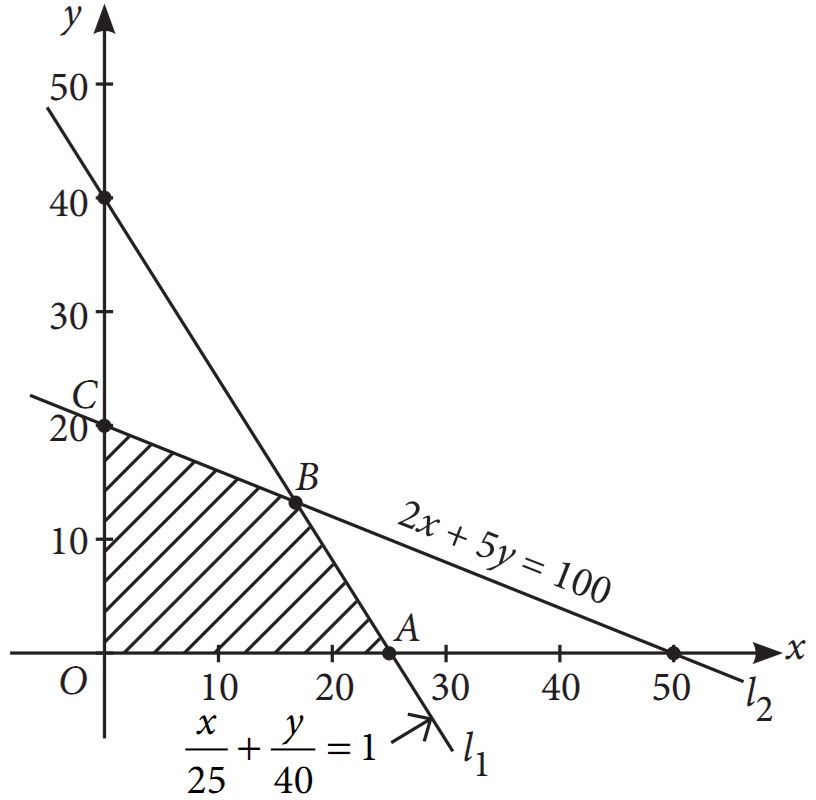
Deepa rides her car at $25 \ km/ hr.$ She has to spend $₹\ 2$ per $\ km$ on diesel and if she rides it at a faster speed of $40 \ km/ hr,$ the diesel cost increases to $₹\ 5$ per $\ km$. She has $₹\ 100$ to spend on diesel. Let she travels $x \ kms$ with speed $25 \ km/ hr$ and $y \ kms$ with speed $40 \ km/ hr.$ The feasible region for the $\text{LPP}$ is shown below:
Based on the above information, answer the following questions.
  1. What is the point of intersection of line $l_1$ and $l_2$?
  1. $\Big(\frac{40}{3},\frac{50}{3}\Big)$
  2. $\Big(\frac{50}{3},\frac{40}{3}\Big)$
  3. $\Big(\frac{-50}{3},\frac{40}{3}\Big)$
  4. $\Big(\frac{-50}{3},\frac{-40}{3}\Big)$
  1. The comer points of the feasible region shown in above graph are:
  1. $(0,25),(20,0),\Big(\frac{40}{3},\frac{50}{3}\Big)$
  2. $(0, 0), (25, 0), (0, 20) $
  3. $(0,0),\Big(\frac{40}{3},\frac{50}{3}\Big),(0,20)$
  4. $(0,0),(25,0),\Big(\frac{50}{3},\frac{40}{3}\Big),(0,20)$
  1. If $Z = x + y$ be the objective function and max $Z = 30.$ The maximum value occurs at point:
  1. $\Big(\frac{50}{3},\frac{40}{3}\Big)$
  2. $(0, 0)$
  3. $(25, 0)$
  4. $(0, 20)$
  1. If $Z = 6x - 9y$ be the objective function, then maximum value of $Z$ is:
  1. $-20$
  2. $150$
  3. $180$
  4. $20$
  1. If $Z = 6x + 3y$ be the objective function, then what is the minimum value of $Z$?
  1. $120$
  2. $130$
  3. $0$
  4. $150$
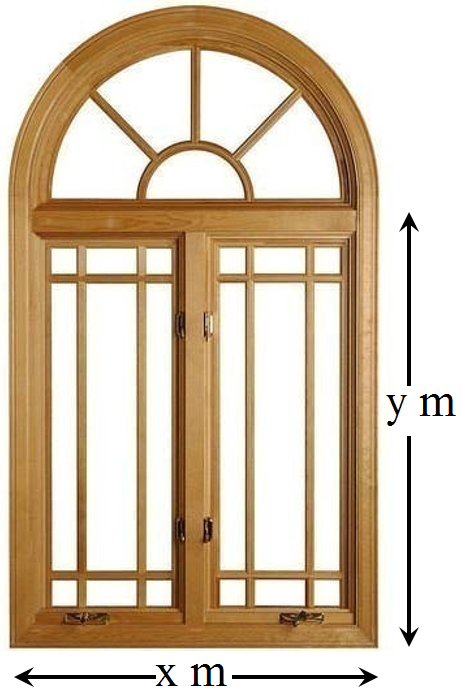
Rohan, a student of class XII, visited his uncle's flat with his father. He observe that the window of the house is in the form of a rectangle surmounted by a semicircular opening having perimeter 10m as shown in the figure.

Based on the above information, answer the following questions.
  1. If x and y represents the length and breadth of the rectangular region, then relation between x and y can be represented as.
  1. $\text{x}+\text{y}+\frac{\pi}{2}=10$
  2. $\text{x}+\text{2y}+\frac{\pi\text{x}}{2}=10$
  3. $\text{2x}+\text{2y}=10$
  4. $\text{x}+\text{2y}+\frac{\pi}{2}=10$
  1. The area (A) of the window can be given by.
  1. $\text{A}=\text{x}-\frac{\text{x}^3}{8}-\frac{\text{x}^2}{2}$
  2. $\text{A}=\text{5x}-\frac{\text{x}^2}{8}-\frac{\pi\text{x}^2}{8}$
  3. $\text{A}=\text{x}+\frac{\pi\text{x}^3}{8}-\frac{\text{3x}^2}{8}$
  4. $\text{A}=\text{5x}+\frac{\text{x}^3}{2}+\frac{\pi\text{x}^2}{8}$
  1. Rohan is interested in maximizing the area of the whole window, for this to happen, the value of x should be.
  1. $\frac{10}{2-\pi}$
  2. $\frac{20}{4-\pi}$
  3. $\frac{20}{4+\pi}$
  4. $\frac{10}{2+\pi}$
  1. Maximum area of the window is.
  1. $\frac{30}{4+\pi}$
  2. $\frac{30}{4-\pi}$
  3. $\frac{50}{4-\pi}$
  4. $\frac{50}{4+\pi}$
  1. For maximum value of A, the breadth of rectangular part of the window is.
  1. $\frac{10}{4+\pi}$
  2. $\frac{10}{4-\pi}$
  3. $\frac{20}{4+\pi}$
  4. $\frac{20}{4-\pi}$