Question
A differential equation is said to be in the variable separable form if it is expressible in the form f(x) dx = g(y) dy.
The solution of this equation is given by
$\int\text{f(x)dx}=\int\text{g(y)dy}+\text{c},$ where c is the constant of integration.
Based on the above information, answer the following questions.
  1. If the solution of the differential equation $\frac{\text{dy}}{\text{dx}}=\frac{\text{ax+3}}{\text{2y+f}}$ represents a circle, then the value of 'a' is:
  1. 2
  2. -2
  3. 3
  4. -4
  1. The differential equation $\frac{\text{dy}}{\text{dx}}=\frac{\sqrt{1-\text{y}^2}}{\text{y}}$ determines a family of circle with.
  1. Variable radii and fixed centre (0, 1)
  2. Variable radii and fixed centre (0, -1)
  3. Fixed radius 1 and variable centre on x-axis
  4. Fixed radius 1 and variable centre on y-axis
  1. If = y'+ 1, y(0) = 1, then y (In 2) =
  1. 1
  2. 2
  3. 3
  4. 4
  1. The solution of the differential equation $\frac{\text{dy}}{\text{dx}}=\text{e}^\text{x-y}+\text{x}^2\text{e}^\text{-y}$ is:
  1. $\text{e}^\text{x}=\frac{\text{y}^3}{3}+\text{e}^\text{y}+\text{c}$
  2. $\text{e}^\text{y}=\frac{\text{x}^2}{3}+\text{e}^\text{x}+\text{c}$
  3. $\text{e}^\text{y}=\frac{\text{x}^3}{3}+\text{e}^\text{x}+\text{c}$
  4. None of these
  1. If $\frac{\text{dy}}{\text{dx}}=\text{y}\sin2\text{x},\ \text{y}(0)=1,$ then its solution is:
  1. $\text{y}=\text{e}^{\sin^2}\text{x}$
  2. $\text{y}={\sin^2}\text{x}$
  3. $\text{y}={\cos^2}\text{x}$
  4. $\text{y}=\text{e}^{\cos^2}\text{x}$
Answer

  1. (b) -2

Solution:

We have, $\frac{\text{dy}}{\text{dx}}=\frac{\text{ax+3}}{\text{2y+f}}$

$\Rightarrow\ \ (\text{ax+3})\text{dx}=(2\text{y}+\text{f})\text{dy}$

$\Rightarrow\text{a}\frac{\text{x}^2}{2}+\text{3x}=\text{y}^2+\text{fy}+\text{c}$ (Integrating)

$\Rightarrow-\frac{\text{a}}{2}\text{x}^2+\text{y}^2-\text{3x}+\text{fy}+\text{C}=0$

This will represent a circle, if $\frac{-\text{a}}{2}=1\Rightarrow\text{a}=-2$

[ $\therefore$ In circle, coefficient of x2 = coefficient of y2)

  1. (c) Fixed radius 1 and variable centre on x-axis

Solution:

We have, $\frac{\text{ydy}}{\sqrt{1-\text{y}^2}}=\text{dx}$

On integration, we get $-\sqrt{1-\text{y}^2}=\text{x+c}$

⇒ 1 - y2 = (x + c)2 (x + c)+ y= 1 which represents a circle with radius I and centre on the x-axis.

  1. (c) 3

Solution:

$\text{y}'=\text{y}+1\Rightarrow\frac{\text{dy}}{\text{y}+1}=\text{dx}$

⇒ In (y + 1) = x + c (integrating)

Now, y(0) = 1 ⇒ c = In 2

$\therefore \ \text{In}\Bigg(\frac{\text{y}+1}{2}\Bigg)=\text{x}$

⇒ y + 1 = 2ex

So, y (In 2) = -1 + 2eIn 2 = -1 + 4 = 3

  1. (c) $\text{e}^\text{y}=\frac{\text{x}^3}{3}+\text{e}^\text{x}+\text{c}$

Solution:

From the given differential equation, we have

$\frac{\text{dy}}{\text{dx}}=\frac{\text{e}^\text{x}+\text{x}^\text{2}}{\text{e}^\text{y}}$

$\Rightarrow\ \text{e}^\text{y}\text{dy}=(\text{e}^\text{x}+\text{x}^2)\text{dx}$

Integrating, we get $\text{e}^\text{y}=\text{e}^\text{x}+\frac{\text{x}^3}{3}+\text{c}$

  1. (a) $\text{y}=\text{e}^{\sin^2}\text{x}$

Solution:

We have, $\frac{\text{dy}}{\text{dx}}=\text{y}\sin2\text{x}$

$\Rightarrow\ \frac{\text{dy}}{\text{y}}=\sin2\text{x}\ \text{dx}$

$\Rightarrow\ \log\text{y}=-\frac{\cos2\text{x}}{2}+\text{c}$

Since x = 0, y = 1

therefore $\text{C}=\frac{1}{2}$

Now, $\log\text{y}=\frac{1}{2}(1-\cos2\text{x})$

$\Rightarrow\ \log\text{y}=\sin^2\text{x}\Rightarrow\text{y}=\text{e}^{\sin^2}\text{x}$

Need a full question paper?

Generate a complete, print-ready paper with questions like this in minutes — across 16+ boards, with answer keys.

Start Generating Free

Similar questions

Order: The order of a differential equation is the order of the highest order derivative appearing in the differential equation.
Degree: The degree of differential equation is the power of the highest order derivative, when differential coefficients are made free from radicals and fractions. Also, differential equation must be a polynomial equation in derivatives for the degree to be defined.
Based on the above information, answer the following questions.
  1. Find the degree of the differential equation $2\frac{\text{d}^2\text{y}}{\text{dx}^2}+3\sqrt{1-\Big(\frac{\text{dy}}{\text{dx}}\Big)^2-\text{y}=0}.$
  1. 3
  2. 4
  3. 3
  4. 1
  1. Order and degree of the differential equation $\text{y}\frac{\text{dy}}{\text{dx}}=\frac{\text{x}}{\frac{\text{dy}}{\text{dx}}+\Big(\frac{\text{dy}}{\text{dx}}\Big)^3}$ are respectively.
  1. 1, 1
  2. 1, 2
  3. 1, 3
  4. 1, 4
  1. Find order and degree of the equation y'" + y2 + ey' = 0.
  1. Order = 3, degree = undefined.
  2. Order = 1, degree = 3.
  3. Order = 2, degree = undefined.
  4. Order = 1, degree = 2.
  1. Determine degree of the differential equation $(\sqrt{\text{a+x}})\times\Big(\frac{\text{dy}}{\text{dx}}\Big)+\text{x}=0.$
  1. 3
  2. Not defined
  3. 1
  4. 2
  1. Order and degree of the differential equation $\Bigg(1+\Big(\frac{\text{dy}}{\text{dx}}\Big)^3\Bigg)^\frac{7}{3}=7\frac{\text{d}^2\text{y}}{\text{dx}^2}$ are respectively.
  1. 2, 1
  2. 2, 3
  3. 1, 3
  4. $1,\ \frac{7}{3}$
A rumour on whatsapp spreads in a population of 5000 people at a rate proportional to the product of the number of people who have heard it and the number of people who have not. Also, it is given that 100 people initiate the rumour and a total of 500 people know the rumour after 2 days.

Based on the above information, answer the following questions.
  1. If y(t) denote the number of people who know the rumour at an instant t, then maximum value of y(t) is:
  1. 500
  2. 100
  3. 5000
  4. None of these
  1. $\frac{\text{dn}}{\text{dt}}$ is proportional to:
  1. (y - 5000)
  2. y(y - 500)
  3. y(500 - y)
  4. y(5000 - y)
  1. The value of y(0) is:
  1. 100
  2. 500
  3. 600
  4. 200
  1. The value of y(2) is:
  1. 100
  2. 500
  3. 600
  4. 200
  1. The value of y at any time t is given by:
  1. $\text{y}=\frac{5000}{_\text{e}-5000\text{kt}_{+1}}$
  2. $\text{y}=\frac{5000}{_\text{1+e}-5000\text{kt}}$
  3. $\text{y}=\frac{5000}{_\text{49e}-5000\text{kt}_{+1}}$
  4. $\text{y}=\frac{5000}{_\text{49}{(_\text{1+e}}-5000\text{kt})}$
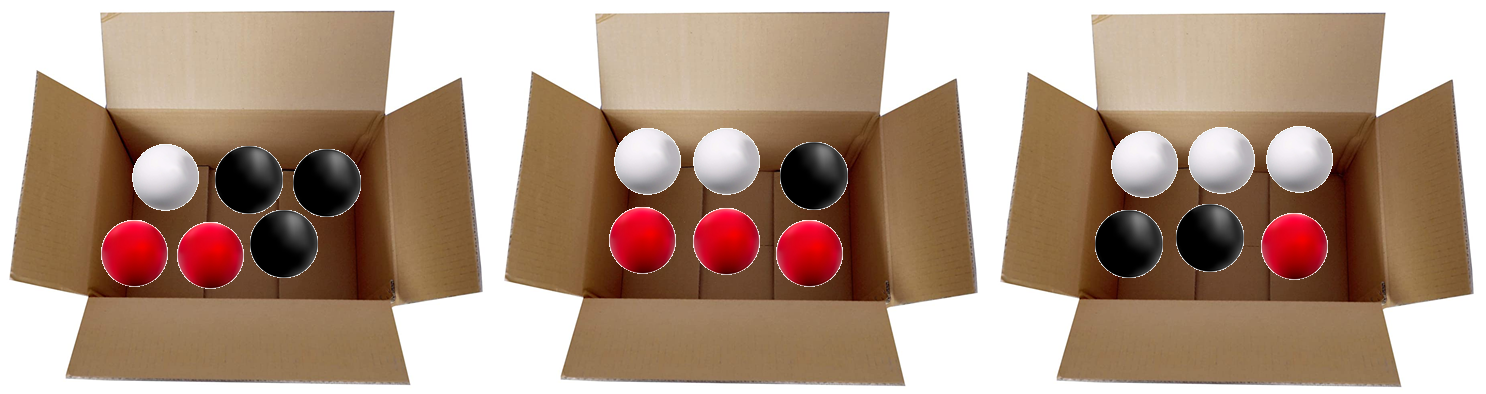
Box I contains 1 white, 3 black and 2 red balls. Box II contains 2 white, 1 black and 3 red balls. Box III contains 3 white, 2 black and 1 red balls. One box is chosen at random and two balls are drawn with replacement.

If E1, E2, E3 be the events that the balls drawn from box I, box II and box III respectively and E be the event that balls drawn are one white and one red, then answer the following questions.

  1. Probability of occurrence of event E given that the balls drawn are from box I, is:
  1. $\frac{1}{9}$

  2. $\frac{2}{6}$

  3. $\frac{3}{5}$

  4. $\frac{1}{7}$
  1. Probability of occurrence of event E, given that the balls drawn are from box II, is:
  1. $\frac{1}{3}$

  2. $\frac{1}{4}$

  3. $\frac{3}{4}$

  4. $\frac{3}{5}$
  1. Probability of occurrence of event E, given that balls drawn are from box III, is:
  1. $\frac{1}{12}$

  2. $\frac{3}{11}$

  3. $\frac{1}{6}$

  4. $\frac{4}{11}$

  1. The value of $\displaystyle{\sum^3_{\text{i}=1}}\text{P(E}|\text{E}_\text{i})$ is equal to.
  1. $\frac{5}{18}$

  2. $\frac{1}{2}$

  3. $\frac{1}{18}$

  4. $\frac{11}{18}$

  1. The probability that the balls drawn are from box II, given that event E has already occurred, is:
  1. $\frac{1}{11}$

  2. $\frac{6}{11}$

  3. $\frac{5}{11}$

  4. None of these

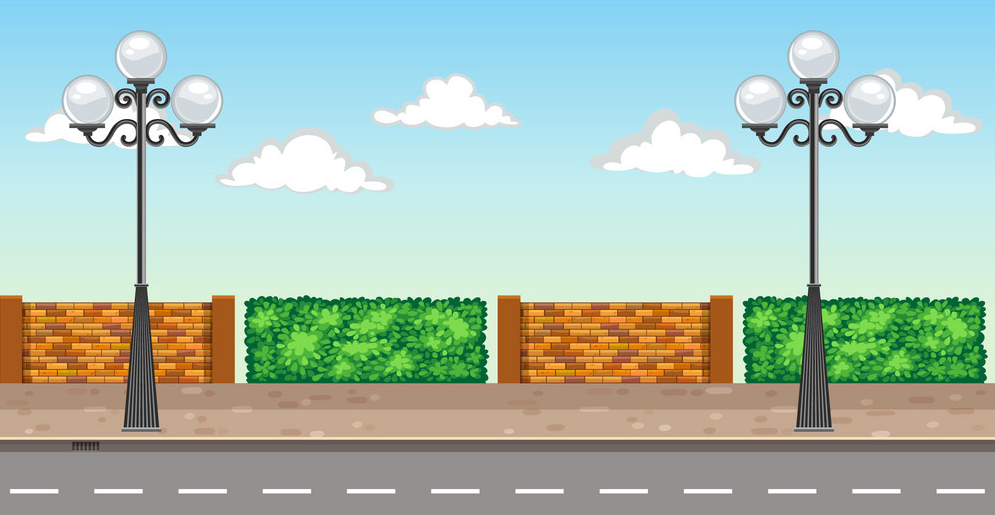
In a street, two lamp posts are 600 feet apart. The light intensity at a distanced from the first (stronger) lamp post is $\frac{1000}{\text{d}^2}$ the light intensity at distance d from the second (weaker) lamp post is $\frac{125}{\text{d}^2}$ (in both cases the light intensity is inversely proportional to the square of the distance to the light source). The combined light intensity is the sum of the two light intensities coming from both lamp posts.

Based on the above information, answer the following questions.
  1. If you are in between the lamp posts, at distance x feet from the stronger tight, then the formula for the combined light intensity coming from both lamp posts as function of x, is
  1. $\frac{1000}{\text{x}^2}+\frac{125}{\text{x}^2}$
  2. $\frac{1000}{\big(600-\text{x}^2\big)}+\frac{125}{\text{x}^2}$
  3. $\frac{1000}{\text{x}^2}+\frac{125}{\big(600-\text{x}^2\big)}$
  4. $\text{None of these}$
  1. The maximum value of x can not be.
  1. 100
  2. 200
  3. 600
  4. None of these
  1. The minimum value of x can not be.
  1. 0
  2. 100
  3. 200
  4. None of these
  1. If l(x) denote the combined tight intensity, then l(x) will be minimum when x =
  1. 200
  2. 400
  3. 600
  4. 800
  1. The darkest spot between the two lights is.
  1. At a distance of 200 feet from the weaker lamp post.
  2. At distance of 200 feet from the stronger lamp post.
  3. At a distance of 400 feet from the weaker lamp post.
  4. None of these
Consider the mapping f: A → B is defined by f(x) = x - 1 such that f is a bijection.
Based on the above information, answer the following questions.

  1. Domain of f is:
  1. R - {2}
  2. R
  3. R - {1, 2}
  4. R - {0}
  1. Range of f is:
  1. R
  2. R - {2}
  3. R - {0}
  4. R - {1, 2}
  1. If g: R - {2} → R - {1} is defined by g(x) = 2f(x) - 1, then g(x) in terms of x is:
  1. $\frac{\text{x}+2}{\text{x}}$
  2. $\frac{\text{x}+1}{\text{x}-2}$
  3. $\frac{\text{x}-2}{\text{x}}$
  4. $\frac{\text{x}}{\text{x}-2}$
  1. The function g defined above, is:
  1. One-one
  2. Many-one
  3. into
  4. None of these
  1. A function f(x) is said to be one-one iff.
  1. f(x1) = f(x2) ⇒ -x= x2
  2. f(-x1) = f(-x2) ⇒ -x1 = x2
  3. f(x1) = f(x2) ⇒ x1 = x2
  4. None of these
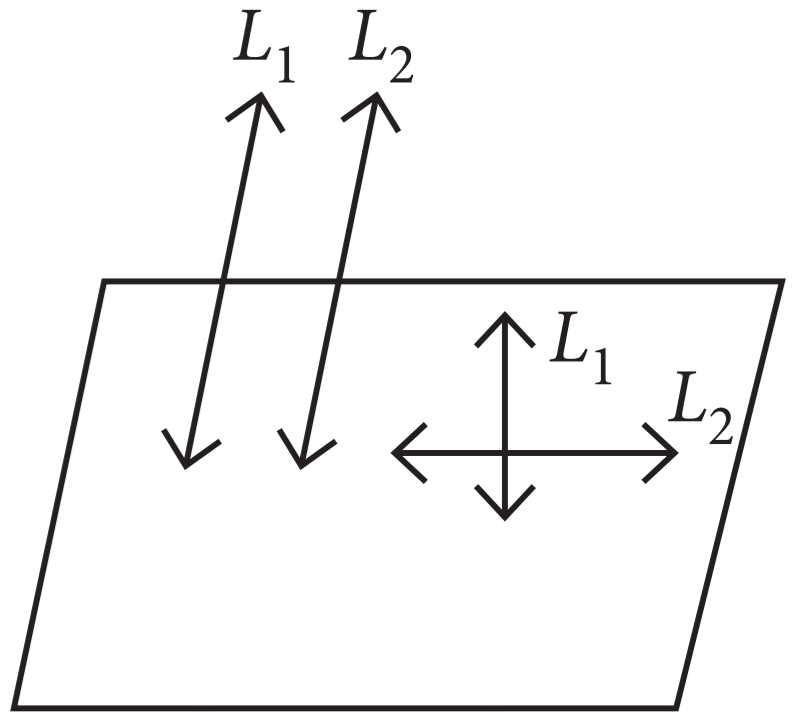
If a1, b1, c1, and a2, b2, c2 are direction ratios of two lines say L1 and L2 respectively. Then L1 || L2 iff $\frac{\text{a}_1}{\text{a}_2}=\frac{\text{b}_1}{\text{b}_2}=\frac{\text{c}_1}{\text{c}_2}$ and $\text{L}_1\perp\text{L}_2$ iff a1a2 + b1b2 + c1c2 = 0.

Based on the above information, answer the following questions.

  1. If l1, m1,  n1, and l2, m2, n2 are the direction cosines of L1 and L2 respectively, then L1 will be perpendicular to L2, iff:
  1. l1l2 + m1m2 + n1n2 = 0
  2. l1m2 + m1l2 + n1n2 = 0
  3. $\frac{\text{l}_1}{\text{l}_2}=\frac{\text{m}_1}{\text{m}_2}=\frac{\text{n}_1}{\text{n}_2}$

  4. None of these
  1. If l1, m1, n1 and l2, m2, n2 are direction cosines of L1 and L2 respectively, then L1 will be parallel to L2, iff:
  1. l1l2 + m1m2 + n1n2 = 0
  2. l1m2 + m1l2 + n1n2 = 0
  3. $\frac{\text{l}_1}{\text{l}_2}=\frac{\text{m}_1}{\text{m}_2}=\frac{\text{n}_1}{\text{n}_2}$

  4. m1n2 + m2n2 + l1l2 = 0
  1. The coordinates of the foot of the perpendicular drawn from the point A(1, 2, 1) to the line joining B(1, 4, 6) and C(5, 4, 4), are:
  1. (1, 2, 1)
  2. (2, 4, 5)
  3. (3, 4, 5)
  4. (3, 4, 5)
  1. The direction ratios of the line which is perpendicular to the lines with direction ratios proportional to (1, -2, -2) and (0, 2, 1) are:
  1. < 1, 2, 1 >
  2. < 2,-1, 2 >
  3. < -1,2, 2 >
  4. None of these
  1. The lines $\frac{\text{x}-2}{3}=\frac{\text{y}+1}{-2}=\frac{\text{z}-2}{0}$ and $\frac{\text{x}-1}{1}=\frac{\frac{\text{y}+3}{2}}{\frac{3}{2}}=\frac{\text{z}+5}{2}$ are:
  1. Parallel.
  2. Perpendicular.
  3. Skew lines.
  4. Non-intersecting.
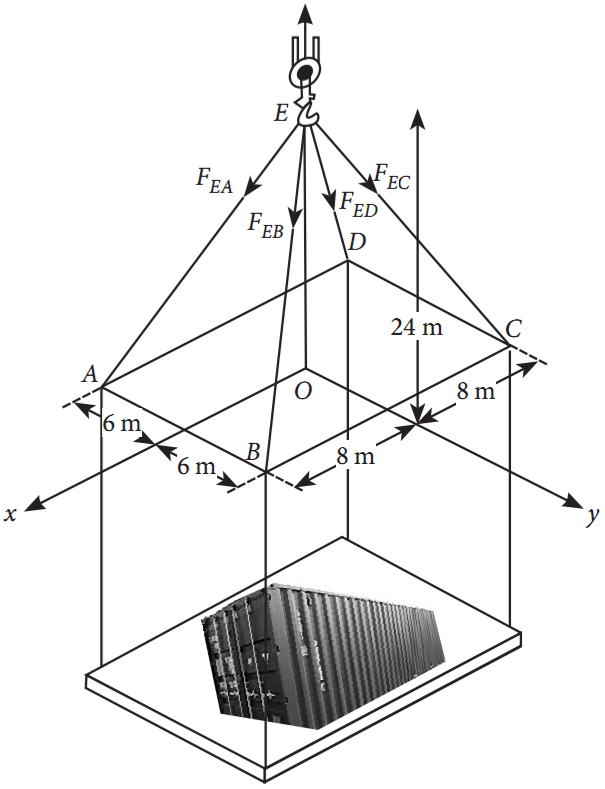
Consider the following diagram, where the forces in the cable are given.

Based on the above information, answer the following questions.

  1. The cartesian equation of line along EA is:
  1. $\frac{\text{x}}{-4}=\frac{\text{y}}{3}=\frac{\text{z}}{12}$

  2. $\frac{\text{x}}{-4}=\frac{\text{y}}{3}=\frac{\text{z}-24}{12}$

  3. $\frac{\text{x}}{-3}=\frac{\text{y}}{3}=\frac{\text{z}-12}{12}$

  4. $\frac{\text{x}}{3}=\frac{\text{y}}{4}=\frac{\text{z}-24}{12}$

  1. The vector $\overline{\text{ED}}$ is:
  1. $8\hat{\text{i}}-6\hat{\text{j}}+24\hat{\text{k}}$

  2. $-8\hat{\text{i}}-6\hat{\text{j}}+24\hat{\text{k}}$

  3. $-8\hat{\text{i}}-6\hat{\text{j}}-24\hat{\text{k}}$

  4. $8\hat{\text{i}}+6\hat{\text{j}}+24\hat{\text{k}}$

  1. The length of the cable EB is:
  1. 24 units
  2. 26 units
  3. 27 units
  4. 25 units
  1. The length of cable EC is equal to the length of:
  1. EA
  2. EB
  3. ED
  4. All of these
  1. The sum of all vectors along the cables is:
  1. $96\hat{\text{i}}$

  2. $96\hat{\text{j}}$

  3. $-96\hat{\text{k}}$

  4. $96\hat{\text{k}}$

If two vectors are represented by the two sides of a triangle taken in order, then their sum is represented by the third side of the triangle taken in opposite order and this is known as triangle law of vector addition. Based on the above information, answer the following questions.

  1. If $\vec{\text{p}},\vec{\text{q}},\vec{\text{r}}$ are the vectors represented by the sides of a triangle taken in order, then $\vec{\text{q}},+\vec{\text{r}}=$
  1. $\vec{\text{p}}$

  2. $2\vec{\text{p}}$

  3. $-\vec{\text{p}}$

  4. None of these
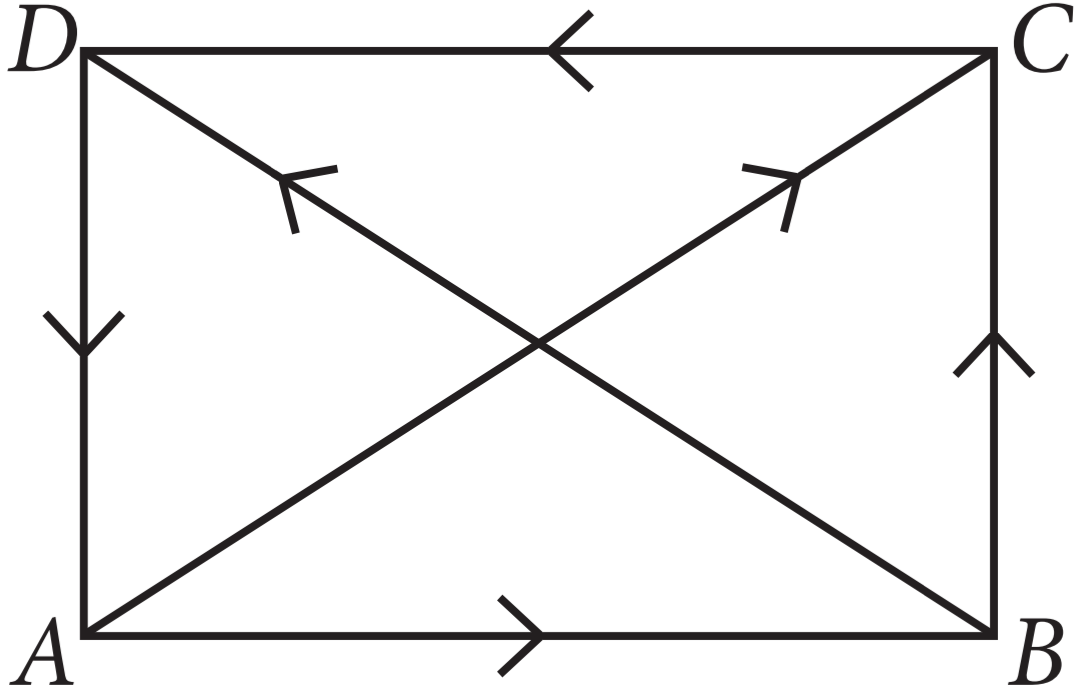
  1. If ABCD is a parallelogram and AC and BD are its diagonals, then $\overline{\text{AC}}+\overline{\text{BD}}=$
  1. $2\overline{\text{DA}}$

  2. $2\overline{\text{AB}}$

  3. $2\overline{\text{BC}}$

  4. $2\overline{\text{BD}}$

  1. If ABCD is a parallelogram, where $\overline{\text{AB}}=2\vec{\text{a}}$ and $\overline{\text{BC}}=2\vec{\text{b}},$ then $\overline{\text{AC}}-\overline{\text{BD}}=$
  1. $3\vec{\text{a}}$

  2. $4\vec{\text{a}}$

  3. $2\vec{\text{b}}$

  4. $4\vec{\text{b}}$

  1. If ABCD is a quadrilateral whose diagonals are $\overline{\text{AC}}$ and $\overline{\text{BD}},$ then $\overline{\text{BA}}+\overline{\text{DC}}=$

  1. $\overline{\text{AC}}+\overline{\text{DB}}$

  2.  $\overline{\text{AC}}+\overline{\text{BD}}$

  3. $\overline{\text{BC}}+\overline{\text{AD}}$

  4. $\overline{\text{BD}}+\overline{\text{CA}}$

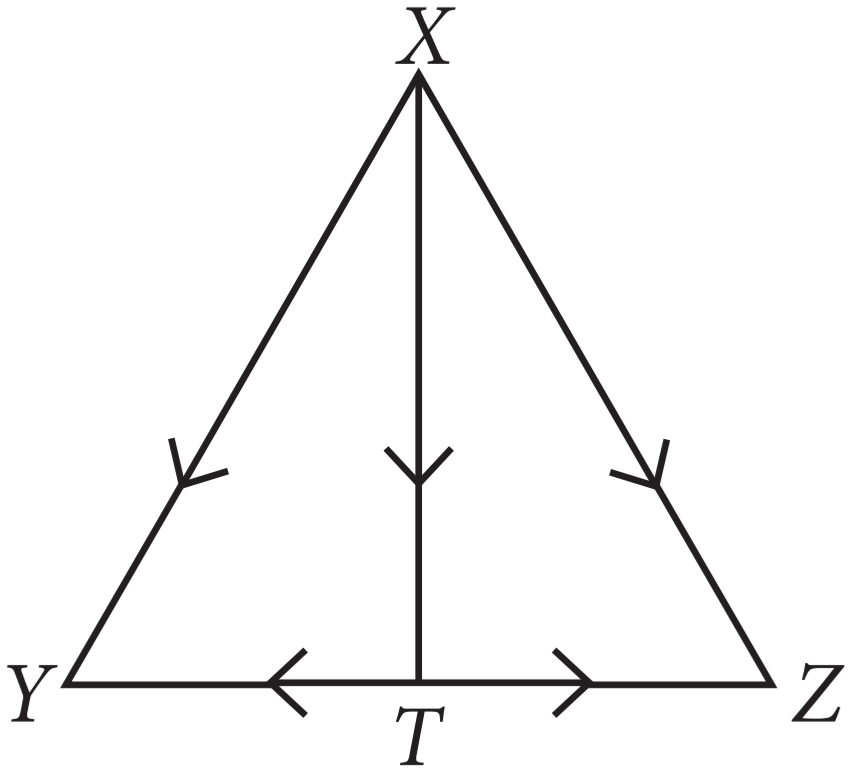
  1. If T is the mid point of side YZ of $\triangle\text{XYZ},$ then $\overline{\text{XY}}+\overline{\text{XZ}}=$

  1. $2\overline{\text{YT}}$

  2. $2\overline{\text{XT}}$

  3. $2\overline{\text{TZ}}$

  4. None of these
A doctor is to visit a patient. From the past experience, it is known that the probabilities that he will come by cab, metro, bike or by other means of transport are respectively 0.3, 0.2, 0.1 and 0.4. 'Tile probabilities that he will be late are 0.25, 0.3, 0.35 and 0.1 if he comes by cab, metro, bike and other means of transport respectively.

Based on the above information, answer the following questions.

  1. When the doctor arrives late, what is the probability that he comes by metro?
  1. $\frac{5}{14}$

  2. $\frac{2}{7}$

  3. $\frac{5}{21}$

  4. $\frac{1}{6}$

  1. When the doctor arrives late, what is the probability that he comes by cab?
  1. $\frac{4}{21}$

  2. $\frac{1}{7}$

  3. $\frac{5}{14}$

  4. $\frac{2}{21}$

  1. When the doctor arrives late, what is the probability that he comes by bike?
  1. $\frac{5}{21}$

  2. $\frac{4}{7}$

  3. $\frac{5}{6}$

  4. $\frac{1}{6}$

  1. When the doctor arrives late, what is the probability that he comes by other means of transport?
  1. $\frac{6}{7}$

  2. $\frac{5}{14}$

  3. $\frac{4}{21}$

  4. $\frac{2}{7}$

  1. What is the probability that the doctor is late by any means?
  1. 1
  2. 0
  3. $\frac{1}{2}$

  4. $\frac{1}{4}$ 

A phannaceutical company wants to advertise a new product on T.V., where the product is specially designed for women. For that an advertising executive is hired to study television-viewing habits of married couples during prime time hours. Based on past viewing records he has determined that during prime time husbands are watching television 70% of the time. It has also been determined that when the husband is watching television, 30% of the time the wife is also watching. When the husband is not watching television, 40% of the time the wife is watching television.

Based on the above information, answer the following questions.

  1. The probability that the husband is not watching television during prime time, is:
  1. 0.6

  2. 0.3

  3. 0.4

  4. 0.5

  1. If the wife is watching television, the probability that husband is also watching television, is:
  1. $\frac{2}{11}$

  2. $\frac{7}{11}$

  3. $\frac{5}{11}$

  4. $\frac{8}{11}$

  1. The probability that both husband and wife are watching television during prime time, is:
  1. 0.21

  2. 0.5

  3. 0.3

  4. 0.4

  1. The probability that the wife is watching television during prime time, is:
  1. 024

  2. 0.33

  3. 0.3

  4. 0.4

  1. If the wife is watching television, then the probability that husband is not watching television, is:
  1. $\frac{2}{11}$

  2. $\frac{4}{11}$

  3. $\frac{1}{11}$

  4. $\frac{5}{11}$