MCQ
A dimensionless quantity:
  • A
    Never has a unit.
  • B
    Always has a unit
  • May have a unit.
  • D
    Does not exist.

Answer

Correct option: C.
May have a unit.
Dimensionless quantities may have units.

Need a full question paper?

Generate a complete, print-ready paper with questions like this in minutes — across 16+ boards, with answer keys.

Start Generating Free

Similar questions

At time $t =0$ a particle starts travelling from a height $7\,\hat{z} cm$ in a plane keeping $z$ coordinate constant. At any instant of time it's position along the $x$ and $y$ directions are defined as $3\,t$ and $5\,t^{3}$ respectively. At $t =1\,s$ acceleration of the particle will be.
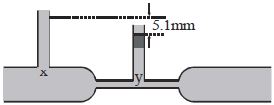
The diagram (figure) shows a venturimeter, through which water is flowing. The speed of water at $X$ is $2\,cm/s.$ The speed of water at $Y$ (taking $g = 1000 \,cm/s^2$ ) is ........ $cm/s$
Water flows into a cylindrical vessel of large cross-sectional area at a rate of $10^{-4}$ $m^3/s$. It flows out from a hole of area $10^{-4}$ $m^2$, which has been punched through the base. How high does the water rise in the vessel?
Three liquids of densities $d, 2d$ and $3d$ are mixed in equal proportion of weights. If density of water is $d,$ then the specific gravity of the mixture is:
A resistor of resistance $R$ is connected to an ideal battery. If the value of $R$ is decreased, the power dissipated in the resistor will:
A solid sphere of radius $R$ has moment of inertia $I$ about its geometrical axis. It is melted into a disc of radius $r$ and thickness $t$. If it's moment of inertia about the tangential axis (which is perpendicular to plane of the disc), is also equal to $I,$ then the value of $r$ is equal to
A second's pendulum is placed in a space laboratory orbiting around the earth at a height $3R$, where $R$ is the radius of the earth. The time period of the pendulum is
A point moves in $x -y$ plane according to the law $x = 3\, cos\,4t$ and $y = 3\, (1 -sin\,4t)$. The distance travelled by the particle in $2\, sec$ is...........$m$  (where $x$ and $y$ are in $metres$ )
The largest and shortest distance of earth from the sun are $r_1$ and $r_2$. Its distance from the sun when it is perpendicular to the major axis of the orbit drawn from the sun is:
At what point of a projectile motion acceleration and velocity are perpendicular to each other