MCQ
A dimensionless quantity:
  • May have a unit.
  • B
    Never has a unit.
  • C
    Always has a unit.
  • D
    Doesn't exist.

Answer

Correct option: A.
May have a unit.
A dimensionless quantity may have a unit. For example, angle has a unit but is dimensionless.

Need a full question paper?

Generate a complete, print-ready paper with questions like this in minutes — across 16+ boards, with answer keys.

Start Generating Free

Similar questions

A heavy uniform chain lies on a horizontal table-top. If the coefficient of friction between the chain and table surface is $0.25$, then the maximum fraction of length of the chain, that can hang over one edge of the table is ...... $\%$
The displacement of the wave given by equation $\text{y (x, t)}=\text{a}\sin(\text{kx}-\omega\text{t}+\phi),$ where $\phi = 0$ at point $x$ and $t = 0$ is same as that at point:
Choose the correct option:
In order to double the frequency of the fundamental note emitted by a stretched string, the length is reduced to $\frac{3}{4}$$^{th}$ of the original length and the tension is changed. The factor by which the tension is to be changed, is
$A$ particle of mass $2\, kg$ located at the position $(\hat i + \hat j)$ $m$ has a velocity $2( + \hat i - \hat j + \hat k)m/s$. Its angular momentum about $z$ -axis in $kg-m^2/s$ is
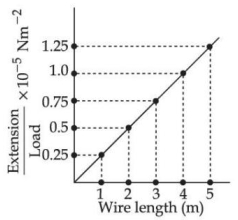
In an experiment to determine the Young's modulus, steel wires of five different lengths $(1,2,3,4$ and $5\,m )$ but of same cross section $\left(2\,mm ^{2}\right)$ were taken and curves between extension and load were obtained. The slope (extension/load) of the curves were plotted with the wire length and the following graph is obtained. If the Young's modulus of given steel wires is $x \times 10^{11}\,Nm ^{-2}$, then the value of $x$ is
In an inelastic collision, what is conserved
The slopes of isothermal and adiabatic curves are related as
Radius of earth is around $6000\, km$. The weight of body at height of $6000 \,km$ from earth surface becomes
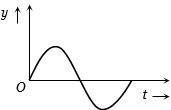
The displacement time graph of a particle executing $S.H.M.$ is as shown in the figureThe corresponding force-time graph of the particle is