MCQ
A diode as a rectifier changes :
  • A
    in alternating current of direct current
  • alternating current into direct current
  • C
    high voltage to low voltage or low voltage to high voltage
  • D
    changing direct current into fixed direct current

Answer

Correct option: B.
alternating current into direct current
(b) - alternating current into direct current

Need a full question paper?

Generate a complete, print-ready paper with questions like this in minutes — across 16+ boards, with answer keys.
Start Generating Free

Similar questions

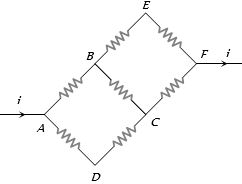
In the adjoining circuit diagram each resistance is of $10$ $\Omega$. The current in the arm $AD$ will be
A thin plano-convex lens acts like a concave mirror of focal length 0.2 m when silvered from its plane surface. The refractive index of the material of the lens is 1.5. The radius of curvature of the convex surface of the lens will be
Potential difference between centre $\&$ the surface of sphere of radius $R$ and uniform volume charge density $\rho$ within it will be :
With a change of load resistance of a triode, used as an amplifier, from 50 kilo ohms to 100 kilo ohms, its voltage amplification changes from 25 to 30. Plate resistance of the triode is
The electric field inside a hollow conducting sphere:
The refractive index of water and glass with respect to air is $1.3$ and $1.5$ respectively. Then the refractive index of glass with respect to water is
An insulating pipe of cross-section area $'A'$ contains an electrolyte which has two types of ions $\rightarrow$ their charges being $-e$ and $+2e$. $A$ potential difference applied between the ends of the pipe result in the drifting of the two types of ions, having drift speed $= v$ ($-ve$ ion) and $v/4$ ($+ve$ ion). Both ions have the same number per unit volume $= n$. The current flowing through the pipe is
A rectangular parallelopiped is measured as $1\,cm \times 1\,cm \times 100\,cm$. If its specific resistance is $3 \times 10^{-7}\,\Omega\,m$, then the resistance between its two opposite rectangular faces will be $..........x^{-7} \Omega$.
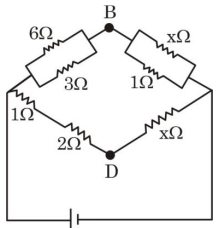
If the potential difference between $B$ and $D$ is zero, the value of $x$ is $\frac{1}{n} \Omega$. The value of $n$ is .......
A photosensitive metallic surface is illuminated alternately with lights of wavelength $3100 \mathring A$ and $6200 \mathring A$. It is observed that maximum speeds of the photoelectrons in two cases are in ratio $2: 1$. The work function of the metal is ( $h c=12400 \,eV\mathring A$ )