MCQ
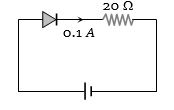
A diode having potential difference $0.5\, V$ across its junction which does not depend on current, is connected in series with resistance of $20$ $\Omega$ across source. If $0.1\, A$ passes through resistance then what is the voltage of the source.....$V$
  • A
    $1.5$
  • B
    $2$
  • $2.5$
  • D
    $5$

Answer

Correct option: C.
$2.5$
c
(c)$V' = V + IR$
$= 0.5 + 0.1 + 20$
$= 2.5\, V$

Need a full question paper?

Generate a complete, print-ready paper with questions like this in minutes — across 16+ boards, with answer keys.

Start Generating Free

Similar questions

A $10\, ohm$ electric heater operates on a $110\, V$ line. Calculate the rate at which it develops heat in ............... $watts$
Serious draw back of the semiconductor device is
A step-up transformer has transformation ratio of $3 : 2$. What is the voltage in secondary if voltage in primary is $30\, V$.....$V$
Let V and E be the gravitational potential and gravitational field at a distance r from the centre of a uniform spherical shell. Consider the following two statements:
  1. The plot of V against r is discontinuous.
  2. The plot of E against r is discontinuous.
A charged particle of mass $5 \times 10^{-5} \mathrm{~kg}$ is held stationary in space by placing it in an electric field of strength $10^7 \mathrm{NC}^{-1}$ directed vertically downwards. The charge on the particle is
When a current of $2\, A$ flows in a battery from negative to positive terminal, the potential difference across it is $12\, V$. If a current of $3\, A$ flows in the opposite direction potential difference across the terminals of the battery is $15\, V$, the $emf$ of the battery is ............... $\mathrm{V}$
If in nature there may not be an element for which the principal quantum number n > 4, then the total possible number of elements will be
A polaroid is placed at  $45^{o}$  to an incoming light of intensity ${I_0}$. Now the intensity of light passing through polaroid after polarisation would be
The magnet can be completely demagnetized by
In the image given below, the total number of reflections of the light ray before it exits the system will be