MCQ
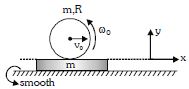
A disc having velocity $v_0$ and angular speed ${\omega _0}$ in anticlockwise direction kept on the rough plank. Initially plank is at rest. (assuming length of plank is very large) Choose $INCORRECT$ option
  • A
    Friction force on the disc is in backward direction till pure rolling start.
  • B
    Friction force between disc and plank is kinetic in nature till pure rolling start.
  • C
    Total momentum of system (disc and plank) is conserved.
  • Angular momentum of disc about any point on the horizontal surface remains conserved.
Answer

Correct option: D.
Angular momentum of disc about any point on the horizontal surface remains conserved.
d
Initial velocity of point of contact of disc is in forward direction.Hence friction backward direction and kinetic in nature.Net force on the system is zero. So momentum is conserved.

Need a full question paper?

Generate a complete, print-ready paper with questions like this in minutes — across 16+ boards, with answer keys.

Start Generating Free

Similar questions

A steel rod of diameter $1\,cm$ is clamped firmly at each end when its temperature is $25\,^oC$ so that it cannot contract on cooling. The tension in the rod at $0\,^oC$ is approximately ......... $N$ $(\alpha = 10^{-5}/\,^oC,\,\,Y = 2 \times 10^{11}\,N/m^2)$
If a man increase his speed by $2 \,m/s$ , his K.E. is doubled, the original speed of the man is
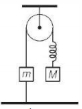
An arrangement of spring, strings, pulley and masses is shown in the figure below.The pulley and the strings are massless and $M>m$. The spring is light with spring constant $k$. If the string connecting $m$ to the ground is detached, then immediately after detachment
A body is moving in a low circular orbit about a planet of mass $M$ and radius $R$. The radius of the orbit can be taken to be $R$ it self. Then the ratio of the speed of this body in the orbit to the escape velocity from the planet is
A stone of mass of $16\, kg$ is attached to a string $144 \,m$ long and is whirled in a horizontal circle. The maximum tension the string can withstand is $16$ Newton. The maximum velocity of revolution that can be given to the stone without breaking it, will be ....... $ms^{-1}$
A particle is acted upon by a force of constant magnitude which is always perpendicular to the velocity of the particle. The motion of the particle takes place in a plane. It follows that,
Young's modules of material of a wire of length ' $L$ ' and cross-sectional area $A$ is $Y$. If the length of the wire is doubled and cross-sectional area is halved then Young's $modules$ will be :
If the atmospheric pressure is $P_a$, then the pressure $P$ at depth $h$ below the surface of liquid of density $\rho $ open to the atmosphere is
Given that $v$ is speed, $r$ is the radius and $g$ is the acceleration due to gravity. Which of the following is dimensionless
Consider the motion of the tip of the minute hand of a clock. In one hour: