MCQ
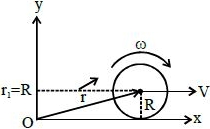
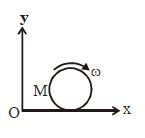
A disc of mass  $M$  and radius  $R$  is rolling with angular speed $\omega $ on a horizontal plane as shown. The magnitude of angular momentum of the disc about the origin $O$ is
  • A
    $\frac {1}{2} MR^2\omega $
  • B
    $MR^2\omega $
  • $\frac {3}{2} MR^2\omega $
  • D
    $2MR^2\omega $

Answer

Correct option: C.
$\frac {3}{2} MR^2\omega $
c
Angular momentum of disc about origin is $:$

$\mathrm{L}=\mathrm{I} \omega+\mathrm{mV}\left(\mathrm{r}_{1}\right)$

$=\frac{\mathrm{MR}^{2}}{2} \omega+\mathrm{mV}(\mathrm{R})$

$=\frac{\mathrm{MR}^{2}}{2} \omega+\mathrm{M}(\omega \mathrm{R})(\mathrm{R})$

$=\frac{3}{2} \mathrm{M} \omega \mathrm{R}^{2}$

Need a full question paper?

Generate a complete, print-ready paper with questions like this in minutes — across 16+ boards, with answer keys.

Start Generating Free

Similar questions

A mass $m$ is suspended from the two coupled springs connected in series. The force constant for springs are ${K_1}$ and ${K_2}$. The time period of the suspended mass will be
In an elliptical orbit under gravitational force, in general
$A$ block of mass $m$ is hung vertically from an elastic thread of force constant $mg/a$. Initially the thread was at its natural length and the block is allowed to fall freely. The kinetic energy of the block when it passes through the equilibrium position will be :
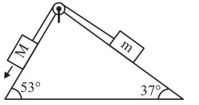
In the given arrangement of a doubly inclined plane two blocks of masses $\mathrm{M}$ and $\mathrm{m}$ are placed. The blocks are connected by a light string passing over an ideal pulley as shown. The coefficient of friction between the surface of the plane and the blocks is $0.25$ . The value of $\mathrm{m}$, for which $\mathrm{M}=10$ $\mathrm{kg}$ will move down with an acceleration of $2 \mathrm{~m} / \mathrm{s}^2$, is : (take $\mathrm{g}=10 \mathrm{~m} / \mathrm{s}^2$ and $\left.\tan 37^{\circ}=3 / 4\right)$
The phase difference between two waves represented by

${y_1} = {10^{ - 6}}\sin [100\,t + (x/50) + 0.5]m$

${y_2} = {10^{ - 6}}\cos \,[100\,t + (x/50)]m$

where $ x$ is expressed in metres and $t$ is expressed in seconds, is approximately .... $ rad$

Newton's second law for rotational motion of a system of particles can be represented as $(L$ is the angular momentum for a system of particles.$)$
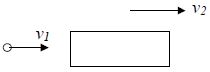
A light particle moving horizontally with a speed $v_1$ strikes a very heavy block moving in the same direction with a speed $v_2$. The collision is elastic. After the collision, the velocity of particle is :-
The co-ordinates of a particle moving in $x-y$ plane are given by :  $\mathrm{x}=2+4 \mathrm{t}, \mathrm{y}=3 \mathrm{t}+8 \mathrm{t}^2 .$ The motion of the particle is :
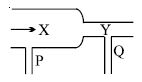
A steady flow of water passes along a horizontal tube from a wide section $X$ to the narrower section $Y$, see figure. Manometers are placed at $P$ and $Q$ at the sections. Which of the statements $A, B, C, D, E$ is most correct?
Two wires $A$ and $B$ of same material have radii in the ratio $2: 1$ and lengths in the ratio $4: 1$. The ratio of the normal forces required to produce the same change in the lengths of these two wires is .......