A disc of radius $R$ and mass $M$ is pivoted at the rim and is set for small oscillations. If simple pendulum has to have the same period as that of the disc, the length of the simple pendulum should be
Diffcult
Download our app for free and get started
(d) Time period of a physical pendulum
$T = 2\pi \sqrt {\frac{{{I_0}}}{{mgd}}} = 2\pi \sqrt {\frac{{\left( {\frac{1}{2}m{R^2} + m{R^2}} \right)}}{{mgR}}} $
$ = 2\pi \sqrt {\frac{{3R}}{{2g}}} $…..$(i)$
${T_{simple\;pendulum}} = 2\pi \sqrt {\frac{l}{g}} $…..$(ii)$
Equating $(i)$ and $(ii),$
$T = 2\pi \sqrt {\frac{{{I_0}}}{{mgd}}} = 2\pi \sqrt {\frac{{\left( {\frac{1}{2}m{R^2} + m{R^2}} \right)}}{{mgR}}} $
$ = 2\pi \sqrt {\frac{{3R}}{{2g}}} $…..$(i)$
${T_{simple\;pendulum}} = 2\pi \sqrt {\frac{l}{g}} $…..$(ii)$
Equating $(i)$ and $(ii),$
$l = \frac{3}{2}R.$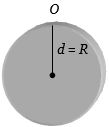

Download our appand get started for free
Experience the future of education. Simply download our apps or reach out to us for more information. Let's shape the future of learning together!No signup needed.*
Similar Questions
- 1The $x-t$ graph of a particle performing simple harmonic motion is shown in the figure. The acceleration of the particle at $t=2 s$ is :View Solution
- 2A particle of mass $m$ is released from rest and follows a parabolic path as shown. Assuming that the displacement of the mass from the origin is small, which graph correctly depicts the position of the particle as a function of time $?$View Solution
- 3A stationary tuning fork is in resonance with an air column in a pipe. If the tuning fork is moved with a speed of $2 ms ^{-1}$ in front of the open end of the pipe and parallel to it, the length of the pipe should be changed for the resonance to occur with the moving tuning fork. If the speed of sound in air is $320 ms ^{-1}$, the smallest value of the percentage change required in the length of the pipe is. . . . . .View Solution
- 4A man weighing $60\ kg$ stands on the horizontal platform of a spring balance. The platform starts executing simple harmonic motion of amplitude $0.1\ m$ and frequency $\frac{2}{\pi } Hz$. Which of the following staements is correctView Solution
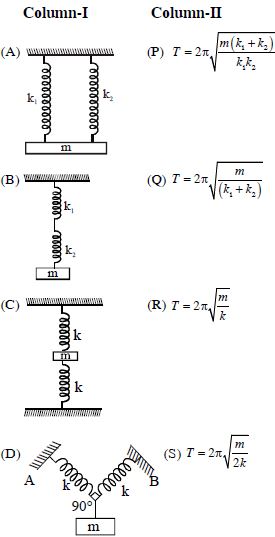
- 5In the following questions, match column $-I$ with column $-II$ and choose the correct optionsView Solution
- 6View SolutionA chimpanzee swinging on a swing in a sitting position, stands up suddenly, the time period will
- 7The angular velocity and the amplitude of a simple pendulum is $'\omega '$ and $'A'$ respectively. At a displacement $x$ from the mean position its kinetic energy is $'T'$ and potnetial energy is $'V'$. Then the ratio $\frac{V}{T}$ isView Solution
- 8The equation of $S.H.M.$ is $y = a\sin (2\pi nt + \alpha )$, then its phase at time $t$ isView Solution
- 9The displacement of a particle is given at time $t$, by:$x=A \sin (-2 \omega t)+B \sin ^2 \omega t \quad$ Then,View Solution
- 10Two particles are executing $SHM$ of the same amplitude $A$ and frequency $\omega $ along the $x-$ axis. Their mean position is separated by $X_0$ (where $X_0 > A$ ). If maximum separation between them is $X_0 + 2A$ , then the phase difference between their motion isView Solution