MCQ
 A disc of radius $R$  is made to oscillate about a horizontal axis passing through its periphery. Its time period would be
  • $2\pi \sqrt {\frac{{3R}}{{2g}}} $
  • B
    $2\pi \sqrt {\frac{{2R}}{{3g}}} $
  • C
    $2\pi \sqrt {\frac{R}{g}} $
  • D
    $2\pi \sqrt {\frac{{2R}}{g}} $

Answer

Correct option: A.
$2\pi \sqrt {\frac{{3R}}{{2g}}} $
a
$T=2 \pi \sqrt{\frac{I}{m g l}}$

$=2 \pi \sqrt{\frac{\frac{3}{2} m r^{2}}{m g r}}=2 \pi \sqrt{\frac{3 r}{2 g}}$

Need a full question paper?

Generate a complete, print-ready paper with questions like this in minutes — across 16+ boards, with answer keys.

Start Generating Free

Similar questions

A particle is released from a height $H$. At a certain height its kinetic energy is two times its potential energy. Height and speed of particle at that instant are
The slopes of isothermal and adiabatic curves are related as
A particle moves $21\, m$ along the vector $6\hat i + 2\hat j + 3\hat k$ , then $14\, m$ along the vector $3\hat i - 2\hat j + 6\hat k$ . Its total displacement (in meters) is
A steady force of $120\ N$ is required to push a boat of mass $700\ kg$ through water at a constant speed of $1\ m/s$ . If the boat is fastened by a spring and held at $2\ m$ from the equilibrium position by a force of $450\ N$ , find the angular frequency of damped $SHM$  ..... $rad/s$ 
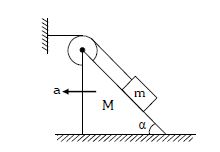
In the adjoining figure if acceleration of $M$ with respect to ground is $a$, then
$A$ flexible chain of weight $W$ hangs between two fixed points $A$ & $B$ which are at he same horizontal level. The inclination of the chain with the horizontal at both the points of support is $\theta$ . What is the tension of the chain at the mid point? 
A small air bubble is at the inner surface of the bottom of a beaker filled with cold water. Now water of the beaker is heated. The size of bubble increases. The reason for this may be
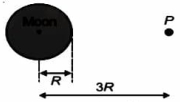
A stationary object is released from a point $P$ at a distance $3 R$ from the centre of the moon which has radius $R$ and mass $M$. Which of the following gives the speed of the object on hitting the moon?
Two concentric shells have masses $M$ and $m$ and their raddi are $R$ and $r$ respectively where $R > r$, if $x$ be the distance from the common centre, then what is the gravitational potential at a point for which $r < x < R$
What is common in the thermal equilibrium of two systems?