Question

A diverging beam of light from a point source S having divergence angle a, falls symmetrically on a glass slab as shown.  The angles of incidence of the two extreme rays are equal.  If the thickness of the glass slab is t and the refractive index n, then the divergence angle of the emergent beam is

(a) Zero

(b) α

(c)  

(d) 2 

Answer

(b) α

Need a full question paper?

Generate a complete, print-ready paper with questions like this in minutes — across 16+ boards, with answer keys.

Start Generating Free

Similar questions

An electron and a proton with equal momentum enter perpendicularly into a uniform magnetic field, then

(a) The path of proton shall be more curved than that of electron

(b) The path of proton shall be less curved than that of electron

(c) Both are equally curved

(d) Path of both will be straight line

 has half life 5700 years. At the end of 11400 years, the actual amount left is

(a) 0.5 of original amount

(b) 0.25 of original amount

(c) 0.125 of original amount

(d) 0.0625 of original amount

A conducting ring of radius 1 meter is placed in an uniform magnetic field B of 0.01Telsa oscillating with frequency 100Hz with its plane at right angles to B. What will be the induced electric field

(a) π volt/m

(b) 2 volt/m

(c) 10 volt/m

(d) 62 volt/m

X-rays of which of the following wavelengths are hardest

(a) 4 Å

(b) 1 Å

(c) 0.1 Å  

(d) 2 Å

Comment on the statement given below:
In self-inductionWhen the current in a coil is increasing, induced emf opposes it
When the current in a coil is decreasing, induced emf supports it
Which of the following phenomena can be demonstrated by light. But not with sound waves in an air column? 

If a full wave rectifier circuit is operating from 50 Hz mains, the fundamental frequency in the ripple will be

(a) 50 Hz 

(b) 70.7 Hz

(c) 100 Hz

(d) 25 Hz

In a coaxial, straight cable, the central conductor and the outer conductor carry equal currents in opposite directions. The magnetic field is zero:
  1. Outside the cable.
  2. Inside the inner conductor.
  3. Inside the outer conductor.
  4. In between the tow conductors.

The nature of binding for a crystal with alternate and evenly spaced positive and negative ions is

(a) Covalent

(b) Metallic

(c) Dipolar

(d) Ionic

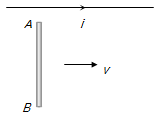
The current carrying wire and the rod AB are in the same plane. The rod moves parallel to the wire with a velocity v. Which one of the following statements is true about induced emf in the rod

(a) End A will be at lower potential with respect to B

(b) A and B will be at the same potential

(c) There will be no induced e.m.f. in the rod

(d) Potential at A will be higher than that at B