MCQ
A drum of radius $R$ and mass $M$, rolls down without slipping along an inclined plane of angle $\theta $. The frictional force
  • A
    Decreases the rotational and translational motion
  • B
    Dissipates energy as heat
  • C
    Decreases the rotational motion
  • Converts translational energy to rotational energy
Answer

Correct option: D.
Converts translational energy to rotational energy
d
When a body rolls down without slipping along an inclined plane of inclination $\theta,$ it rotates about a horizontal axis through its centre of mass and also its centre of mass moves. Therefore, rolling motion may be regarded as a rotational motion about an axis through its centre of mass plus a translational motion of the centre of mass. As it rolls down, it suffers loss in gravitational potential energy provided translational energy due to frictional force is converted into rotational energy.

Need a full question paper?

Generate a complete, print-ready paper with questions like this in minutes — across 16+ boards, with answer keys.

Start Generating Free

Similar questions

A steel rod $100 cm$ long is clamped at its mid-point. The funda-mental frequency of longitudinal vibrations of the rod is given to be $2.53 kHz$. What is the speed of sound in steel .... $km/s$
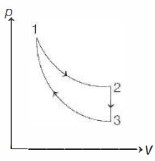
The three processes in a thermodynamic cycle shown in the figure are : Process $1 \rightarrow 2$ is isothermal; Process $2 \rightarrow 3$ is isochoric (volume remains constant); Process $3 \rightarrow 1$ is adiabatic. The total work done by the ideal gas in this cycle is $10 \,J$. The internal energy decreases by $20 \,J$ in the isochoric process. The work done by the gas in the adiabatic process is $-20 \,J$. The heat added to the system in the isothermal process is .............. $J$
A steel rod of length $\ell$, cross sectional area $A$, young's modulus of elasticity $Y$, and thermal coefficient of linear expansion $'a'$ is heated so that its temperature increases by $t\,^oC$. Work that can be done by rod on heating will be
Which graph represents the uniform acceleration
Two balls of equal mass undergo head on collision while each was moving with speed $6 \,m / s$. If the coefficient of restitution is $\frac{1}{3}$, the speed of each ball after impact will be ............ $m / s$
Who gave theory of relativity?
A vehicle travels half the distance $L$ with speed $V_1$ and the other half with speed $V_2$, then its average speed is:
A cubic vessel $($with face horizontal $+$ vertical$)$ contains an ideal gas at $\text{NTP.}$ The vessel is being carried by a rocket which is moving at a speed of $500\ ms^{-1}$ in vertical direction. The pressure of the gas inside the vessel as observed by us on the ground:
Which of the following parameters is the same for molecules of all gases at a given temperature?
Density of ice is $\rho $ and that of water is $\sigma $. What will be the decrease in volume when a mass $M$  of ice melts