A dry cell has an $e.m.f.$ of $1.5\, V$ and an internal resistance of $0.05\,\Omega $. The maximum current obtainable from this cell for a very short time interval is ................... $A$
Easy


Download our appand get started for free
Experience the future of education. Simply download our apps or reach out to us for more information. Let's shape the future of learning together!No signup needed.*
Similar Questions
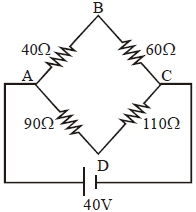
- 1Four resistances $40 \ \Omega, 60\ \Omega, 90\ \Omega$ and $110\ \Omega$ make the arms of a quadrilateral $A,B,C,D$. Across $AC$ is a battery of emf $40\, V$ and internal resistance negligible. The potential difference across $BD$ is $V$ is......View Solution
- 2View SolutionIf the length of potentiometer wire is increased, then the length of the previously obtained balance point will
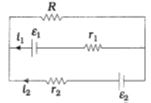
- 3View SolutionSee the electrical circuit shown in this figure. Which of the following equations is a correct equation for it ?
- 4A battery of $e.m.f.$ $3\, volt$ and internal resistance $1.0\, ohm$ is connected in series with copper voltameter. The current flowing in the circuit is $1.5\, amperes$. The resistance of voltameter will be ........... $ohm$View Solution
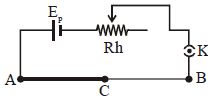
- 5A potentiometer consists of two wires $AC$ and $CB$ of same material and of equal lengths but diameters in the ratio $3 : 1.$ Then the potential gradients on the two wires will be in the ratio :-View Solution
- 6Two resistors are joined in parallel whose, resultant is $\frac{6}{5} \,\Omega$. One of the resistance wire is broken and the effective resistance becomes $2 \,ohms$. Then the resistance (in $ohm$) of the wire that got broken is ..........View Solution
- 7$A$ brass disc and a carbon disc of same radius are assembled alternatively to make a cylindrical conductor. The resistance of the cylinder is independent of the temperature. The ratio of thickness of the brass disc to that of the carbon disc is [$\alpha$ is temperature coefficient of resistance and Neglect linear expansion ]View Solution
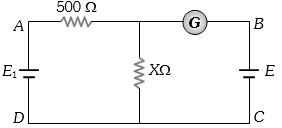
- 8In the adjoining circuit, the battery ${E_1}$ has an $e.m.f.$ of $12\,volt$ and zero internal resistance while the battery $E$ has an $e.m.f.$ of $2\,volt$. If the galvanometer $G$ reads zero, then the value of the resistance $X$ in $ohm$ isView Solution
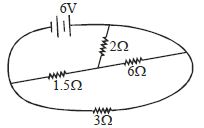
- 9Find the value of current from battery in the circuit ............... $A$View Solution
- 10The heat generated through $2 \,ohm$ and $8\, ohm$ resistances separately, when a condenser of $200\,\mu F$ capacity charged to $200\, V$ is discharged one by one, will beView Solution